|
VOOZH | about |
|
VOOZH | about |
The International Organization for Standardization (ISO) has established a series of ISO and ISO/IEC standards for software quality. Starting with the ISO 9000-3 instructions for implementing the ISO 9001 standard, which is concerned with quality assurance processes, to the creation, supply, installation, and maintenance of computer software. The ISO/IEC 9126 standard for software product quality should be used in conjunction with ISO/IEC 14598 for evaluating software products.
Table of Content
ISO/IEC 9126 is an international standard proposed to make sure 'quality of all software-intensive products' which includes a system like safety-critical where in case of failure of software lives will be in jeopardy. ISO i.e. International Organization for Standardization and IEC i.e. International Electrotechnical Commission have developed ISO/IEC 9126 standards for software engineering → Product Quality to provide an all-inclusive specification and evaluation model for the quality of the software product.
The standard is divided into 4 parts as depicted in the following figure:
Quality Model describes the quality model framework which explains relationships between different approaches to quality as well as identifying quality characteristics and sub-characteristics of software products.
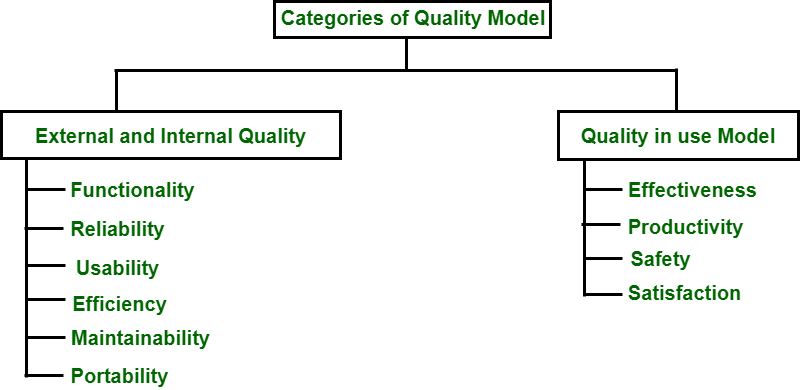
Furthermore, the first part i.e. the Quality model is concerned classified into two categories as depicted in the following figure:
Internal External Quality Part determines the quality of a software product through six characteristics which are Functionality, Reliability, Usability, Efficiency, Maintainability, and Portability.
The functions are those that will satisfy implied needs.
A set of attributes that will bear on the capability of software to maintain the level of performance.
A set of attributes that bear on the effort needed for use by an implied set of users.
A set of attributes that bear on the relationship between the level of performance of the software under stated conditions.
A set of attributes that bear on the effort needed to make specified modifications.
A set of attributes that bear on the ability of software to be transferred from one environment to another.
It identifies the four quality characteristics.
External Metrices is used to describe external metrics that are used to measure characteristics and sub-characteristics which are identified in quality model.
Internal Metrices is used to describe internal metrics that are used to measure characteristics and sub-characteristics which are identified in quality model.
Quality in use metrices is used to identify metrics that are used to measure the effects of combined quality characteristics for users.
Below are some points related to history of ISO/IEC 9126
1. According to the ISO-9126 Standard Quality Model, match the attributes given in List 1 with their definition in List-2. [UGC-NET CS 2019]
List-1 | List-2 |
|---|---|
a. Functionality | i. Relationship between level of performance and amount of resources |
b. Reliability | ii. Characteristics related to the achievement of the purpose |
c. Efficiency | iii. Efforts needed to make for improvement |
d. Maintainability | iv. The capability of software to maintain the performance of Software |
Choose the correct option from the ones given below.
(A) a-i, b-ii, c-iii, d-iv
(B) a-ii, b-i, c-iv, d-iii
(C) a-ii, b-iv, c-i, d-iii
(D) a-i, b-ii, c-iv, d-iii
Solution: Correct Answer is (C).
ISO/IEC 9126 is a standard given by the international organization for standardization (ISO) for evaluating software product quality. It is divided into four parts: Quality Model, External Metrics, Internal Metrics, and Quality in Use Metrics, each gives different aspects of software quality assessment. It has six main characteristics: functionality, reliability, usability, efficiency, maintainability, and portability. It provides a structured approach for developers and evaluators to measure and improve software quality.