Software is a program or set of programs containing instructions that provide the desired functionality. Engineering is the process of designing and building something that serves a purpose efficiently and cost-effectively.
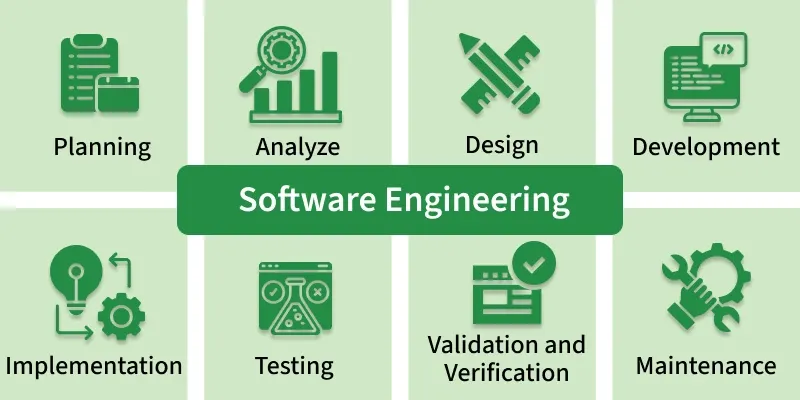
It is the systematic process of designing, developing, testing, and maintaining software using techniques like requirements analysis, design, testing, and maintenance.
It ensures software is high-quality, reliable, and maintainable, especially for large software systems.
Software Engineering improves efficiency, quality, and budget management, helping deliver software on time, within budget, and meeting all requirements.
It continuously adopts new tools and methodologies to handle complexity and evolving technologies.
Software has a dual role in the industry. The first one is as a product and the other one is as a vehicle for delivering the product.
1. As a Product
It delivers computing potential across networks of Hardware.
It enables the Hardware to deliver the expected functionality.
It acts as an information transformer because it produces, manages, acquires, modifies, displays, or transmits information.
2. As a Vehicle for Delivering a Product
It provides system functionality (e.g., payroll system).
It controls other software (e.g., an operating system).
It helps build other software (e.g., software tools).
Objectives or Attributes
Maintainability: It should be feasible for the software to evolve to meet changing requirements.
Efficiency: The software should not make wasteful use of computing devices such as memory, processor cycles, etc.
Correctness: A software product is correct if the different requirements specified in the SRS Document have been correctly implemented.
Reusability: A software product has good reusability if the different modules of the product can easily be reused to develop new products.
Testability: Here software facilitates both the establishment of test criteria and the evaluation of the software concerning those criteria.
Reliability: It is an attribute of software quality. The extent to which a program can be expected to perform its desired function, over an arbitrary time period.
Portability: In this case, the software can be transferred from one computer system or environment to another.
Adaptability: In this case, the software allows differing system constraints and the user needs to be satisfied by making changes to the software.
Interoperability: Capability of 2 or more functional units to process data cooperatively.
What Careers Are There in Software Engineering?
A degree in software engineering and relevant experience can be utilized to explore several computing job choices. Software engineers have the opportunity to seek well-paying careers and professional progress, although their exact possibilities may vary depending on their particular school, industry, and region.
Following are the job choices in software engineering:
SWE (Software Engineer)
SDE ( Software Development Engineer)
Web Developer
Quality Assurance Engineer
Web Designer
Software Test Engineer
Cloud Engineer
Front-End Developer
Back-End Developer
DevOps Engineer
Security Engineer
What Tasks do Software Engineers do?
The main responsibility of a software engineer is to develop useful computer programs and applications. Working in teams, you would complete various projects and develop solutions to satisfy certain customer or corporate demands.
Some of the key responsibilities of software engineer are:
Requirement Analysis: Collaborating with stakeholders to understand and gather the requirements to design and develop software solutions.
Design and Development: Creating well-structured, maintainable code that meets the functional requirements and adheres to software design principles.
Testing and Debugging: Writing and conducting unit tests, integration tests, and debugging code to ensure software is reliable and bug-free.
Code Review: Participating in code reviews to improve code quality, ensure adherence to standards, and facilitate knowledge sharing among team members.
Maintenance: Updating and maintaining existing software systems, fixing bugs, and improving performance or adding new features.
Documentation: Writing clear documentation, including code comments, API documentation, and design documents to help other engineers and future developers understand the system.
What Skills do Software Engineers Need?
Following are some must have technical skills to become Software Engineers:
Following are some must have soft skills to become Software Engineers:
Communication skills
Team player
Problem solving
Attention to detail
Program vs Software Product
Parameters
Program
Software Product
Definition
A program is a set of instructions that are given to a computer in order to achieve a specific task.
Software is when a program is made available for commercial business and is properly documented along with its licensing.
Software Product = Program + Documentation + Licensing.
Scope
Limited to specific problem
Broder scope, Solves real world problems
Stages Involved
Program is one of the stages involved in the development of the software.
Software Development usually follows a life cycle, which involves the feasibility study of the project, requirement gathering, development of a prototype, system design, coding, and testing.