|
VOOZH | about |
|
VOOZH | about |
In the field of software architecture and design, it is essential to comprehend the basic components of a system. Software components and connections are two essential ideas that are crucial to this field. These components serve as the foundation for the organization, communication, and functionality of software systems. To effectively design, build, and maintain strong and scalable systems, architects and developers must be able to distinguish between software components and connectors.
In this article, we are going to learn the difference between Software Components and Software Connectors. Let's learn this in a detailed form:
A software component is a self-contained, reusable piece of software that performs a specific function or set of functions. It is a modular, independent unit of code that can be easily integrated into a larger software system. Components are designed to be flexible, scalable, and maintainable, making it easier to develop, test, and deploy software applications.
It includes user interface elements (like buttons or input fields), data processing modules, authentication services, or communication interfaces.
A connector in software architecture refers to an intermediary that facilitates communication and coordination between different software components or systems. It acts as an intermediary, facilitating the exchange of data, requests, or responses between different systems, allowing them to work together seamlessly.
A RESTful API (Representational State Transfer Application Programming Interface) connector facilitates communication and data exchange between software components or systems using HTTP protocols.
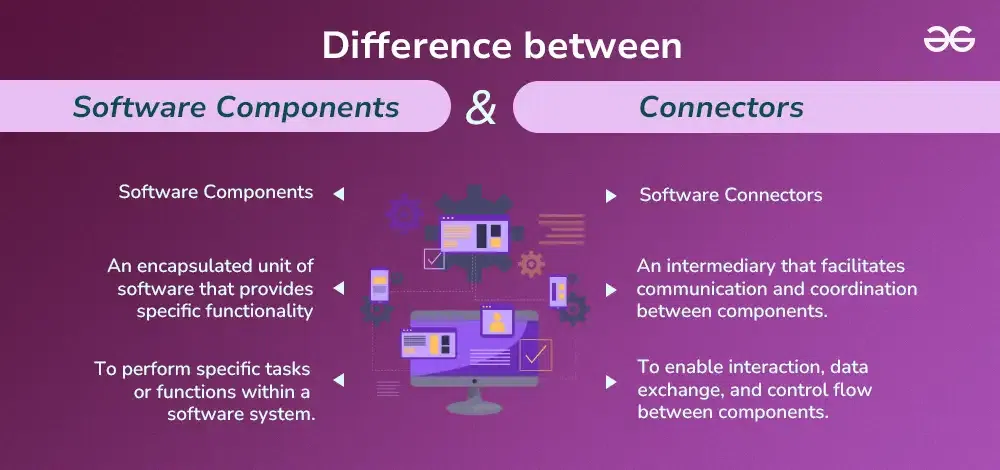
Here are the following differences between Software Components and Connectors:
Software Components | Software Connectors |
|---|---|
An encapsulated unit of software that provides specific functionality. | An intermediary that facilitates communication and coordination between components. |
To perform specific tasks or functions within a software system. | To enable interaction, data exchange, and control flow between components. |
Typically more granular, representing individual modules or functions. | Often more abstract, representing the communication pathways and protocols. |
Maintains state and behavior internally. | Generally stateless, focusing on facilitating communication. |
Can be reused across different systems and contexts. | Can be reused but often specific to the communication needs of particular components. |
Implemented as classes, objects, functions, or services. | Implemented as APIs, middleware, communication protocols, or message queues. |
Directly interacts with data and executes business logic. | Manages the interaction between components, ensuring data is properly exchanged. |
Dependent on connectors to communicate with other components. | Dependent on components to define the endpoints of communication. |
A user authentication module, a data processing service. | RESTful API, message broker, socket connection. |
Focused on the specific functionality and internal logic. | Focused on the integration and communication mechanisms. |
Unit testing focuses on individual component functionality. | Integration testing focuses on the communication between components. |
Performance depends on internal algorithms and data handling. | Performance depends on the efficiency of the communication mechanism. |
Example: Authentication Service, Data Processing Module. | Example: RESTful API, Database Connector. |
In simple terms, The distinction between software components and connectors is pivotal in modern software architecture. Components serve as reusable, maintainable units encapsulating specific tasks, enhancing modularity and scalability. Connectors enable seamless component communication, managing data flow and ensuring flexibility and interoperability. Together, they empower developers to construct adaptive, scalable systems, streamlining development and fostering software evolution and efficiency.