Different types of risks in Software Project Development
Last Updated : 23 Jan, 2026
Software development is a structured, multi-stage process that follows the Software Development Life Cycle (SDLC), including design, documentation, coding, testing, and maintenance. Each phase of this process involves inherent risks that can impact cost, schedule, quality, and performance. Since modern enterprises heavily depend on software systems, identifying and managing these risks is critical. Effective risk management helps prevent failures, reduce losses, and ensure successful project delivery.
Risk and Importance of Risk Management
Risk refers to an uncertain future event that has a probability of occurring and may negatively impact a software project if it occurs.
Risks can affect project cost, schedule, quality, or overall performance.
Risk identification involves recognizing potential threats early in the project lifecycle.
Risk management focuses on analyzing, prioritizing, and mitigating risks to minimize their impact.
Effective risk management is critical, as the success or failure of a software project largely depends on how well risks are handled.
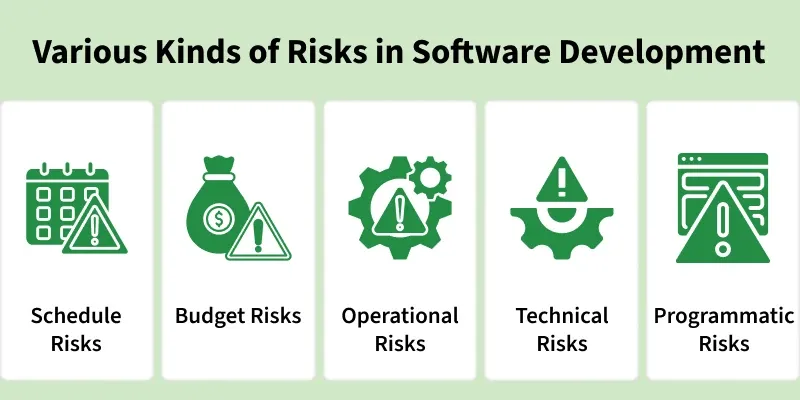
Schedule related risks refers to time related risks or project delivery related planning risks. The wrong schedule affects the project development and delivery. These risks are mainly indicates to running behind time as a result project development doesn't progress timely and it directly impacts to delivery of project.
Reasons for Schedule risks:
Time is not estimated perfectly
Improper resource allocation
Tracking of resources like system, skill, staff etc.
Frequent project scope expansion
Failure in function identification and its' completion
2. Budget Risk
Budget related risks refers to the monetary risks mainly it occurs due to budget overruns. Always the financial aspect for the project should be managed as per decided but if financial aspect of project mismanaged then there budget concerns will arise by giving rise to budget risks.
Reasons for Budget risks:
Wrong/Improper budget estimation
Unexpected Project Scope expansion
Mismanagement in budget handling
Cost overruns
Improper tracking of Budget
3. Operational Risks
Operational risk refers to the procedural risks means these are the risks which happen in day-to-day operational activities during project development due to improper process implementation or some external operational risks.
Reasons for Operational risks:
Insufficient resources
Conflict between tasks and employees
Improper management of tasks
No proper planning about project
Less number of skilled people
Lack of communication and cooperation
Lack of clarity in roles and responsibilities
Insufficient training
4. Technical Risks
Technical risks refers to the functional risk or performance risk which means this technical risk mainly associated with functionality of product or performance part of the software product.
Reasons for Technical risks:
Frequent changes in requirement
Less use of future technologies
Less number of skilled employee
High complexity in implementation
Improper integration of modules
5. Programmatic Risks
Programmatic risks refers to the external risk or other unavoidable risks. These are the external risks which are unavoidable in nature. These risks come from outside and it is out of control of programs.
Reasons for Programmatic risks:
Rapid development of market
Running out of fund / Limited fund for project development
Changes in Government rules/policy
Loss of contracts due to any reason
Additional Risks Associated with Software Development
Communication Risks: Inadequate or unclear communication can lead to misunderstandings, errors, delays, and confusion among stakeholders and team members.
Security Risks: Security risks arise from system vulnerabilities that may compromise data privacy, system reliability, or accessibility, and are increasingly common in modern software systems.
Quality Risks: These risks occur when the delivered software fails to meet required standards, specifications, or end-user expectations, leading to dissatisfaction or rework.
Legal and Compliance Risks: Ignoring applicable laws, regulations, or industry standards can result in legal penalties, compliance issues, and operational challenges.
Cost Risks: Unexpected expenses, budget overruns, or uncontrolled changes in project scope can disrupt financial planning and threaten project completion.
Market Risks: Rapid technological changes, evolving customer demands, or increased competition can reduce the product’s effectiveness or relevance in the market.