|
VOOZH | about |
|
VOOZH | about |
Fault injection is a technique used in software engineering to test the resilience of a software system. The idea is to intentionally introduce errors or faults into the system to see how it reacts and to identify potential weaknesses. This can be achieved in several ways, such as:
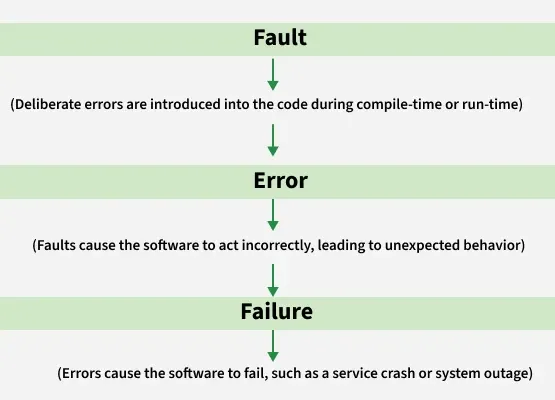
Fault Injection is a technique for enhancing the testing quality by involving intentional faults in the software. Fault injection is often in Stress Testing, and it is considered an important part of developing robust software. The broadcast of a fault through to a noticeable failure follows a well-defined cycle. During execution, a fault can cause an error that is not a valid state within a system boundary.
The same error can cause further errors within the system boundary, hence each new error acts as a fault, and it may propagate to the system boundary and be observable. When an error state is observed at the system boundary that is called a failure.
The Fault Injection process follows a Fault-Error-Failure Cycle, which includes these steps:
This cycle helps identify weaknesses in the system and improves its design for better performance and resilience.
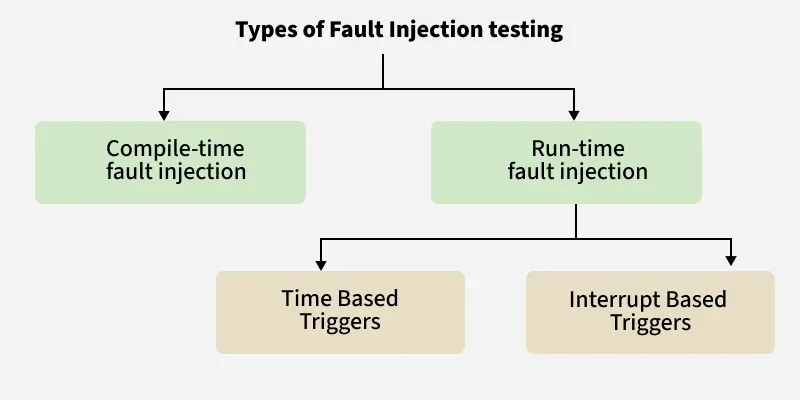
Fault injection can be categorized into two types based on software implementation:
These are explained as following below.
Compile-time fault injection is a fault injection technique in which source code is modified to inject imitated faults into a system. Two methods are used to implement fault while compile time:
Example:
Original Code:
int main()
{
 int a = 10;
 while ( a > 0 )
 {
 cout << "GFG";
 a = a - 1;
 }
 return 0;
}
Modified Code:
int main()
{
 int a = 10;
 while ( a > 0 )
 {
 cout << "GFG";
 a = a + 1; // '-' is changed to '+'
 }
 return 0;
}
Example:
Original Code:
int main()
{
 int a = 10;
 while ( a > 0 )
 {
 cout << "GFG";
 a = a - 1;
 }
 return 0;
}
Modified Code:
int main()
{
 int a = 10;
 while ( a > 0 )
 {
 cout << "GFG";
 a = a - 1;
 a++; // Additional code
 }
 return 0;
}
Run-time fault injection technique uses a software trigger to inject a fault into a running software system. Faults can be injected via a number of physical methods and triggers can be implemented in different ways. Software Triggers used in Run-time fault injection:
1. Time Based Triggers
2. Interrupt Based Triggers
3 methods are used to inject fault while run-time:
Fault Injection in Different Software Testing:
Fault Injection is particularly useful when testing software systems that rely on external services, third-party APIs, or are deployed across multiple platforms. It helps assess how the system handles issues or disruptions in these external dependencies.
It is also valuable during the early stages of the software development process (SDLC) to identify potential failure points in a controlled environment, before the software is released to production.
There are several tools available to automate Fault Injection testing. Some of the widely used ones include:
Software Fault Injection is an important testing method that helps evaluate how software handles unexpected errors, ensuring it’s strong and reliable. It's especially useful for complex systems that depend on external services or run across multiple platforms. By injecting faults in a controlled environment, developers can see how the software reacts to stress and fix any vulnerabilities before the software is released.
While Fault Injection is valuable, it requires careful planning since it can disrupt normal operations and needs changes to the source code. Despite these challenges, it offers important insights into the software’s reliability, making it a powerful tool to improve its quality and performance.