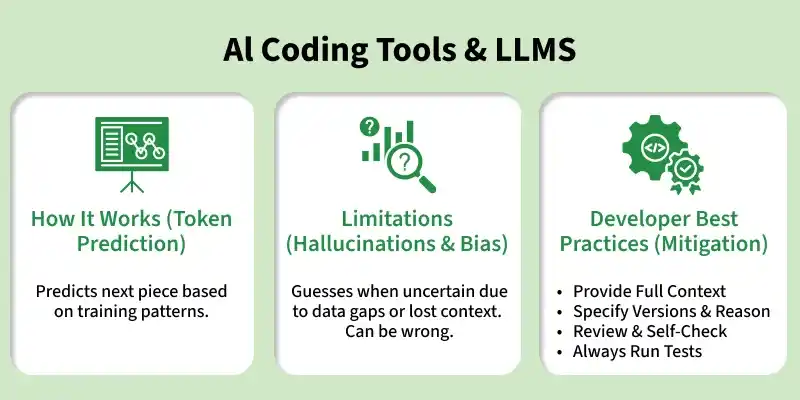
AI coding tools powered by large language models (LLMs) help write, explain, refactor, and debug code, but they do not truly understand it like humans. They rely on statistical pattern matching to predict the next token based on training data, which can sometimes result in inaccuracies due to limited context or probabilistic predictions.
Here are the key things developers need to know:
LLMs generate code one small piece (token) at a time using next-token prediction
Code is handled differently from natural language because of strict syntax, symbols, and structure
Training data comes from huge public code repositories, but has real limitations and biases
Hallucinations (made-up or wrong code) happen for specific reasons and can be reduced but not eliminated
LLMs don't write code by thinking like a programmer. They predict what comes next, one tiny piece at a time.
Every time you give a prompt, the model:
Breaks your input + any context into tokens.
Looks at the entire sequence so far.
Calculates probabilities for thousands of possible next tokens.
Picks one (usually the most likely, or samples for variety).
Adds it to the output and repeats until it stops.
This autoregressive process (next-token prediction) is the same for chat, stories, or code. For code, it works surprisingly well because programming languages have strong patterns: if you see "function add(a, b)", it's very likely "return a + b;" follows.
Code vs Natural Language
Tokenization treats code and English differently, which affects how well models handle each.
Natural language tokens: Mostly whole words or common subwords ("unhappiness" → "un", "happi", "ness"). Focus on meaning, grammar, and flow. Models trained heavily on books/web/text are very good at fluent English.
Code tokens: Include many special symbols (;, {, }, =>, ===), indentation/spaces (meaningful in Python), camelCase/snake_case patterns, and rare library names. Tokenizers (like Byte-Pair Encoding) learn to split code efficiently, but code uses way more unique "words" (function/variable names) than English.
This makes code "token-expensive": the same logical idea takes more tokens in code than in comments. Models fine-tuned on code (StarCoder, CodeLlama, DeepSeek-Coder, Qwen2.5-Coder) handle syntax better because they see more code-specific patterns during training.
Where the Knowledge Comes From
LLMs learn code by seeing trillions of lines from public like GitHub repos, Stack Overflow, docs, tutorials, and code in web pages/books.
Sources:
Massive public code dumps (The Stack v2, GitHub public repos, BigCode datasets).
Synthetic data (AI-generated code + verified fixes).
Bias toward popular languages/frameworks (Python, JS/TS, Java dominate; niche like Rust or legacy COBOL get less attention).
Outdated patterns (models trained up to mid-2025 may miss 2025–2026 library updates).
Bugs and bad practices in training data get reproduced.
Data scarcity for rare tasks (obscure libraries, internal company patterns).
No real "understanding", just patterns. If something is rare in training, the model guesses based on similar things.
Result: Great at common tasks (React components, Express APIs, Python scripts), weaker on bleeding-edge or proprietary code without good context.
Why Hallucinations Happen
Hallucinations are when the model confidently outputs wrong, made-up, or broken code.
Major reasons:
Probabilistic guessing: Models are trained to always continue, never say "I don't know." If unsure, they pick the most likely-looking continuation (even if wrong).
Training data gaps: Rare libraries, new APIs (e.g., React 19 features if cutoff early), or domain-specific patterns aren't well-represented.
Context overflow or loss: If key files/docs exceed the window, the model "forgets" and invents.
Over-confident fine-tuning: Benchmarks reward fluent, complete answers over admitting uncertainty.
Pattern matching gone wrong: Sees similar code and completes it incorrectly (e.g., invents a non-existent method because it fits the pattern).
Even frontier models hallucinate less (down to ~10–20% on benchmarks vs 30–50% in 2024), but it never goes to zero. Agentic setups (self-checking, tool use, multiple generations) reduce it a lot in practice.
How Context Windows Affect Code Quality
Context windows define how much information an LLM can “see” at one time. This includes your prompt, conversation history, pasted files, and any system instructions. Once this limit is exceeded, older or less-relevant parts are dropped or compressed, which directly affects code quality.
For coding tasks, this matters a lot because software rarely lives in a single file. Functions depend on other modules, configs, types, and conventions. If those details fall outside the context window, the model must guess—and guessing leads to bugs or hallucinations.
Key impacts on code generation:
Partial understanding of the codebase: If only some files fit, the model may reference functions, variables, or patterns that don’t actually exist.
Inconsistent behavior: Earlier constraints (language version, framework choice, style rules) can be forgotten as the conversation grows.
Broken refactors: Large refactors fail when the model cannot see all call sites or shared abstractions.
Invented APIs: Missing docs or interfaces often cause the model to create methods that “look right” but are not real.
How Developers Should Use AI for Coding
Provide full file context: Share relevant files, interfaces, and dependencies so the model doesn’t guess missing pieces.
Specify language version: Clearly mention the language and framework version to avoid outdated or incompatible syntax.
Ask for step-by-step reasoning: This helps the model follow correct logic and reduces silent mistakes.
Use self-check prompts: Ask the model to review, validate, or explain its own output to catch errors early.
Run tests always: Never trust generated code without executing tests or validating behavior.
Treat output as a draft, not truth: AI-generated code is a starting point, not a final authority.