|
VOOZH | about |
|
VOOZH | about |
Two common ways to structure software are called monolithic and microservices architectures. Let us see how these two approaches differ and when you might choose one over the other.
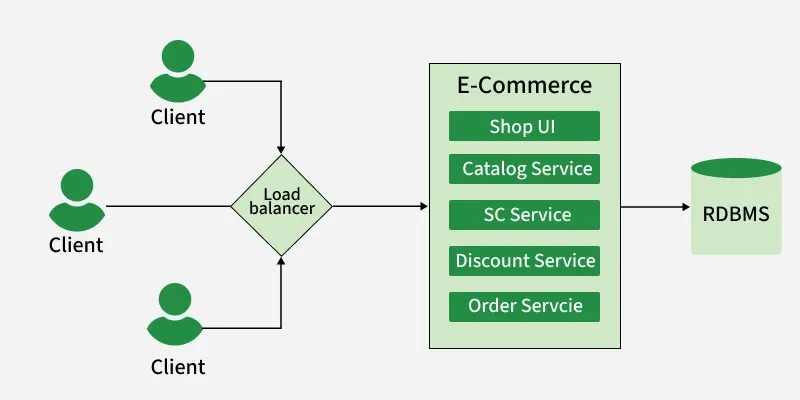
Software is traditionally designed using a monolithic architecture, in which the entire program is constructed as a single, indivisible unit.
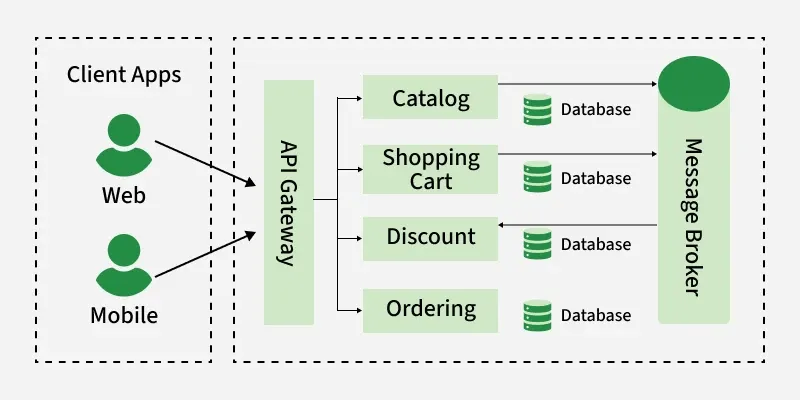
A microservices architecture is an approach where an application is designed as a set of small, independent services, each representing a specific business capability. These services are loosely coupled and communicate over a network.
Below are the differences between Monolithic and Microservice Architecture:
| Monolithic Architecture | Microservice Architecture |
|---|---|
| Single codebase | Distributed services |
| Built as one large application with tightly coupled components | Composed of small, loosely coupled services components |
| Deployed as a single unit | Individual services can be deployed independently |
| Horizontal scaling can be challenging | Easier to scale horizontally |
| Development is simpler initially | Development is more complex due to multiple services |
| Technology stack choices are usually limited | Freedom to choose the best technology for each service |
| Entire application may fail if a part fails | Individual services can fail without affecting others |
| Easier to maintain due to its simplicity | Requires more effort to manage multiple services |
| Less flexible as all components are tightly coupled | More flexible as components can be developed, deployed, and scaled independently |
| Communication between components is faster | Communication may be slower due to network calls |
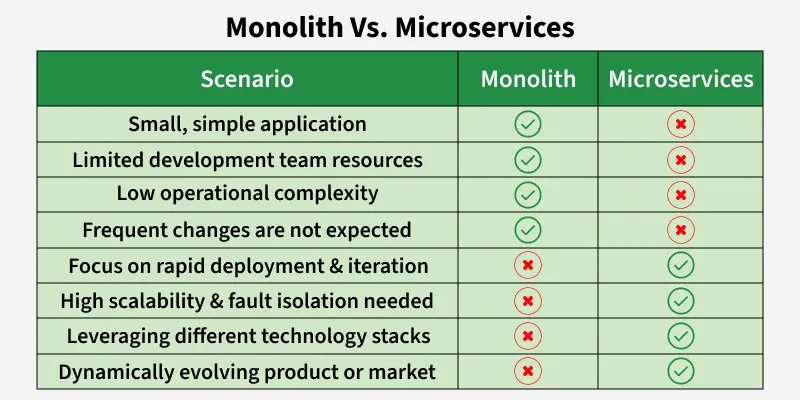
The best scenarios where we can use Monolithic Architecture or Microservices Architecture are: