|
VOOZH | about |
|
VOOZH | about |
Pairwise Testing is a software testing technique that uses permutation and combination to test all possible pairs of input parameters. It reduces the number of test cases while still ensuring effective coverage of interactions between inputs.
Example: Testing all combinations of 20 inputs is impractical. Pairwise testing reduces this by testing only input pairs, making it efficient.
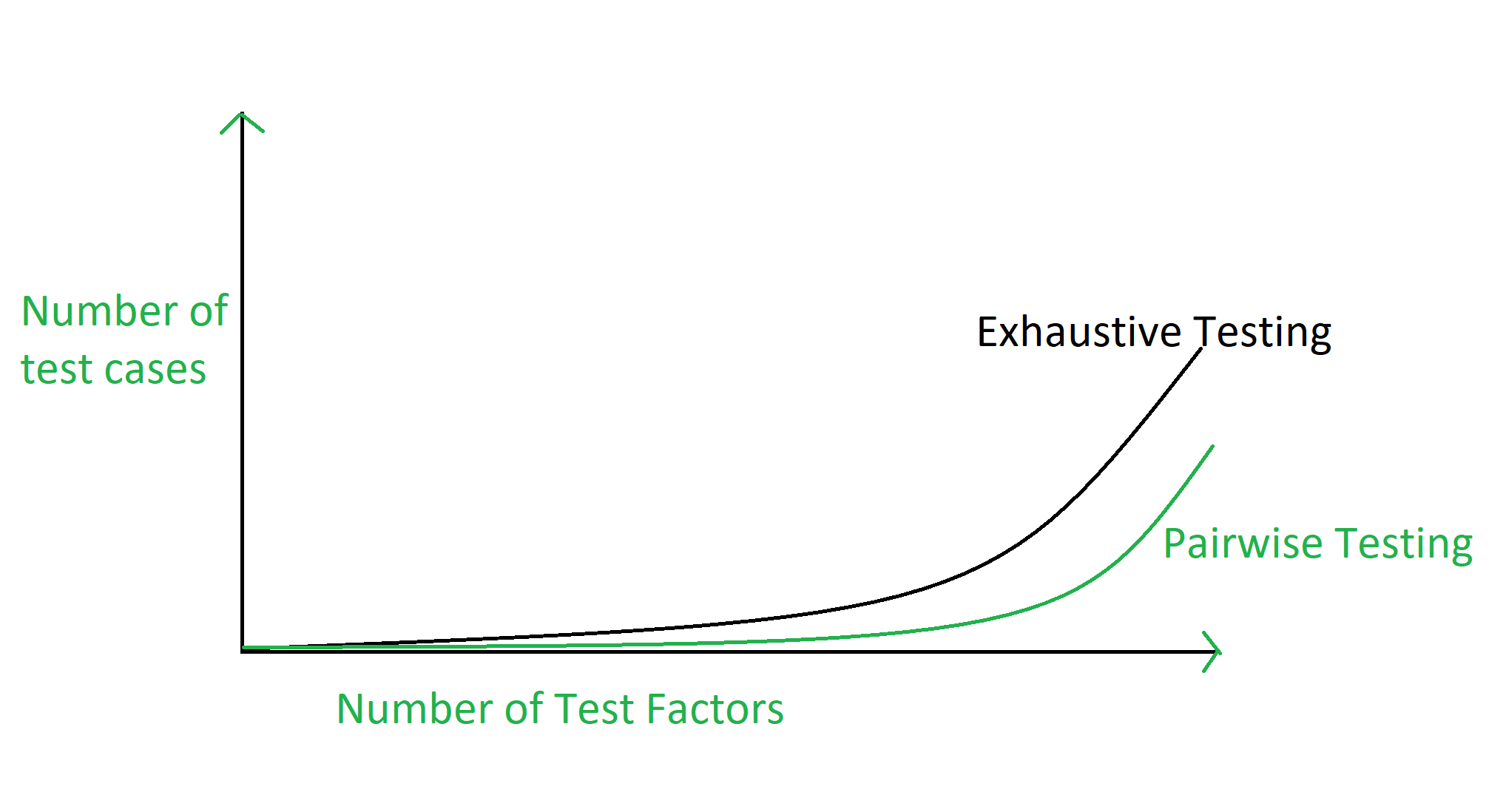
The graph shows how the number of test cases increases with the number of test factors in both pairwise and exhaustive testing approaches.
👁 ImagePairwise testing is more efficient and scalable compared to exhaustive testing, especially for systems with a large number of input parameters.
Pairwise testing is a specific case of a broader approach known as N-wise testing, where interactions between multiple parameters are tested.
Sorting is applied to the set
X=n{i}
so that the parameter set P=P{i} is also ordered.
The sorted set can be represented as an N-tuple:
P{s}={P{i}} such that ∣R(P{i})∣<∣R(P{j})∣
This structured ordering helps in selecting parameter combinations systematically.
Explanation:
Represents pairwise (2-wise) testing.
X(2)={P{N−1},P{N−2}
Represents 3-wise testing.
X(3)={P{N−1},P{N−2},P{N−3}
Represents K-wise testing.
X(K)={P{N−1},P{N−2},...,P{N−K}
N-wise testing includes all such combinations, where increasing the value of K increases interaction coverage but also increases the number of test cases.
Pairwise testing helps improve test efficiency by reducing the number of test cases while still covering important input interactions.
While pairwise testing is efficient, it has some limitations when dealing with complex systems and higher-level interactions.