|
VOOZH | about |
|
VOOZH | about |
In today’s world, teams want to work better and adapt quickly to changes. Using kanban is an easy and efficient approach to better teamwork and job management. Using Kanban can help you stay organized, prevent delays, and continuously improve your work, whether you're starting a new project or trying to make an old one better. Kanban can be implemented as a new project. Or, it can be integrated into the existing project. Knowing the right principles for both these use cases is very important for the Project Professionals.
In this article, we will dive deep into the practices for implementing Kanban in new and existing projects so that you can use it for your project. So let us start without any delay.
Table of Content
Executing a Project involves a lot of tasks and activities which may also include unnecessary tasks. Thus, it will impact the execution efficiency of our Project. But Kanban, an Agile framework addresses this issue by moving ahead with the task that matters most and in a continuous manner.
You now understand Kanban, however, it is crucial to clearly understand that the principles defined in the Kanban Methodology are solely dedicated to Agile-based project management. So, we have to check whether Kanban is suitable for our project or not.
As we know Agile breakdowns the large projects into smaller builds, that are developed iteratively through sprint planning. Kanban follows the same principle but it has more flexibility in terms of project delivery and execution process. Following are the scenarios in which the Kanban is suitable for our Project.
Now, let us see how to get started with Kanban. There are multiple ways in which you can create the Kanban Board. You may use your template as per the business requirements. Or, you can use Project Management Tools such as Jira and Asana that provide the Kanban Board templates to create an interactive workflow. You can follow the below approach to get started with Kanban.
After gaining insights into the Kanban basics, let us see its practical implementation.
This applies to you if you have just decided to initiate a new project. The various principles and practices are required be be thoroughly understood for using Kanban in a new project. Let us quickly dive into these practices.
👁 Implementing Kanban in a New ProjectThis is a basic practice to initiate a Kanban Project. Project experts have to create a Kanban Board on their own or use the tools or platforms for creating the Kanban Board. It is important to assign a relevant name to the Kanban Board that aligns with the requirements.
The project may include multiple tasks according to different categories like ‘In-progress,’ ‘Done,’ or ‘On-hold.’ Thus, create columns to represent all these task categories.
After creating the columns, limit them by defining the WIP (Work-In-Progress) Limit which is the maximum number of tasks for each column. It is needed so the team does not progress ahead as long as the current tasks are completed.
Now, the project experts define the issues, tasks, bugs, or subtasks. They can also create a custom issue type and assign the tasks to the appropriate team members so that they can be executed within the timeline.
The project lead can visualize the project timeline according to days, weeks, months, or quarters so that tasks can be managed as per the deadline.
Ask the stakeholders and the project team about their feedback to identify the areas of improvement. This practice is important for assessing the project and keeping the project adaptive to dynamic requirements.
As a project professional, you have to make sure only necessary tasks are taken into consideration. Thus, a backlog maintains the upcoming tasks that will be undertaken after the current tasks are executed. The upcoming tasks in the sprint can be maintained in the backlog list and can be moved into the Kanban Board when needed.
With the above basic practices, you can easily implement the Kanban in the new Project. Now let us see how to implement Kanban in the Existing Project.
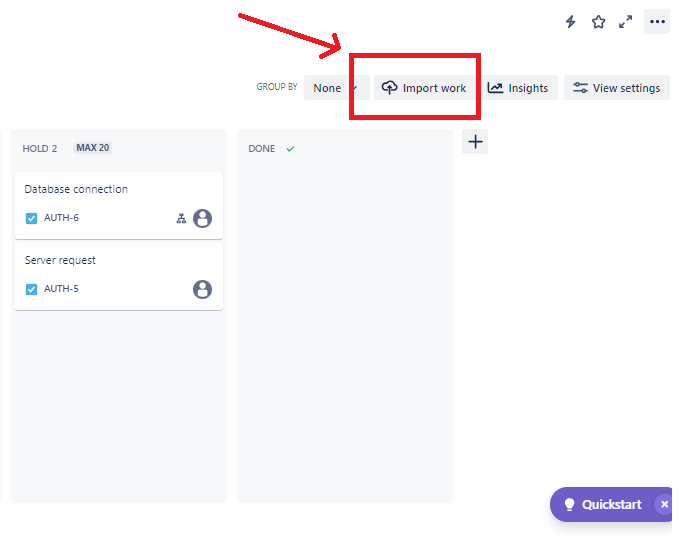
Kanban allows us to migrate an ongoing project into the Kanban Workflow easily. We can import our existing workflow into the Kanban Board. However, the import feature depends on which Kanban Tool you are using to manage your Project. Here are the practices for using Kanban in your existing project.
👁 Transitioning to Kanban in an Existing ProjectUse the import wizard of Kanban Board to use the existing project plan under execution along with the progress report. Then, analyze it and configure the Kanban Board as per the existing project. Thus, the order of the tasks can be well maintained.
Older workflow might have been managed by a different team. Thus, identify the current team’s potential and set the limits for the number of tasks in each column so that the existing project can be taken forward by the team.
It is important to schedule the sessions with the team and train them about the current project scenario, its progress, and current execution plans. Also, define the roles and responsibilities of the team so that they can take ownership of the project tasks.
This will help you to keep a check on what is being executed and how it will impact the project. The Kanban method has various metrics such as Cycle Time Report, Throughput, and Cumulative Flow Diagram using which project managers identify how efficient their project plan is. Also, take timely feedback from the stakeholders to enhance project outcomes.
An important point is that the practices of the Kanban Implementation also depend on the project requirements. Thus, a proper understanding of the project along with Kanban Practices will help you to execute your project.
Implementing Kanban is easy but it always has some challenges associated with its project-specific application. Following are challenges and ways to overcome them so that you find no issue in practicing Agile using Kanban.
To fully utilize the advantages of the Kanban, you have to define proper rules for monitoring and adapting. Let us see how to do this:
Multiple case studies show how the teams achieved success using Kanban. Following are the case studies:
The above real-world examples show us how Kanban made projects successful.
In Conclusion, Kanban can be used for the new Project or you can integrate it into the existing projects. The main advantage of Kanban is that it allows the project team to practice the Agile Principles without the fixed time-bounded iterations. Hence, you can plan your release continuously. Also, it saves time by reusing the existing project plan. You have gained a clear idea about the practices for implementing the Kanban in new or Existing Projects. Now, you can easily practice Agile Principles with Kanban.