 |
VOOZH | about |
|
VOOZH | about |
Unified Modeling Language (UML) is a standardized modeling language widely used in software engineering for visualizing, specifying, constructing, and documenting the artifacts of a system. UML provides a set of graphical notations and a framework for modeling complex systems, helping software developers and system architects communicate and understand the design of a system more effectively.
Think of UML as a set of drawings or diagrams that help people see and grasp different parts of a software project. It's like a visual toolkit that makes it easier to explain ideas, plan how things will work together, and document the whole process. This way, everyone working on the project can be on the same page, reducing misunderstandings and making the whole development process smoother. The Object Management Group (OMG) liked this idea so much that they officially adopted UML in the 1990s, and since then, it's been widely used in the software development world.
The Timetable Generating System outlines a roadmap for enhancing the scheduling process by addressing the problem through clear definition, strategic solutions, and efficient implementation, ultimately automating and optimizing the college timetable creation for a more user-friendly academic experience.
The primary objective of this project is to analyze the requirements of students and faculty, design and implement an automated timetable system, rigorously test its functionality, and ensure ongoing maintenance of the software.
UML diagrams come in different types, each serving a specific purpose in the software development lifecycle. Some of the most commonly used UML diagrams include:
A use case diagram is a visual representation that helps describe how a system interacts with its users, or actors, to achieve specific goals or tasks. It's a way to illustrate the functionalities of a system from a user's perspective, focusing on what users want to accomplish. Some of the terms used in the use case diagram are:
Use case diagrams are beneficial during the early stages of software development or when discussing system requirements. They provide a high-level overview, making it easier for stakeholders, including developers, designers, and clients, to understand how the system will function without delving into technical details. By focusing on user interactions and goals, use case diagrams contribute to better communication and collaboration among the project team.
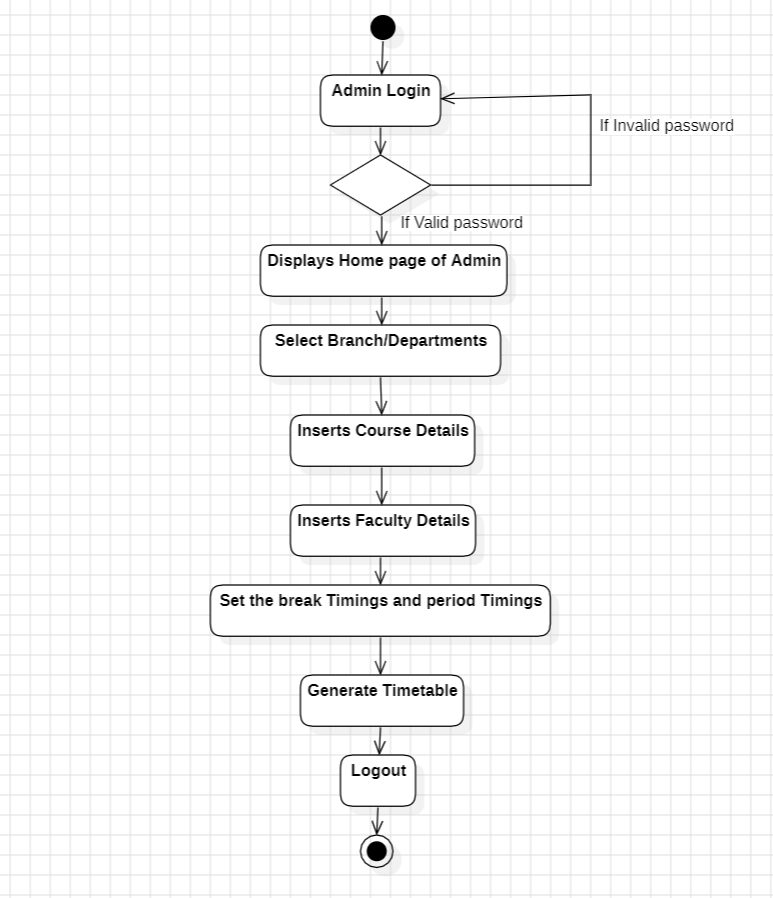
An activity diagram is a type of UML diagram that focuses on illustrating the flow of activities or actions within a system or a specific business process. It provides a visual representation of how different tasks or activities are carried out, their sequence, and the conditions that guide their execution. Some of the terms used in the activity diagram are:
Activity diagrams are particularly useful for modeling business processes, workflows, and complex procedures. They help stakeholders understand the dynamic aspects of a system, including the order of actions and decision points, fostering better comprehension and communication among team members. Activity diagrams are commonly employed during the analysis and design phases of software development to ensure a clear understanding of the system's behavior.
A class diagram is a type of UML diagram that provides a visual representation of the static structure and relationships within a system. It primarily focuses on the classes, their attributes, methods, and the associations between classes. Class diagrams are especially useful for modeling the structure of object-oriented systems. Some of the terms used in the class diagram are:
Class diagrams are instrumental during the design phase of software development. They help developers visualize the structure of their system, understand the relationships between classes, and ensure a well-organized and modular design.
A sequence diagram is a type of UML diagram that illustrates the dynamic interactions between objects or components in a system over time. It focuses on the sequence of messages exchanged between different entities to achieve a specific behavior or scenario. Sequence diagrams are particularly useful for modeling the flow of operations or events in a system. Some of the terms used in a sequence diagram are:
Sequence diagrams are especially valuable for capturing the dynamic behavior of a system during a specific scenario or use case. They help developers understand the chronological order of interactions between objects and provide insights into the timing and dependencies of different operations. Sequence diagrams are commonly used during the analysis and design phases of software development to ensure a clear understanding of how components collaborate and communicate in the system.
A state chart diagram is a type of UML diagram that represents the dynamic behavior of a system in response to external stimuli and internal conditions. It focuses on modeling the different states that an object or a system can be in and the transitions between these states based on events. Some of the terms used in a state chart diagram are:
Statechart diagrams are particularly effective for modeling the behavior of systems with distinct and well-defined states. They are commonly used in software engineering, especially in the design and analysis phases, to represent the behavior of objects in reactive systems. State charts help in visualizing the different states a system can be in, the events that trigger transitions between states, and the actions associated with these transitions, providing a clear understanding of the system's behavior over time.
An object diagram is a type of UML diagram that provides a snapshot of the instances of classes in a system at a specific point in time. It represents a set of objects and their relationships, showing how they collaborate to fulfill a certain scenario or use case. Some of the terms used in Object diagram are:
Object diagrams are useful for visualizing the relationships between instances of classes and how they collaborate during a specific scenario. They provide a concrete representation of the objects and their associations, offering a more detailed view than class diagrams, which focus on the structure of classes. Object diagrams are particularly helpful during the design phase of software development when you want to show how a set of objects interact or collaborate to achieve a specific functionality. They help in understanding the actual instances of classes and their relationships in a real-world context.
A swimlane diagram, also known as a cross-functional flowchart or process map, is a visual representation that illustrates how different individuals, departments, or entities within an organization contribute to a particular process. The diagram is called a "swimlane" because the chart is divided into distinct lanes, each representing a specific role, department, or participant in the process. Some of the terms used in swimlane diagrams are:
Swimlane diagrams are valuable tools for visualizing complex processes, as they depict the interactions between different departments or roles. They are commonly used in business process improvement, project management, and system analysis to identify bottlenecks, streamline workflows, and enhance collaboration between different stakeholders. These diagrams are versatile and can be adapted for various purposes, making them a widely used tool in business and project management to enhance communication and understanding of complex processes.
In simple terms, Unified Modeling Language (UML) is a crucial tool in software engineering. It helps people understand, design, and talk about complex systems in a standardized and visual way. The Timetable Generating System project shows how different UML diagrams, like Use Case, Activity, Class, Sequence, State Chart, and Object diagrams, can be useful in different stages of software development.
Each type of UML diagram has a specific purpose, helping us understand things like system requirements, structure, behavior, and how different parts interact. Using these diagrams in the Timetable Generating System project makes communication between team members easier. It reduces the chances of misunderstandings and promotes collaboration.
From the early stages of system analysis to the design and implementation phases, UML diagrams play a pivotal role in ensuring that all team members, including developers, designers, and clients, share a common understanding of the project's intricacies. The visual representations provided by UML diagrams enhance clarity, streamline development processes, and contribute to the overall success of the software project.

.png)

.png)


-(1).png)