|
VOOZH | about |
|
VOOZH | about |
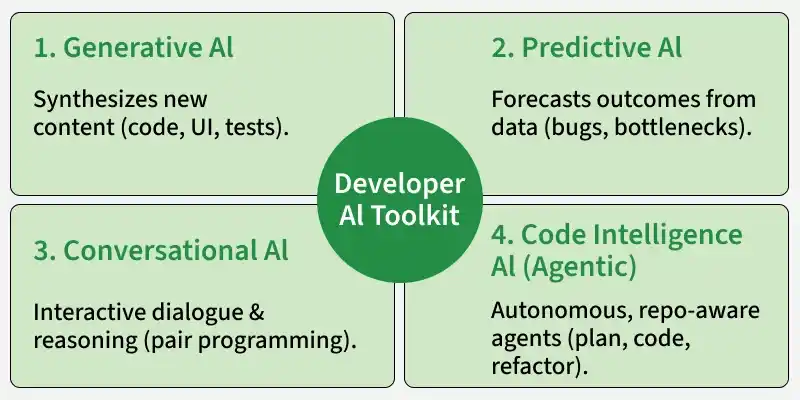
The AI ecosystem for software developers centers on four practical categories that directly enhance coding, debugging, architecture, and deployment workflows. Rather than relying on a single AI tool, developers combine these types to cover speed, accuracy, reasoning, and execution across real-world projects.
Types of AI developers should know include:
Together, these four types form the core AI toolkit most developers use daily
Generative AI, built on large language models (LLMs) and multimodal foundations, excels at synthesizing new content, text, code, images, or even structured data, from prompts or context.
For developers:
Strengths:
Limitations:
Reality: Generative AI has matured for enterprise use with better reasoning, longer contexts, and integration into workflows, but it's most powerful when combined with human oversight or agentic loops.
Predictive AI uses supervised/unsupervised machine learning to forecast outcomes based on historical patterns, making it ideal for optimization, risk assessment, and data-informed decisions.
For developers:
Strengths:
Limitations:
Reality: Predictive models embed deeply in tools (e.g., Sentry AI for error prediction, or repo analytics dashboards), helping teams sustain innovation while generative handles novelty.
Conversational AI focuses on natural, interactive dialogue, understanding intent, maintaining context across turns, and responding in human-like ways.
For developers:
Strengths:
Limitations:
Reality: Conversational interfaces remain the entry point for most devs, but increasingly route to specialized agents or code intelligence for deeper tasks.
Code intelligence AI specializes in understanding, generating, refactoring, and reasoning over codebases, now dominated by agentic capabilities where AI autonomously plans, uses tools (e.g., search, execute code, read files via MCP), loops through iterations, and completes goals.
For developers:
Strengths:
Limitations:
Reality: Agentic code intelligence represents the biggest shift, from single prompts to orchestrated systems. Developers who master building/using agents become orchestrators, with tools handling execution.
To understand how these AI types work in practice, consider a simple feature development flow where a developer combines all four to build efficiently:
1. Conversational AI → Understand Requirements
The developer starts by discussing the feature with a conversational assistant, clarifying requirements, edge cases, and possible approaches. This helps refine the problem before writing any code.
2. Generative AI → Write Code
Once the requirements are clear, generative AI is used to create the initial implementation, such as API endpoints, UI components, or database schemas, based on natural language prompts.
3. Predictive AI → Analyze Risks
Predictive tools analyze the code to identify potential issues, such as bug-prone areas, performance bottlenecks, or missing test coverage, using historical patterns and insights.
4. Code Intelligence AI → Refactor and Test
Finally, code intelligence tools refine the implementation by performing multi-file edits, improving structure, generating tests, and fixing issues through iterative, agentic workflows.
5. Result: Instead of a linear, manual process, development becomes a coordinated workflow where each AI type contributes at the right stage, improving speed, quality, and confidence in delivery.
| Type | Best For | Key Tools/Examples | Productivity Boost | Human Role Required |
|---|---|---|---|---|
| Generative AI | Ideation, prototyping, boilerplate | Cursor, v0, Claude Code | High (creation speed) | High verification |
| Predictive AI | Forecasting, optimization, risk | Sentry AI, CodeQL, repo analytics | Medium-High (accuracy) | Data oversight |
| Conversational AI | Brainstorming, debugging dialogue | ChatGPT/Claude/Gemini | Medium (exploration) | Iterative guidance |
| Code Intelligence/Agentic | Full workflow automation, refactoring | Cursor agent mode, LangGraph agents, MCP-integrated tools | Very High (autonomy) | Strategic direction & final review |