Prioritization in product management is the practice of deciding which features, tasks, or initiatives to work on first. It involves evaluating items based on impact, value, urgency, and effort. Effective prioritization ensures that teams focus their time and resources on the work that delivers the greatest value to users and the business. It also helps product managers manage trade-offs and maintain clarity in decision-making.
What are Product Prioritization Frameworks
Product prioritization frameworks are structured approaches used by product managers and teams to decide which features, initiatives, or tasks should be worked on first. These frameworks help teams allocate time and resources effectively by evaluating work based on factors such as customer value, business impact, effort, and strategic goals.
Using the right prioritization framework helps teams answer critical questions, such as:
Are we focusing on the highest-value initiatives for the business?
Are we delivering meaningful value to our customers?
Does our work align with overall business objectives?
Can we realistically and successfully bring this product to market?
Common Product Prioritization Frameworks
Product managers use various prioritization frameworks to decide which features or initiatives should be worked on first. These frameworks help balance customer value, business impact, effort, and urgency.
Some commonly used product prioritization frameworks include:
MoSCoW Method
Kano Model
RICE Score
WSJF (Weighted Shortest Job First)
Value vs. Effort Matrix
Eisenhower Matrix
Let us see about each framework in detail:
MoSCoW Method
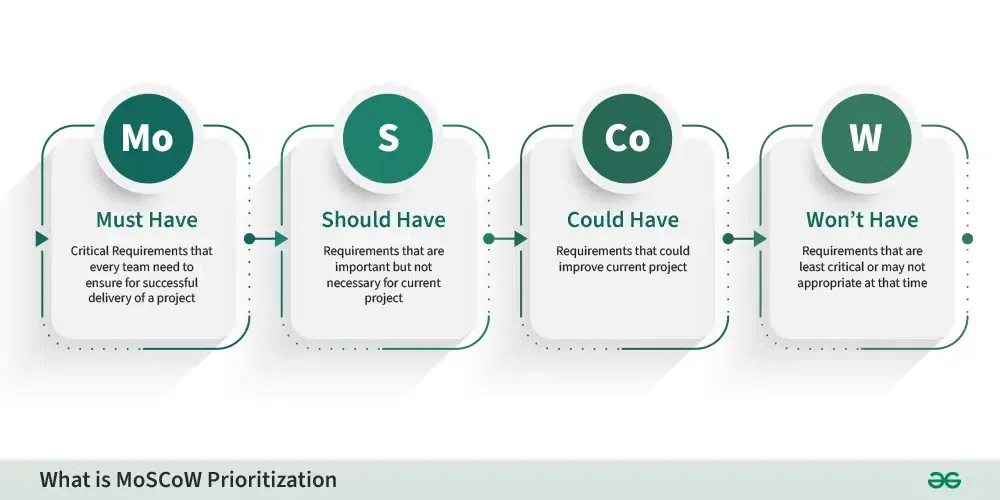
The MoSCoW Method is a prioritization technique commonly used in product management and software development to classify requirements or features based on their importance and impact on the product.
MoSCoW Full Form
The acronym MoSCoW represents four priority categories:
Must Have (Mo): Critical requirements without which the product cannot function or be released.
Should Have (S): Important features that add significant value but are not critical for launch.
Could Have (Co): Desirable enhancements that improve the product if time and resources allow.
Won’t Have (W): Features that are explicitly excluded from the current scope or release.
The MoSCoW Method is a simple prioritization technique that helps teams classify features or requirements based on their importance and impact, ensuring focus on what is essential for a product or release.
Advantages of MoSCoW Method:
Clear Prioritization: Provides a simple and structured way to rank features based on importance and impact, helping teams focus on what truly matters for a release.
Flexibility: Allows features to be grouped into Must, Should, Could, and Won’t categories, enabling balanced and realistic prioritization.
Improved Collaboration: Creates a shared language for discussing priorities, helping teams and stakeholders stay aligned on product decisions.
Disadvantages of MoSCoW Method:
Subjective Decision-Making: Relies heavily on team judgment, which can introduce bias and disagreements.
Lack of Quantitative Metrics: Uses qualitative assessment rather than measurable data, making comparisons harder.
Limited Scope: Does not explicitly account for factors such as cost, effort, or risk, which can lead to incomplete prioritization.
The MoSCoW Method helps product managers prioritize features by grouping them into four categories based on importance and impact. This ensures critical features are delivered first, while less important items are deferred to future releases.
Kano Model in Product Prioritization
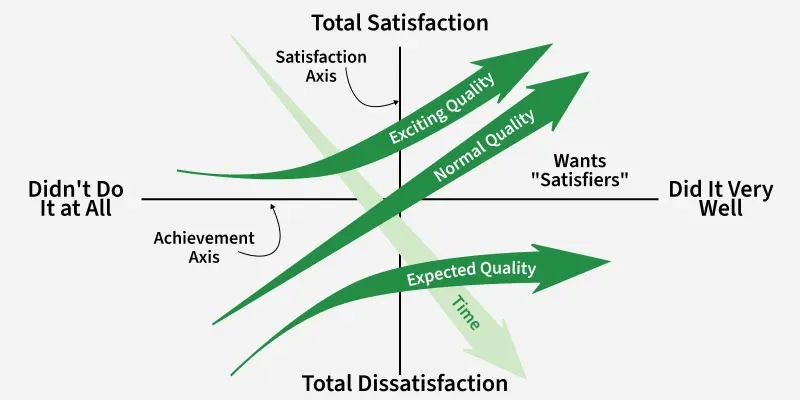
The Kano model helps us understand what features will really make customers happy. In Image provided below. On the horizontal line, we have three types of features:
Must-haves (Basic Features): These are things your product must have. If you don't have them, people won't even consider buying your product.
Performance Features: The more you work on these, the happier customers will be. It's like adding extra goodness to your product.
Delighters (Excitement Features): These are cool surprises. Customers don't expect them, but when they get them, it makes them super happy.
On the vertical line, we measure customer satisfaction. At the bottom, it's like the product didn't meet their needs at all. As you go up, satisfaction increases until it's fully met at the top.
To understand what people want, you ask them questions using a Kano questionnaire. You figure out how they feel about having or not having specific features.
Here's the key idea: The more you focus on improving features in each of these categories, the happier your customers will be. So, it's about wisely spending your time and resources to create a product that really satisfies your customers.
Essential features that customers expect by default. Their absence causes dissatisfaction, but their presence does not significantly increase satisfaction
Examples: A smartphone having a battery, a car having four wheels.
Performance Features:
Features that directly influence customer satisfaction and are used to compare products. Better performance leads to higher satisfaction.
Examples: Fuel efficiency in a car, camera quality in a smartphone.
Excitement Features:
Unexpected features that delight customers and create a strong competitive advantage. They are not essential but can significantly enhance user experience.
Used to prioritize features based on their impact on customer satisfaction and delight.
Helps distinguish between essential features, differentiators, and delight factors.
Benefits of Kano Model
Customer-Centric: Focuses on understanding customer needs and expectations.
Effective Prioritization: Helps prioritize features that drive satisfaction and differentiation.
Competitive Advantage: Identifies features that can delight users and set the product apart.
Drawbacks of Kano Model
Subjectivity: The Kano Model is subjective and relies on the judgment of the product manager and team members to categorize features.
Complexity: The Kano Model can be complex and difficult to apply in practice, especially for products with a large number of features.
Limited Scope: The Kano Model is limited in scope and does not take into account other factors that may affect prioritization, such as cost, effort, or risk.
RICE Score in Product Prioritization
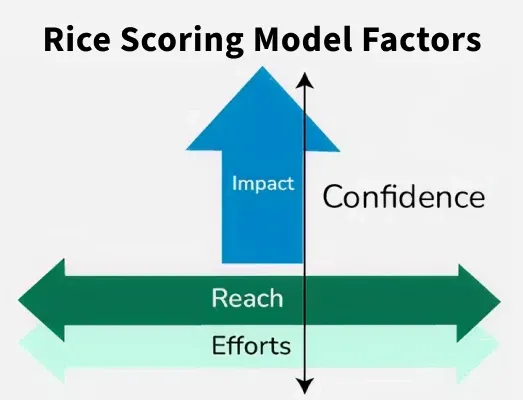
The RICE Score is a prioritization framework developed by Intercom that helps product managers and teams prioritize features and projects based on their potential impact and feasibility.
Defines the number of users or customers who will be affected by the project or feature. It helps in estimating the potential audience and impact.
2. Impact:
Measures the degree of positive change the project or feature is expected to bring. It could include factors such as revenue increase, user satisfaction improvement, or other relevant metrics.
It use a multiple choice scale
3 = massive impact
2 = high impact
1 = medium impact
0.5 = low
0.25 = minimal
3. Confidence:
Represents the level of certainty or confidence the team has in the estimations for reach and impact. It considers the amount of available data, user feedback, or other factors influencing the project's success.
It Uses a % Score where,
100 % high confidence
80 % medium confidence
50 % low confidence
4. Effort:
Quantifies the resources (time, money, manpower) required to complete the project. This includes development, testing, and any other necessary tasks.
How to Calculate RICE Score Model
RICE Score = (Reach x Impact x Confidence) / Effort
Use Case of RICE Score Model
Used to prioritize features and initiatives based on potential impact and feasibility.
Helps product managers allocate resources effectively and focus on high-value work.
Benefits of RICE Score Model
Objective: Provides a data-driven approach to prioritization.
Comprehensive: Considers multiple factors—Reach, Impact, Confidence, and Effort.
Flexible: Can be tailored to suit different product goals and team contexts.
Drawbacks of RICE Score Model
Complexity: Can be time-consuming and difficult to apply for large or complex initiatives.
Subjectivity: Estimates for RICE components may vary and introduce bias.
Limited Scope: Does not explicitly account for factors such as cost, risk, or strategic alignment.
Overall, the RICE Score is a useful framework for prioritizing features and projects based on their potential impact and feasibility.
WSJF (Weighted Shortest Job First) in Product Prioritization
WSJF (Weighted Shortest Job First) is a prioritization framework developed by Don Reinertsen that helps product managers and teams prioritize features and projects based on their value and urgency. It assigns weights to features based on their cost of delay, job size, and risk reduction, and prioritizes features with the highest WSJF score.
WSJF stands for Weighted Shortest Job First.
Features of WSJF
Cost of Delay: The cost of delaying a feature or project in terms of lost revenue or opportunity. It helps product managers understand the urgency and importance of the feature or project and prioritize features with a high cost of delay.
Job Size: The size of the feature or project in terms of complexity or effort required. It helps product managers understand the effort and resources required to implement the feature or project and prioritize features with a smaller job size.
Risk Reduction: The potential risk reduction or mitigation that the feature or project provides. It helps product managers understand the potential impact and value of the feature or project and prioritize features with a higher risk reduction.
Use Case of WSJF
WSJF is used by product managers and teams to prioritize features and projects based on their value and urgency.
It helps product managers make informed decisions about where to allocate resources and focus their efforts.
Benefits of WSJF
Objective: WSJF provides an objective and data-driven approach to prioritization.
Comprehensive: WSJF takes into account multiple factors, including cost of delay, job size, and risk reduction, to provide a comprehensive view of the value and urgency of features and projects.
Flexible: WSJF can be customized and adapted to match the specific needs and goals of the product manager and the team.
Drawbacks of WSJF
Complexity: WSJF can be complex and difficult to apply in practice, especially for features and projects with a large number of variables and dependencies.
Subjectivity: WSJF relies on the judgment of the product manager and team members to estimate cost of delay, job size, and risk reduction, which can be subjective and biased.
Limited Scope: WSJF is limited in scope and does not take into account other factors that may affect prioritization, such as cost, effort, or strategic alignment.
Overall, WSJF is a useful framework for prioritizing features and projects based on their value and urgency.
Value vs. Effort Matrix in Product Prioritization
The Value vs. Effort Matrix is a prioritization framework that helps product managers and teams prioritize features and projects based on their value and effort required. It categorizes features into four quadrants based on their value and effort: high value, low effort; high value, high effort; low value, low effort; and low value, high effort.
Features of Value vs. Effort Matrix
High Value, Low Effort: Features that provide high value with low effort. They are quick wins and should be prioritized.
High Value, High Effort: Features that provide high value but require significant effort. They are important but may require more resources and time.
Low Value, Low Effort: Features that provide low value with low effort. They are low priority and may not be worth pursuing.
Low Value, High Effort: Features that provide low value and require significant effort. They are low priority and may not be worth pursuing.
Use Case of Value vs. Effort Matrix
Prioritizes features and projects based on value delivered versus effort required.
Helps teams focus on high-value, low-effort initiatives first.
Enables informed decision-making on resource allocation and trade-offs.
Benefits of Value vs. Effort Matrix
Objective: The Value vs. Effort Matrix provides an objective and data-driven approach to prioritization.
Comprehensive: The Value vs. Effort Matrix takes into account both value and effort required to provide a comprehensive view of the priority of features and projects.
Flexible: The Value vs. Effort Matrix can be customized and adapted to match the specific needs and goals of the product manager and the team.
Drawbacks of Value vs. Effort Matrix
Complexity: The Value vs. Effort Matrix can be complex and difficult to apply in practice, especially for features and projects with a large number of variables and dependencies.
Subjectivity: The Value vs. Effort Matrix relies on the judgment of the product manager and team members to estimate value and effort required, which can be subjective and biased.
Limited Scope: The Value vs. Effort Matrix is limited in scope and does not take into account other factors that may affect prioritization, such as cost, risk, or strategic alignment.
Overall, the Value vs. Effort Matrix is a useful framework for prioritizing features and projects based on their value and effort required.
Eisenhower Matrix in Product Prioritization
The Eisenhower Matrix, also known as the Urgent–Important Matrix, is a prioritization framework used to organize tasks based on their urgency and importance. It helps product managers focus on what truly matters while reducing time spent on low-value work.
Features of Eisenhower Matrix
Urgent and Important: Tasks that require immediate attention and are critical to product or project success.
Important but Not Urgent: High-impact tasks that should be planned and scheduled for later.
Urgent but Not Important: Tasks that demand immediate action but contribute limited value and should be delegated or minimized.
Not Urgent and Not Important: Low-priority tasks that can be deprioritized or eliminated.
Use Case of Eisenhower Matrix
Used to prioritize tasks and deliverables based on urgency and importance.
Helps teams allocate time and effort more effectively.
Benefits of Eisenhower Matrix
Simple and Clear: Easy to understand and apply for day-to-day task prioritization.
Balanced View: Considers both urgency and importance for better decision-making.
Flexible: Can be adapted to different team needs and workflows.
Drawbacks of Eisenhower Matrix
Subjective: Relies on personal judgment, which can introduce bias.
Limited Scope: Does not consider factors such as effort, cost, or strategic alignment.
Not Ideal for Complex Planning: Less effective for long-term or large-scale product initiatives.