
Not too long ago, there was a moment when we all thought AMD finally had the answer to Nvidia's DLSS. After years of playing catch-up with Team Green's leaps in upscaling technology, AMD's FSR Redstone felt like it wasn't a stopgap or a "good enough" alternative. Instead, Redstone felt like a proper forward-looking suite of technologies that could go toe-to-toe with Nvidia's AI-driven dominance.
And yet, before Redstone has even had the chance to properly settle into the ecosystem, AMD has already shifted the conversation toward something newer, shinier, and far more ambitious: FSR Diamond, which is reportedly tied to next-generation Xbox hardware.
At this point, a bit of unease has begun creeping in. Right now, it's hard not to feel like AMD is asking us to look ahead all while it hasn't fully delivered on what's already here.
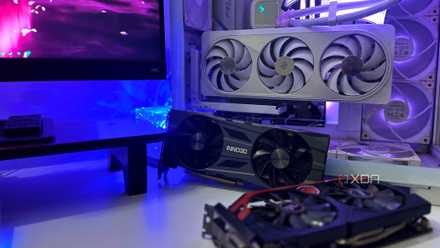
12 years ago, I left AMD for NVIDIA, and AMD has never given me a reason to come back
NVIDIA's ecosystem became about much more than silicon, years ago.
FSR Redstone was supposed to be AMD's turning point
It was FSR 4, but shinier and better
FSR Redstone isn't just another version bump at all. It isn't an incremental update, either. It's suppposed to be AMD embracing what it had needed for years to finally go toe-to-toe with Nvidia: a full-stack, machine learning-driven rendering pipeline. FSR Redstone was about so much more than just upscaling, too. It brings together ML-based super-resolution (AMD's DLSS-equivalent), frame generation, Ray Regeneration (AMD's Ray Reconstruction-equivalent), and radiance caching for path-traced lighting.
On paper, everyone felt like this was AMD finally closing the gap, matching Nvidia feature-for-feature, building a cohesive ecosystem that developers could actually rely on. AMD owners finally felt like Team Red had arrived. Redstone was a technology launch on paper, but in the bigger picture, it felt like a loud statement of intent.
Instead, it arrived half-baked and barely there
Redstone landed more like a preview than a finished product
For starters, Redstone has been "officially" locked behind RDNA 4 cards, and it's taken a lot of tinkering for AMD owners to use it on RDNA 3 cards. That aside, support has been sparse, and outside of a handful of early showcases and limited implementations, most of Redstone's promised capabilities haven't meaningfully propagated across the games people are actually playing. For something positioned as a foundational shift, it feels strangely absent. The feature rollout itself ran into problems because not everything arrived together. Something as key as radiance caching is still trickling into real-world usage, turning what should have been a cohesive platform into a fragmented one. Frame generation, something that Nvidia has been doing for well over two years now, is still running into immersion-breaking frame pacing issues on AMD's side — something even Redstone hasn't seemed to be able to fix.
Hardware support hasn't helped, either. Much of Redstone's full feature set is effectively locked to newer RDNA 4 GPUs, cutting off a massive portion of AMD's existing user base. And unlike older versions of FSR that thrived on broad compatibility, this shift introduced friction for both players and developers. Even when it does show up, the results can be inconsistent. Fluid motion frames, which is AMD's answer for DLSS Frame Generation, hasn't exactly delivered the kind of smooth, artifact-free experience that users have come to expect after looking at what Nvidia has been doing. All of this contributes to the lingering feeling that Redstone is completely unfinished, which is why the news of the next FSR Diamond has irked many users.
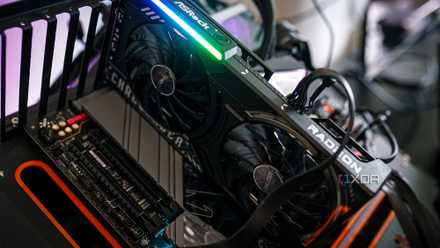
AMD's FSR 4 beats DLSS 4 in one surprising way
For the first time ever, AMD's FSR 4 can properly compete with DLSS 4.
FSR Diamond is now stealing the spotlight
Redstone hasn't even had any time to mature
Positioned as part of next-generation Xbox hardware initiatives, FSR Diamond represents a more fully-realized version of AI-driven rendering for Project Helix. The messaging around it sure is confident, and it's decidedly more cohesive, too. Diamond promises deeper integration with future GPU architectures, more advanced frame generation techniques, and a cleaner, more unified feature stack.
All of it sounds exciting, but right now, only in isolation. After all, this is exactly the kind of long-term direction that AMD needs to stay competitive with Nvidia's progress in upscaling. In context, however, it does create a problem.
FSR Diamond shifts attention away from Redstone at the exact moment when Redstone still needs it the most. It feels like AMD's skipping a step here, and instead of building momentum on a solid foundation, Team Red is risking fragmenting its own ecosystem (again) by moving the conversation forward before the present has even had the chance to stabilize.
I tried running games at native resolution again, but DLSS 4.5 changed my mind
Even pixel peepers would struggle to justify native rendering at this point
Crimson Desert shows just how far Redstone still has to go
Frame-pacing and 4K upscaling continue to have problems
If the earlier concerns around Redstone were about perception, Crimson Desert has turned them into something much harder to ignore: tangible results. In its latest showing, the game offers one of the clearest side-by-side looks at what Redstone is capable of in a demanding, modern workload. When focusing on 4K using performance-oriented upscaling modes, the comparison... doesn't flatter AMD.
Against DLSS 4.5, Redstone's 4K upscaling struggles to hold the same level of image stability. Fine details like foliage, distant geometry, and texture clarity all tend to break down more noticeably. There's a softness to the image that persists even when sharpening is applied, and motion introduces further instability that's hard to unsee once you notice it.
On the other hand, DLSS leans in a more aggressive direction, but it remains controlled. Nvidia's upscaler reconstructs detail with a level of confidence that keeps edges crisp, surfaces readable, and motion surprisingly stable. Even when it's clearly doing heavy lifting under the hood, the end result holds together in a way that feels far more consistent. I'm not talking about pixel-peeping here, either. It's the overall presentation that shows a clear chasm between where FSR Redstone has reached and where DLSS 4.5 already is. Not only is FSR Redstone incomplete, but it's also visibly behind Nvidia in at least one of the most important real-world scenarios, which is 4K high-end displays.
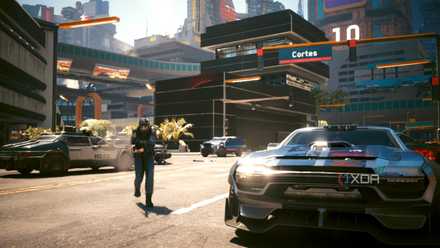
I tried gaming in 360p with DLSS 4.5, and the results left me shocked
Night City at 360p is remarkable, to say the least
This is less about technology and more about trust
I'd love to see AMD follow through here
AMD doesn't have a vision problem. If anything, I'd say that both Redstone and Diamond together prove that the company knows exactly where its rendering technology is headed. There is, however, a follow-through problem that AMD has to contend with. Right now, the experience certainly feels fragmented. A promising platform launched without full support, features arrived in pieces, and its adoption remains limited. Oh, and before it all comes together, the spotlight shifts to something new entirely.
For gamers, it's no wonder that a move like this creates hesitation. It's not as if the tech isn't interesting — we've seen Nvidia do this time and time again — but it's hard to know when it will feel complete. For developers, it complicates priorities as well, because now they'll be investing time into a platform that may be superseded or recontextualized within a short window.
AMD Radeon Adrenalin Edition

3 reasons why AMD finally used AI for FSR 4
AMD's FSR 3 wasn't far behind the competition, but FSR 4 needed sweeping changes for truly impressive gains
Why not finish what you started?
FSR Diamond might be the future, but Redstone, the present, risks becoming a stepping stone.
Look, it's not like FSR Redstone is a lost cause. The foundation is there, and in many ways, it's the strongest one AMD has laid in years. It's still FSR 4, after all. But foundations only matter if you actually build on them.
Right now, FSR Diamond looks like it's the future, and it very well might be. Whether or not it's even coming to PC is something we'll find out, but we do know it will be locked to RDNA 5 architecture cards, owing to their ML and AI cores. In the meantime, though, Redstone is still the present, and until AMD commits to fully realizing it through wider support and complete feature delivery, it risks becoming another stepping stone that never quite reaches its destination.
Found an error? Send it info@www.xda-developers.com so it can be corrected.