
For years now, the GPU conversation has revolved around VRAM, and rightly so. 6GB became 8GB, and 8GB became the new minimum, which, suddenly, started feeling like it wasn't enough. Modern games have ballooned in size, textures have gotten much sharper, and memory demands have clearly spiraled out of control.
At GTC 2026, Nvidia didn't respond the way most people expected. For starters, we didn't get any new RTX 50 series Super cards or larger memory pools across the board, either. Instead, they've introduced a way to need less VRAM now. Neural Texture Compression is a new approach to traditional texturing in games, and if it sticks, it could flip on its head what "enough VRAM" even means.
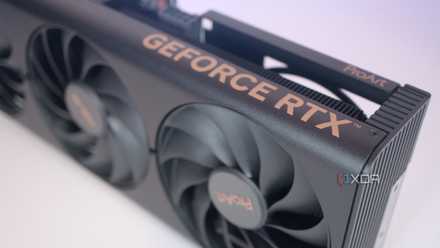
We have reached the GPU ceiling, and AI tricks like DLSS are how companies pretend we haven't
Silicon alone can only do so much without software bearing the load
Nvidia's NTC is a new approach to texturing your games
Stored data is transforming into reconstructed detail
Traditional texturing has always been brute force disguised as efficiency. Every surface you come across in any game is essentially just an image wrapped around a 3D object in the engine. These are then rendered in real time by your GPU, meaning that massive chunks of precomputed image data are stored directly in VRAM. Every surface is a stack of layers of texture maps that scale aggressively with resolution. That's why higher-quality visuals have also led to higher VRAM usage, and why 8GB of VRAM is quickly beginning to feel too little.
Nvidia's Neural Texture Compression technique flips this model entirely. Instead of storing textures, it stores a compact neural representation of the texture — a tiny model that reconstructs the texture when needed, using Tensor Cores. The biggest result of this technology is a dramatic reduction in memory footprint. Nvidia's own demos show texture data that requires over 6GB of VRAM shrinking to under a gigabyte (970 MB) without the traditional overhead you'd expect. Neural Texture Compression turns static texture assets into instructions that are reconstructed in real time.
Consequently, VRAM stops being the bottleneck it currently is. It's not eliminated, though — other rendering techniques like lighting and geometry still eat into a GPU's VRAM resources — but it's significantly less dominant.
NTC might become an excuse for 8GB GPUs to stick around
There's a less comfortable angle to all of this
For years, users have been pushing back against 8GB GPUs, especially as newer titles started to exceed that limit at higher settings. And yet, we've seen cards even in the latest RTX 50 series ship with 8GB configurations, like the RTX 5060 and its 8GB Ti variant as well. These cards instead lean heavily on technologies like multi-frame generation to stay relevant. Now, with NTC, Nvidia has something that's even stronger than marketing, and that's a technical justification.
If Neural Texture Compression reduces VRAM usage by the margins they're claiming, then 8GB will stop looking as restrictive on paper. This would then give Nvidia room to keep lower-capacity variants in circulation, potentially extending that trend into the RTX 60 series as well. And yet, the frustration on the part of gamers and other consumers hasn't really gone anywhere. We still end up running into memory limits in real games today. While NTC may point to a better future, it doesn't really solve present-day constraints while running games like Borderlands 4, Hogwarts Legacy, or Avatar: Frontiers of Pandora. When you look at it this way, NTC starts to feel more and more like a way for Nvidia to redefine the VRAM problem instead of outright fixing it.
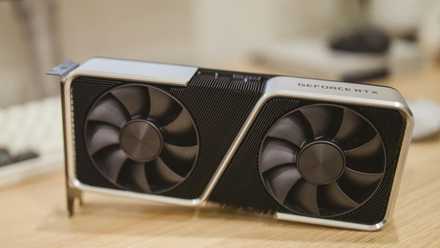
Don't throw away your 8GB VRAM GPU yet — 3 ways to reduce your VRAM dependency
A combination of optimized graphics settings and third-party assistance is all you need
Your old 8GB GPU isn't getting a second life
The RTX 20 and 30 series won't fully benefit from NTC
Sadly, if you're still holding onto an older 8GB card, NTC isn't the miracle upgrade it sounds like. Neural Texture Compression comes in multiple implementation paths, and not all of them deliver the same benefits. The most effective mode, which performs real-time reconstruction during rendering and delivers the biggest VRAM savings, is called Inference-on-Sample. Despite its VRAM usage benefits, this method also demands significant AI compute performance — the kind that newer architectures are far better equipped to handle.
Older GPUs with fewer Tensor Cores, like the RTX 20 and 30 series, are more likely to fall back to Inference-on-Load methods, where textures are reconstructed ahead of time and then stored in more traditional compressed formats. While this reduces bandwidth and streaming overhead, it doesn't meaningfully lower the VRAM usage as Inference-on-Sample does. So, while NTC might technically run on older hardware, it won't transform it.
Then there's the fact that older cards playing current games won't find any meaningful benefit from Neural Texture Compression. This is a new technology that developers have to integrate into their pipelines manually. That means we'll see the benefits of NTC only in future games, or in the rare few games which may be updated to implement NTC instead of traditional texturing. So, the GPUs that are already struggling in modern titles aren't going to be revived by NTC all of a sudden. Instead, with this technology, Nvidia is only laying the groundwork for what comes next.
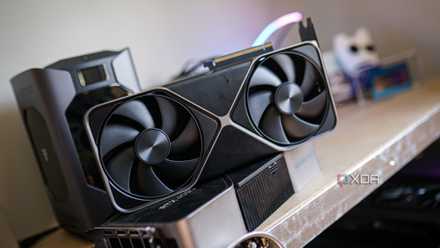
Nvidia's 6x frame generation proves that we've reached the hardware ceiling for GPUs
There's only so much VRAM to go around.
AI seems to be replacing traditional graphics pipelines
Nvidia loves finding workarounds for traditional problems
Over the past few years, what we've seen Nvidia do in terms of graphics rendering is a clear sign that AI is actively and rapidly replacing traditional pipelines. DLSS uses deep learning and neural networks to upscale lower-resolution graphics, and frame generation utilizes AI models to create and insert AI-generated frames as well. NTC, too, uses machine learning — specifically trained, small neural networks — to reconstruct texture data in real time. Individually, these are all clever optimizations, and together, they do point to the bigger picture, showing how Nvidia is no longer interested in overcoming the challenges posed by traditional rendering. Instead, Team Green is dead set on routing around them.
While we once relied on raw raster performance, bandwidth, and memory capacity, we're now leaning into AI-driven reconstruction at nearly every stage of the pipeline. Resolution, motion, lighting, and textures are increasingly becoming outputs of inference rather than direct computation or storage, and it's all pointing to a fundamentally different philosophy for games of the future. If this direction holds, the future of graphics will be defined less by how much raw data you can store or process, and more by how convincingly you can recreate it on the fly.
Gigabyte GeForce RTX 5070 Ti Eagle OC Ice SFF
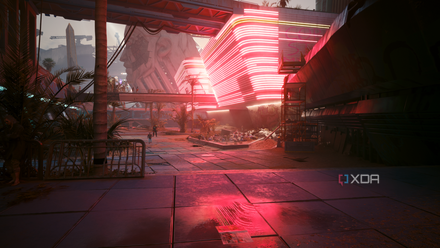
DLSS closed the gap to native resolution so well that native gamers became the outliers
Gaming at native resolution makes you a Luddite today
This is the era of algorithmic sorcery
Raw specs are clearly becoming secondary to algorithmic magic now.
The one thing that has become clear over the past few years is that we're nearing the end of the "brute force" era. We're now moving toward a reality where our GPUs act less like high-speed warehouses and more like a computational machine that paints a masterpiece from a handful of notes.
Whether you find this pivot brilliant or look at it as a cynical dodge of hardware limitations, the trajectory couldn't be clearer: raw specs are now becoming secondary to algorithmic magic. The most powerful graphics card isn't going to be the one with the most memory. Instead, it'll be the one with the smartest software stack behind it.