|
VOOZH | about |
|
VOOZH | about |
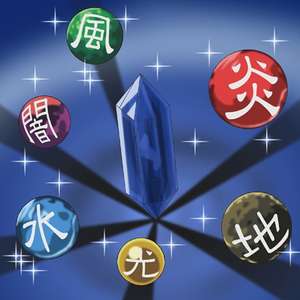
Attributes (Japanese: Zokusei) are characteristics of Monster Cards in Yu-Gi-Oh! media and card games. They represent the monster's "elemental" grouping, and are involved in card effects in the card games.
The manga featured seven Attributes: Light, Dark, Water, Fire, Wood, Earth, and Lightning. Unlike other games, Attribute icons are not visible on the cards and are only made known through exposition and card effects. This system is used in Yu-Gi-Oh! and Yu-Gi-Oh! R. Later series more closely follow the OCG rules.
The English manga variously translates the word "Attribute" as "Attribute", "Element" and "category".
A monster can have multiple Attributes, such as "Red-Eyes Black Dragon", whose Attribute was stated to be Dark,[1] while its attack was said to be Fire-Attribute.[2]
With the exception of Light and Dark, each Attribute benefited from a different terrain:
The effectiveness of an attack can be influenced by the Attribute of the monsters battling. What happens in the case of an effective attack has been inconsistent. Sometimes the monster of the weaker Attribute loses half its ATK.[4] Sometimes the weaker monster loses 300 ATK.[2][5]
If monsters of incompatible Attributes are fused, for example a Light and a Dark monster are fused, Attribute repulsion () occurs and the Fusion Monster corrodes,[6] causing it to lose ATK equal to that of the weaker fusion material monster each turn.[7]
A number of merchandise released in the era of the Toei anime used the same Attributes as the manga. Either all seven (LIGHT, DARK, WATER, FIRE, WOOD, EARTH, THUNDER) or the five elemental ones (WATER, FIRE, WOOD, EARTH, THUNDER).
Yu-Gi-Oh! Sticker Retsuden used the five-Attribute subset. Each monster sticker featured the five Attributes arranged in a circle with the applicable one highlighted. While the packaging contained rules for the game, there were no rules for Attributes. Instead it suggested players invent their own rules that incorporate them to enhance the game.
The Yu-Gi-Oh! Carddass, Top Yu-Gi-Oh! Card Gum and Yu-Gi-Oh! Sealdass all used the seven Attributes. Monster Cards could have up to two Attributes. These would be reflected in the background of the cards' illustrations. If a card has two Attributes, its background is a blending of the two.
Top Yu-Gi-Oh! Card Gum also used icons to represent the Attributes.
The Yu-Gi-Oh! Sealdass also featured circles in the top two corners of the cards. The circles' colors represented the monster's Attribute.
The Yu-Gi-Oh! Official Card Game and Yu-Gi-Oh! Trading Card Game feature six Attributes plus an exclusive seventh Attribute:
The seventh Attribute is "DIVINE". The monsters that have that attribute are the Egyptian Gods.
The LAUGH Attribute is used lightheartedly on the "Charisma Token". It is not considered to exist officially in the game.
LAUGH
Yu-Gi-Oh! Rush Duel features the same Attributes as the OCG/TCG, except for DIVINE.
The international release of Yu-Gi-Oh! RUSH DUEL: Dawn of the Battle Royale!! suffixes Attribute names with "Attribute" (without the hyphen) in card texts, even though "Attribute" was never used in that way in TCG texts.
The anime Rush Duel game uses the same Attributes as the real-world Rush Duel.
Several one-off Attributes appeared in Yu-Gi-Oh! SEVENS episode 07272: "Stop the Presses!", in which several characters discovered a Duel Card Manufacturer and played around with it by printing cards based on themselves:
The video games with the early Gameboy rules featured a classification called "Summon" ( Shōkan), alternatively translated as "Alignment" (North American Dark Duel Stories) or "Attribute" (European Dark Duel Stories). It was similar to Attributes and featured five of the seven manga Attributes, combined with four of the manga Types, and also included "Wind" and "Divine".
Yu-Gi-Oh! Capsule Monster Coliseum featured eight Attributes: the original seven from the manga and WIND.
| Language | Name | Romanized |
|---|---|---|
| French | Attribut | — |
| German | Eigenschaft | — |
| Italian | Attributo | — |
| Portuguese | Atributo | — |
| Spanish | Atributo | — |
| Japanese | Zokusei | |
| ぞくせい (kana) | ||
| 属性 (base) | ||
| Korean | 속성 | Sokseong |
| Chinese (Traditional) | 屬性 | Shǔxìng |
| Chinese (Simplified) | 属性 | Shǔxìng |