|
VOOZH | about |
|
VOOZH | about |
Artificial intelligence (AI) transforms data analytics by providing advanced tools and methodologies that enhance data processing, analysis, and interpretation. This evolution is crucial as organizations seek innovative ways to extract meaningful insights from vast amounts of data.
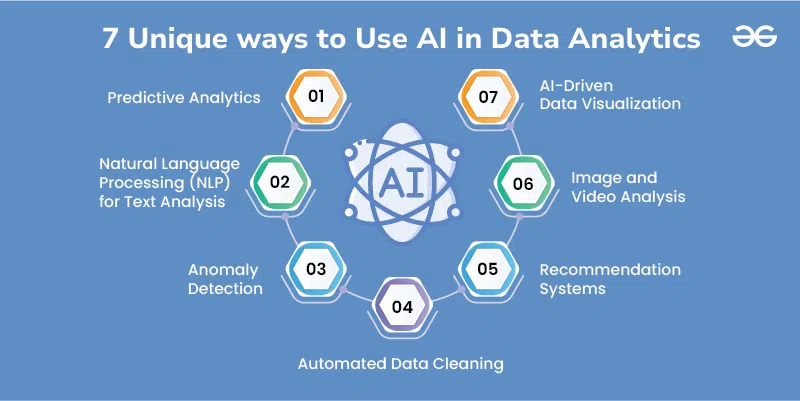
In this article, we will explore 7 Unique ways to Use AI in Data Analytics is revolutionizing data analytics, showcasing how these applications are driving efficiency and uncovering new opportunities.
7 Unique Ways to Use AI in Data Analytics
Predictive analytics uses historical data, statistical algorithms and machine learning techniques to identify the likelihood of future outcomes based on historical data.
Predictive analytics involves using historical data to make informed predictions about future events. AI enhances predictive analytics by utilizing machine learning algorithms to identify patterns and trends that might not be evident through traditional analysis.
The NLP is a branch of AI that enables machines to the understand, interpret and generate human language.
Natural Language Processing (NLP) allows AI to understand and interpret human language, making it invaluable for analyzing text data.
The Anomaly detection involves identifying unusual patterns or outliers in the data that do not conform to the expected behavior.
Anomaly detection is crucial for identifying deviations from the norm that could indicate fraud, security breaches, or other issues. AI excels in this area by processing large datasets quickly and accurately, flagging anomalies that require attention.
The Data cleaning involves correcting or removing inaccuracies and inconsistencies in the datasets to the improve data quality.
Data cleaning is a critical step in data analytics, ensuring that the data used for analysis is accurate and reliable. AI automates this process, saving time and reducing errors.
The Recommendation systems use algorithms to the suggest products, services or content to the users based on their preferences and behavior.
AI's ability to analyze user data and preferences allows for the creation of personalized recommendations, enhancing user experience and engagement.
The Image and video analysis involves the extracting meaningful information from the visual data using the computer vision techniques.
AI's ability to analyze image and video data opens up new avenues for data analytics. This capability is particularly useful in industries that rely on visual information.
The Data visualization is the graphical representation of the data to make information easily understandable.
AI-driven data visualization tools create dynamic and interactive visuals that make data easier to understand and interpret. These tools use AI to identify the most relevant data points and the best ways to visualize them.
The AI is transforming data analytics by providing the advanced tools and techniques that enable businesses to the extract deeper insights make the accurate predictions and automate complex processes. From predictive analytics and NLP to the anomaly detection and AI-driven data visualization these unique applications of the AI are helping the organizations leverage their data more effectively driving better decision-making and business outcomes.