Conversational RetrievalQA lets the LLM chat naturally while pulling facts from external documents. It remembers previous messages, handles follow-up questions and gives grounded responses, making it useful for support bots and research assistants.
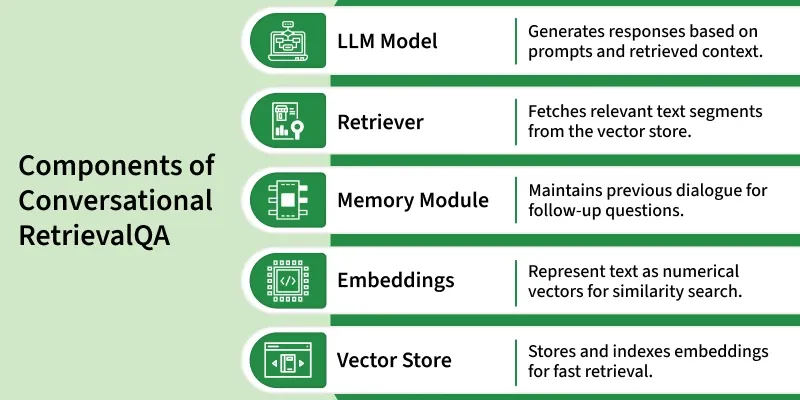
👁 components_of_conversational_retrievalqa onversational RetrievalQA Need for Conversational RetrievalQA Some of the reasons Conversational RetrievalQA is required in LangChain are:
Maintaining Context: Users often ask follow-up questions that depend on earlier responses in a conversation. Grounded Responses: The technique retrieves document-based evidence, ensuring answers remain factual and relevant. Reduced Hallucinations: Retrieval prevents the model from fabricating details or providing unsupported statements. Efficient Knowledge Access: Only the most relevant chunks are surfaced, minimizing unnecessary token processing. Enhanced User Experience: Multi-turn context enables natural and coherent dialogue. Working Working of Conversational RetrievalQA is:
User Query Input: The user asks a document-related question and the system captures it along with previous context. Embedding Generation: The query is converted into semantic embeddings that represent meaning instead of exact wording. Vector Search in Knowledge Base: These embeddings are compared with stored document vectors to fetch the most relevant text chunks. Context Assembly: Retrieved chunks are combined with recent conversation history to interpret references and maintain continuity. LLM Reasoning and Response: The LLM analyzes both the query and retrieved context to generate accurate, grounded answers. Follow-Up Question Handling: Earlier responses and referenced text remain accessible, enabling smooth, contextual follow-up responses. Continuous Context Updating: Each exchange updates the conversational memory, improving relevance over time. Implementation Step wise implementation of Conversational RetrievalQA:
Step 1: Install Required Libraries Installing LangChain for retrieval pipelines, Chroma for vector storage and Groq to access LLaMA or Mixtral models.
Step 2: Import Modules Importing required modules.
ConversationalRetrievalChain: Conversation-aware question answering Chroma: Vector database for chunk embeddings ChatGroq: Groq LLM wrapper for inference HuggingFaceEmbeddings: Generates text embeddings ConversationBufferMemory: Stores previous chats os: For environment variables like API keys Step 3: Setup Environment Setting up environment using Groq API Key, we can also use any other supported provider.
Refer to this article: Fetching Groq API Key
Step 4: Prepare Example Documents Creating a small list of text segments to simulate information storage.
Step 5: Create Embeddings and Vector Store Generating embeddings from documents and storing them inside Chroma.
Step 6: Initialize Conversation Memory Maintaining the chat history and provides continuity for follow-up questions.
Step 7: Build the Conversational Retrieval Chain Connecting the model, retriever and memory into an executable pipeline.
Step 8: Provide Queries and Run the Chain Sending the first question, followed by a related question without repeating context.
Output:
response = qa_chain({"question": "What is cloud computing?"}) Cloud computing offers scalable resources over the internet. Yes, it does. Serverless platforms automatically manage infrastructure allocation, including servers.
You can download the source code from here .
Applications Some of the applications of Conversational RetrievalQA are:
Enterprise Knowledge Assistants: Answer employee queries using policy documents while retaining context across follow-up questions. Document-Aware Chatbots: Interact with manuals, guides and legal texts conversationally without searching through long pages. Research Assistants: Provide grounded information from academic papers and technical reports quickly. Customer Support Automation: Resolve user queries using updated product knowledge bases and troubleshooting logs. Product Documentation Helpdesk: Guide users through setup and error fixes referenced from official instructions. Advantages Some of the advantages of Conversational RetrievalQA are:
Contextual Continuity: Maintains important details throughout multi-turn conversations for smoother dialogue. Data-Driven Responses: Reduces hallucination by grounding answers directly in source documents. Better User Engagement: Supports iterative questioning, making interactions feel more natural. Modular Integration: Compatible with various vector stores, memory tools and document loaders. Efficient Search: Retrieves only relevant segments, improving response speed and precision. Disadvantages Some of the disadvantages of Conversational RetrievalQA are:
Token Budget Pressure: Long chats can exceed model limits, requiring summarization strategies. Ambiguous Follow-Ups: Vague references may reduce retrieval accuracy and lead to partial answers. Embedding Overhead: Requires additional processing and storage for vector embeddings. Chunk Sensitivity: Poor chunk sizes can cause missing context or noisy retrieval.