LangChain and LangGraph are tools that help build AI workflows. LangChain works in a step by step way, while LangGraph allows more flexible paths. Both make it easier to connect AI models with data and tools to create smarter applications.
LangChain
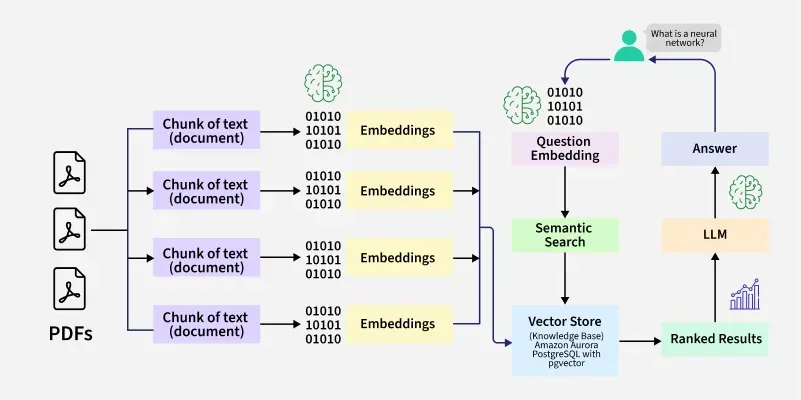
LangChain is a framework designed to connect large language models into structured workflows enabling multi step reasoning and automation.
Purpose: It simplifies building AI applications that require chaining multiple steps together such as processing user input, retrieving information and generating responses.
Structure: Uses “chains” which are sequences of operations where the output of one step becomes the input for the next, allows complex logic to be broken down into manageable components.
Applications: It's used for building chatbots, automating multi-step reasoning tasks, document retrieval and summarization and integrating LLMs with external tools or APIs.
Strengths: Straightforward to implement for linear workflows, modular so steps can be reused or swapped easily, supports integration with external tools and APIs for extended functionality.
Limitations: It can be complex to set up for multi step workflows, may face latency with large models, requires careful error handling and can be difficult to debug in long or branching chains.
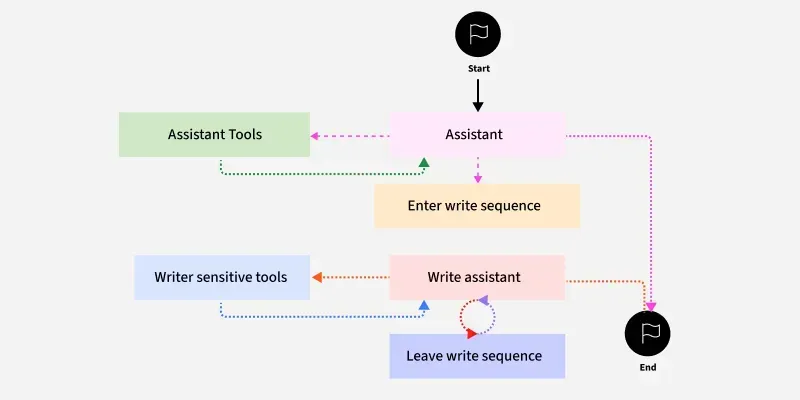
LangGraph is a framework that organizes large language models into graph based workflows enabling flexible and parallel multi step reasoning.
Purpose: It helps build AI applications where tasks can branch, loop or run in parallel allowing more complex logic than sequential chains.
Structure: Uses nodes and edges to represent operations and data flow so outputs from one node can feed multiple downstream nodes supporting dynamic decision paths.
Applications: Ideal for multi agent coordination, complex decision making pipelines, task automation with conditional logic and orchestrating multiple LLMs or tools simultaneously.
Strengths: Flexible for branching and parallel tasks, modular for reusing nodes, supports dynamic workflows and integrates easily with LLMs and external APIs.
Limitations: Can be harder to learn initially, debugging complex graphs may be challenging, may introduce latency with large or many parallel operations..