Ollama stands for (Omni-Layer Learning Language Acquisition Model), At its core, Ollama is a groundbreaking platform that democratizes access to large language models (LLMs) by enabling users to run them locally on their machines. Developed with a vision to empower individuals and organizations, Ollama provides a user-friendly interface and provides access to various models through a single point of contact.
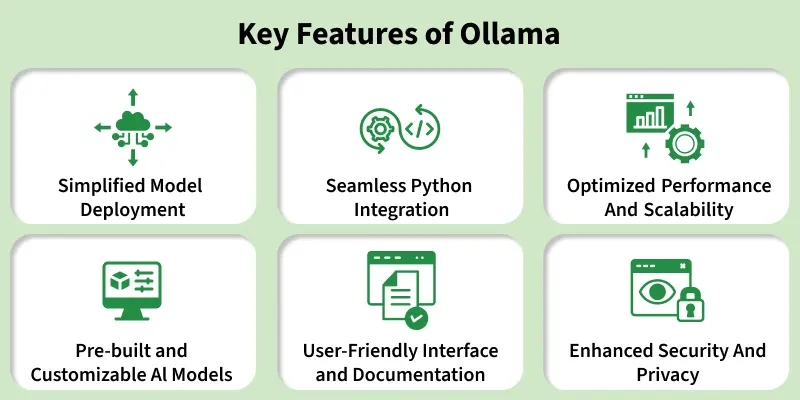
Local Execution: One of the distinguishing features of Ollama is its ability to run LLMs locally, mitigating privacy concerns associated with cloud-based solutions. By bringing AI models directly to users' devices, Ollama ensures greater control and security over data while providing faster processing speeds and reduced reliance on external servers.
Extensive Model Library: Ollama offers access to an extensive library of pre-trained LLMs, including popular models like Llama 3. Users can choose from a range of models tailored to different tasks, domains and hardware capabilities, ensuring flexibility and versatility in their AI projects.
Seamless Integration: Ollama seamlessly integrates with a variety of tools, frameworks and programming languages, making it easy for developers to incorporate LLMs into their workflows.
Customization and Fine-tuning: With Ollama, users have the ability to customize and fine-tune LLMs to suit their specific needs and preferences. From prompt engineering to few-shot learning and fine-tuning processes, Ollama empowers users to shape the behavior and outputs of LLMs, ensuring they align with the desired objectives.
Ollama enables developers to run pre-trained, open-weight language and multimodal models locally through a unified runtime and API. This eliminates the need for training models from scratch while reducing infrastructure complexity and compute costs, allowing rapid integration into applications.
LLaMA 2 : A general-purpose large language model suitable for text generation, reasoning and instruction-following tasks.
Mistral : A high-performance model optimized for efficiency and strong reasoning capabilities.
Gemma : A lightweight, instruction-tuned model designed for conversational and task-oriented use cases.
LLaVA : A multimodal model that combines vision and language understanding for image-aware interactions.
Ollama v/s Cloud based LLMs
Below are the key distinctions between ollama and cloud based LLMs:
Dimension
Ollama (Local LLMs)
Cloud-Based LLMs
Deployment Model
Runs locally on user machine or self-managed server
Creative Writing and Content Generation: Writers and content creators can leverage Ollama to overcome writer's block, brainstorm content ideas and generate diverse and engaging content across different genres and formats.
Code Generation and Assistance: Developers can harness Ollama's capabilities for code generation, explanation, debugging and documentation, streamlining their development workflows and enhancing the quality of their code.
Language Translation and Localization: Ollama's language understanding and generation capabilities make it an invaluable tool for translation, localization and multilingual communication, facilitating cross-cultural understanding and global collaboration.
Limitations of ollama
Hardware Dependency: Performance and maximum model size are strictly limited by local CPU/GPU, RAM and VRAM, making large models slow or impractical on consumer machines.
Scalability Constraints: Ollama is optimized for local usage and experimentation, not for high-concurrency, production-scale or distributed inference workloads.
Model Ecosystem Limitations: Access is restricted to supported open-source models, with no availability of frontier or proprietary models and slower adoption of the latest research releases.


.png)
