|
VOOZH | about |
|
VOOZH | about |
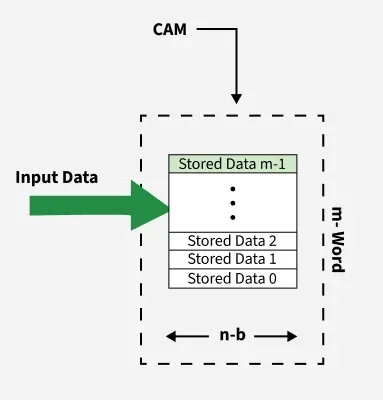
Content-Addressable Memory (CAM) is a form of memory that enables faster data retrieval by comparing incoming input to all stored values simultaneously. CAM's high-speed search capabilities is useful for application requiring higher speed such as database maintenance and network switching. CAM is comparatively better than conventional memory devices, although at a greater cost and power consumption.
It stores memory in cells. When any aspect of the memory is entered, the CAM compares the input with all the stored data. It is a high-speed technology. In CAM, memories are not arranged in chronological order and are not packed in isolated modules.
Content-addressable memory (CAM) is a silicon chip for amazingly quick yet unmistakable kinds of memory queries. Queries utilizing a CAM is theoretically like cooperative exhibit rationale in data structures yet the yield is very streamlined. At the point when the key is passed to a CAM sub-framework, it restores the related incentive to that key. Because a "key -> esteem" pair is made that can be referenced further. The most significant element is that a query of a section in a CAM can be performed in a solitary clock cycle in the silicon. A RAM module that requires various clock cycles to make a solitary memory brings a CAM cell in the chip that comprises two SRAM cells. SRAM requires broad silicon entryways to actualize that require a great deal of intensity per door for quick exchanging. In a chip, control utilization creates heat and prompts constraints on warm scattering by the restricted impression of a chip.
In multilayer switching, CAM is used for the purpose of switching frames to their destination. The switch takes care of the incoming frame source MAC address and enters it into the CAM table and stays there at 300 seconds before aging out. Generally, for security-related purposes, it is the default value. Suppose the device that is connected to the switch port moved to another port, then the switch records the incoming source MAC address, then updates the CAM table and removes its previous entry for the same MAC address.
In multilayer switches, all the matching process that ACLs provides is implemented in hardware called a TCAM. With TCAM a packet can be evaluated against an entire access list within a single table lookup. Switches use multiple TCAMs so that both inbound and outbound security and QoS ACLs can be evaluated simultaneously or entirely in parallel with layer 2 or layer 3 forwarding decisions.
There are two basic forms of CAM- Content Addressable Memory (CAM) and Ternary Content Addressable Memory (TCAM).
| CAM | TCAM | |
|---|---|---|
| 1. | The full form of CAM is Content Addressable Memory | The full form of TCAM is Ternary content addressable memory. |
| 2. | CAM performs binary operation | TCAM performs ternary operations. |
| 3. | Matches are based on 0 and 1 values and no bits are ignored | Matches are based on 0, 1, and X ( don’t care) |
| 4. | Returns a result as “HIT” | Longest match returns “HIT”. |
| 5. | It is used for MAC address lookup | It is used for lookup where not all values in the key must have an exact match |
| 6. | It is useful for layer 2 security-related VPN segregation. | It is useful for layer 3 and layer 4 classification for QoS purposes. |
| 7. | It is used in Ethernet switch | It is used in routers. |