|
VOOZH | about |
|
VOOZH | about |
Bayes Theorem explains how to update the probability of a hypothesis when new evidence is observed. It combines prior knowledge with data to make better decisions under uncertainty and forms the basis of Bayesian inference in machine learning.
Bayes Theorem describes the relationship between conditional probabilities and is mathematically expressed as:
where
For a set of mutually exclusive and collectively exhaustive hypotheses and an observation the generalized Bayes’ Theorem is given by:
where
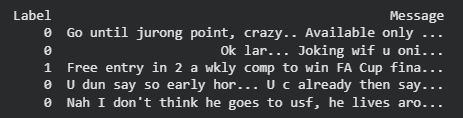
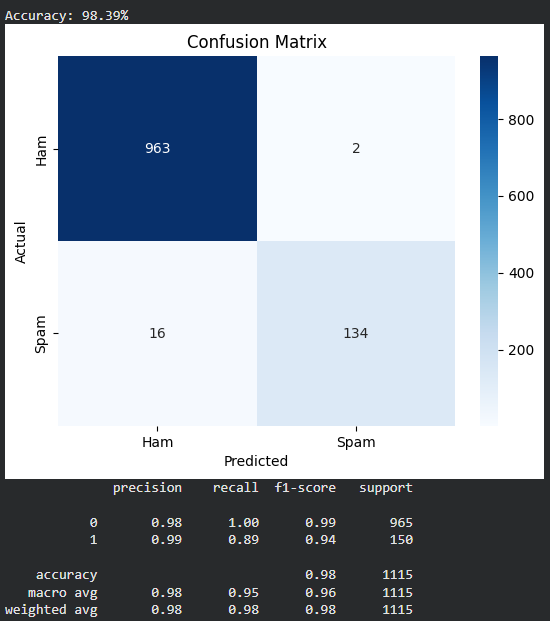
Here in this code we implements a Naive Bayes classifier that uses Bayes Theorem to compute the probability of a message being spam or ham based on word frequencies trains the model on labeled data, evaluates its performance and predicts the class of new unseen messages.
You can download dataset from here
Output:
Output:
Output:
Message: 'Congratulations! You won a free ticket.' => Prediction: Spam
Message: 'Hey, are we still meeting today?' => Prediction: Ham
You can download full code from here
Bayes Theorem ability to handle uncertainty and incorporate prior knowledge allows models to make accurate predictions even with incomplete or noisy data like:
1. Naive Bayes Classifier: It is a simple probabilistic model based on Bayes’ theorem that assumes feature independence, making it efficient and effective for tasks like text classification and spam detection.
2. Bayes optimal classifier: The Bayes optimal classifier is a theoretical model that predicts the class with the highest posterior probability for given features, representing the best possible classification accuracy. It uses Bayes’ theorem to update probabilities based on new evidence.
where
3. Bayesian Optimization: Bayesian Optimization is a technique for efficiently finding the maximum or minimum of expensive to evaluate functions using a probabilistic model often a Gaussian process. It iteratively selects the most promising points to evaluate, making it ideal for tasks like hyperparameter tuning in machine learning.
4. Bayesian Belief Networks (BBNs): Bayesian Belief Networks (BBNs) or Bayesian networks are probabilistic graphical models that represent variables and their conditional dependencies using a directed acyclic graph (DAG). They are widely applied in risk analysis, diagnostics and decision-making.