|
VOOZH | about |
|
VOOZH | about |
Transactions are fundamental operations that allow us to modify and retrieve data. However, to ensure the integrity of a database, it is important that these transactions are executed in a way that maintains consistency, correctness, and reliability even in the case of failures/errors. This is where the ACID properties come into play.
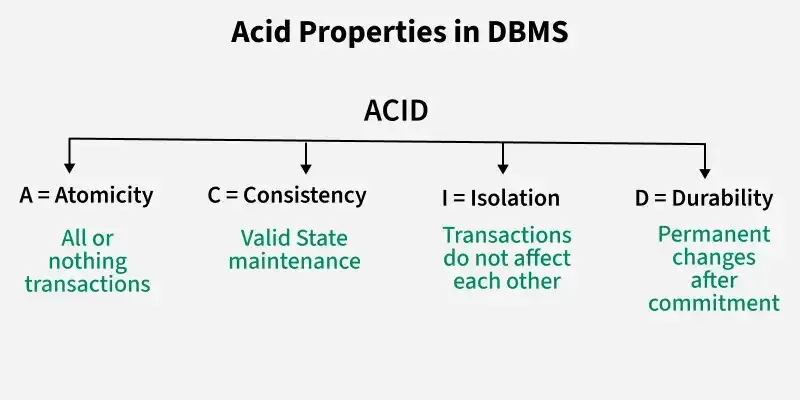
Atomicity means a transaction is all-or-nothing either all its operations succeed, or none are applied. If any part fails, the entire transaction is rolled back to keep the database consistent.
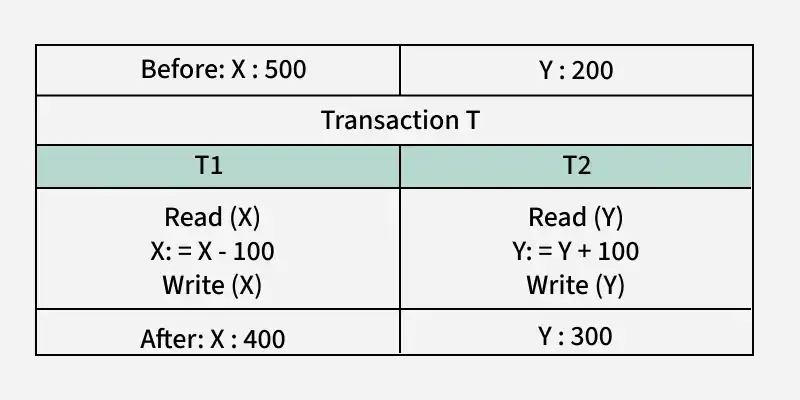
Example: Consider the following transaction T consisting of T1 and T2 : Transfer of $100 from account X to account Y .
If the transaction fails after completion of T1 but before completion of T2, the database would be left in an inconsistent state. With Atomicity, if any part of the transaction fails, the entire process is rolled back to its original state, and no partial changes are made.
Consistency in transactions means that the database must remain in a valid state before and after a transaction.
Example: Suppose the sum of all balances in a bank system should always be constant. Before a transfer, the total balance is $700. After the transaction, the total balance should remain $700. If the transaction fails in the middle (like updating one account but not the other), the system should maintain its consistency by rolling back the transaction.
Total before T occurs = 500 + 200 = 700 .
Total after T occurs = 400 + 300 = 700 .
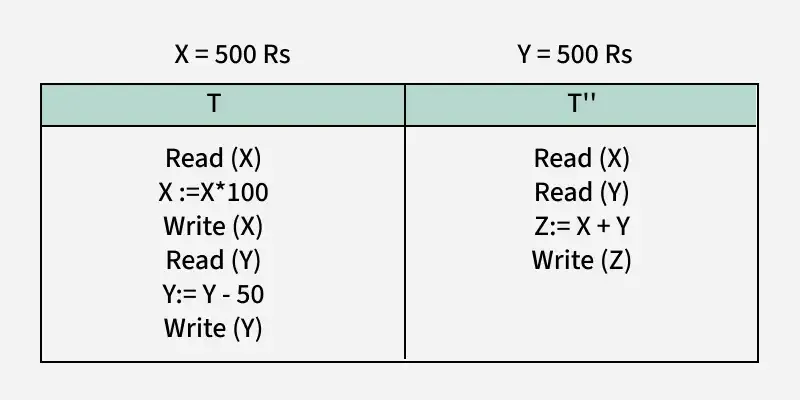
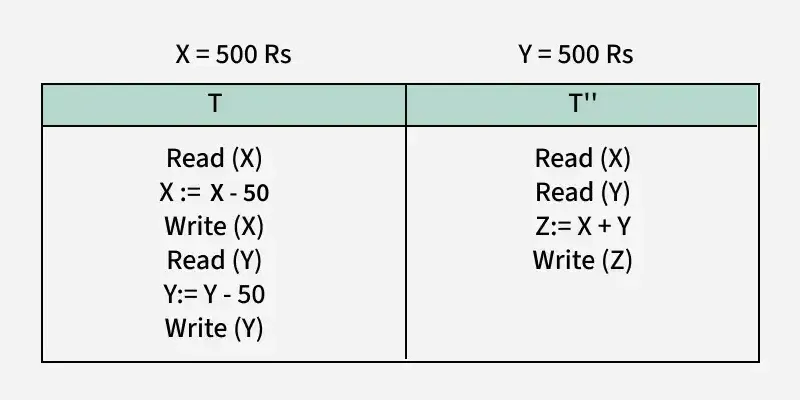
Isolation ensures that transactions run independently without affecting each other. Changes made by one transaction are not visible to others until they are committed.
It ensures that the result of concurrent transactions is the same as if they were run one after another, preventing issues like:
Example: Consider two transactions T and T''.
Explanation:
Durability ensures that once a transaction is committed, its changes are permanently saved, even if the system fails. The data is stored in non-volatile memory, so the database can recover to its last committed state without losing data.
Example: After successfully transferring money from Account A to Account B, the changes are stored on disk. Even if there is a crash immediately after the commit, the transfer details will still be intact when the system recovers, ensuring durability.
The ACID properties, in totality, provide a mechanism to ensure the correctness and consistency of a database in a way such that each transaction is a group of operations that acts as a single unit, produces consistent results, acts in isolation from other operations, and updates that it makes are durably stored.
ACID properties safeguard the data integrity of a DBMS by ensuring that transactions either complete successfully or leave no trace if interrupted. They prevent partial updates from corrupting the data and ensure that the database transitions only between valid states.
ACID properties provide a solid framework for managing concurrent transactions. Isolation ensures that transactions do not interfere with each other, preventing data anomalies such as lost updates, temporary inconsistency, and uncommitted data.
Durability ensures that even if a system crashes, the database can recover to a consistent state. Thanks to the Atomicity and Durability properties, if a transaction fails midway, the database remains in a consistent state.
| Property | Responsibility for maintaining properties |
|---|---|
| Atomicity | Transaction Manager |
| Consistency | Application programmer |
| Isolation | Concurrency Control Manager |
| Durability | Recovery |
In modern applications, ensuring the reliability and consistency of data is crucial. ACID properties are fundamental in sectors like: