|
VOOZH | about |
|
VOOZH | about |
Redundancy means having multiple copies of the same data in the database. This problem arises when a database is not normalized. Suppose a table of student details attributes is: student ID, student name, college name, college rank, and course opted.
| Student_ID | Name | Contact | College | Course | Rank |
|---|---|---|---|---|---|
| 100 | Michael | 7300934851 | GEU | B.Tech | 1 |
| 101 | David | 7900734858 | GEU | B.Tech | 1 |
| 102 | James | 7300936759 | GEU | B.Tech | 1 |
| 103 | William | 7300901556 | GEU | B.Tech | 1 |
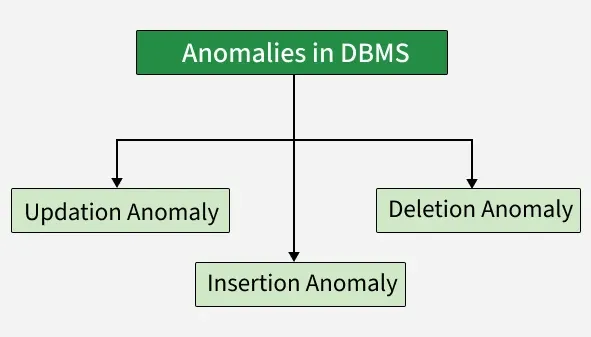
It can be observed that the values of the attributes college name, college rank, and course are being repeated, which can lead to problems. Major problems caused by redundancy are called anomalies. The following types of anomalies are caused by redundancy:
In Insertion anomaly, if a student's details have to be inserted whose course has not been decided yet, then insertion will not be possible till the course is decided for the student.
| Student_ID | Name | Contact | College | Course | Rank |
|---|---|---|---|---|---|
| 100 | Michael | 7300934851 | GEU | B.Tech | 1 |
Note: This problem happens when the insertion of a data record is not possible without adding some additional unrelated data to the record.
In Deletion anomaly, If the details of students in this table are deleted then the details of the college will also get deleted which should not occur by common sense. This anomaly happens when the deletion of a data record results in losing some unrelated information that was stored as part of the record that was deleted from a table.
Note: It is not possible to delete some information without losing some other information in the table as well.
In Updation anomaly, Suppose the rank of the college changes then changes will have to be all over the database which will be time-consuming and computationally costly. All places should be updated, If updation does not occur at all places then the database will be in an inconsistent state.
Note: Redundancy in a database occurs when the same data is stored in multiple places. Redundancy can cause various problems such as data inconsistencies, higher storage requirements, and slower data retrieval.
Note: To prevent redundancy in a database, Normalization is used, which is the process of organizing data in a database to eliminate redundancy and improve data integrity.