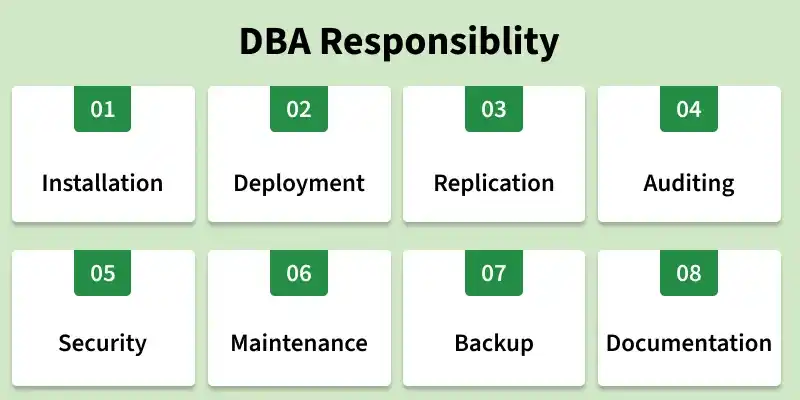
A Database Administrator (DBA) is a person responsible for managing and maintaining a Database Management System (DBMS) to ensures the database runs smoothly, securely, and efficiently.The DBA handles task include database installation, configuration, security management, user authorization, performance monitoring, backup, and recovery. And also responsible for handling capacity planning, troubleshooting, migration, and system upgrades.Overall, a DBA ensures that the database remains secure, available, consistent, and reliable for the organization.
There are different types of Database Administrators (DBAs) based on their roles and responsibilities in managing, maintaining, and securing database systems.
Administrative DBA – Manages the database server, backups, security, replication, migration, and troubleshooting to keep the system running properly.
Data Warehouse DBA – Designs and maintains the data warehouse, integrates data from multiple sources, and performs data cleaning before loading.
Cloud DBA – Manages databases hosted on cloud platforms, ensuring data security, availability, scalability, and reduced risk of data loss.
Development DBA – Develops queries, stored procedures, and database code to support application and organizational requirements.
Application DBA – Manages database components related to applications, including installation, upgrades, cloning, and data load processes.
Database Architect – Designs database schemas, tables, and overall structure based on organizational needs.
OLAP DBA – Designs and maintains multidimensional cubes for OLAP and decision-support systems.
Data Modeler – Designs data models and structures; often supports database architecture but may not always be classified as a DBA.
Task-Oriented DBA – Specializes in specific tasks such as backup and recovery, usually found in large organizations.
Database Analyst – Assists in database design and analysis; sometimes considered a junior DBA or similar to a data architect role depending on the organization.
Importance of Database Administrator (DBA)
Manages and control all three levels of DBMS architecture—internal, conceptual, and external levels.
The DBA defines the overall structure of the database and provides different views for users and applications.
They are responsible for maintaining data integrity, security, and access control, ensuring that only authorized users can access the database.
The DBA also manages user profiles, protects the system from unauthorized access, and minimizes the risk of data loss through regular backup and recovery procedures.
Duties of Database Administrator (DBA)
Hardware Selection – Chooses cost-effective and efficient hardware suitable for organizational needs.
Data Integrity and Security Management – Ensures data accuracy, maintains relationships between data, and protects the database from unauthorized access.
Database Accessibility Control – Grants user permissions and manages access rights to control who can view or modify data.
Database Design – Responsible for logical design, physical design, external model design, and enforcing integrity and security constraints.
Database Implementation – Installs and configures the DBMS and supervises database creation and data loading.