|
VOOZH | about |
|
VOOZH | about |
Specialization and Aggregation in Database Management Systems are the Enhanced Entity Relationship Diagrams also known as (EER-Diagrams). Specialization and Aggregation in the ER model are used for data abstraction in which an abstraction mechanism is used to hide details of a set of objects.
Specialization in DBMS is the concept where the major entity is further represented by dividing it into its sub-entities. A High-Level Entity is specialized into two or more two-level entities. The parameter taken into consideration while dividing the High-Level Entity is the characteristics, according to the characteristics the dividing process into sub-entities is done. The concept of Inheritance in OOP can be related to this Specialization in DBMS, the main focus is the same to divide the Parent Entity into Child or Base entities.
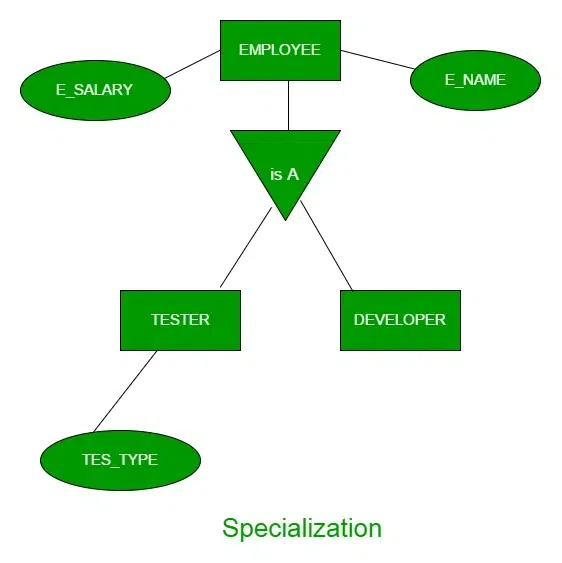
Consider an entity EMPLOYEE in an Employee management system can be specialized into DEVELOPER, TESTER, etc. as shown in the below diagram. In this case, common attributes like E_NAME, E_SAL, etc. become part of a higher entity (EMPLOYEE), and specialized attributes TES_TYPE become part of a specialized entity (dTESTER).
Below there is a Visual Representation of the above Example.
Aggregation in DBMS is the concept where the relation between 2 different entities is considered as a single entity. In Aggregation, a relationship with its adjacent entities is aggregated into a parent or high-level entity. In simpler terms, we can say that Aggregation is used to define relationships among relationships. It shows a 'has-a' or 'is-part-of' kind of relationship where one represents the whole and the other as part.
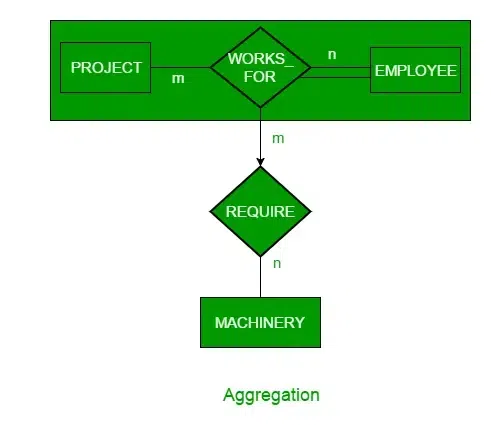
For Example, An employee working on a project requires some machinery. So, REQUIRE relationship is needed between the relationship WORKS_FOR and entity MACHINERY. By using aggregation, WORKS_FOR relationship with entities EMPLOYEE and PROJECT are aggregated into a single entity. Relationship REQUIRE is created between the aggregated entity and MACHINERY.
Below there is a Visual Representation of the above Example.
Parameter | Specialization | Aggregation |
|---|---|---|
Definition | Specialization defines as creating sub-entities with additional attributes or characteristics based on the parent or high-level entity. | Aggregation defines as combining 2 more entities to form a new entity. |
Relationship | Created Sub-Entities are the type of Higher-Level Entity. | Entities are independent and also have a relationship with the aggregated entity. |
Data Modelling | Data can be modeled using an "is-a" relationship. | Data can be modeled using a "has-a" relationship. |
Inheritance | Created Sub-Entities inherit from a parent higher-level entity. | Aggregated Entities do not possess any inheritance. |
Structure | Specialization structures a hierarchy of entities. | Aggregation does not impose any hierarchical structure. |
| Reusability | Specialized Entities can be reused in different scenarios. | Aggregated entities are designed for specific cases, so may not be reusable in other scenarios. |
| Complexity | Specialization has more complexity than Aggregation. | The aggregation has less complexity as compared to Specialization. |
Specialization and aggregation are both essential techniques in database modeling, each serving different purposes. Specialization is used to create detailed sub-entities from a general entity, enhancing data granularity and clarity. Aggregation simplifies complex relationships by combining entities into a higher-level entity, improving data modeling efficiency and integrity. Understanding the differences between these techniques allows for more effective database design and management.