|
VOOZH | about |
|
VOOZH | about |
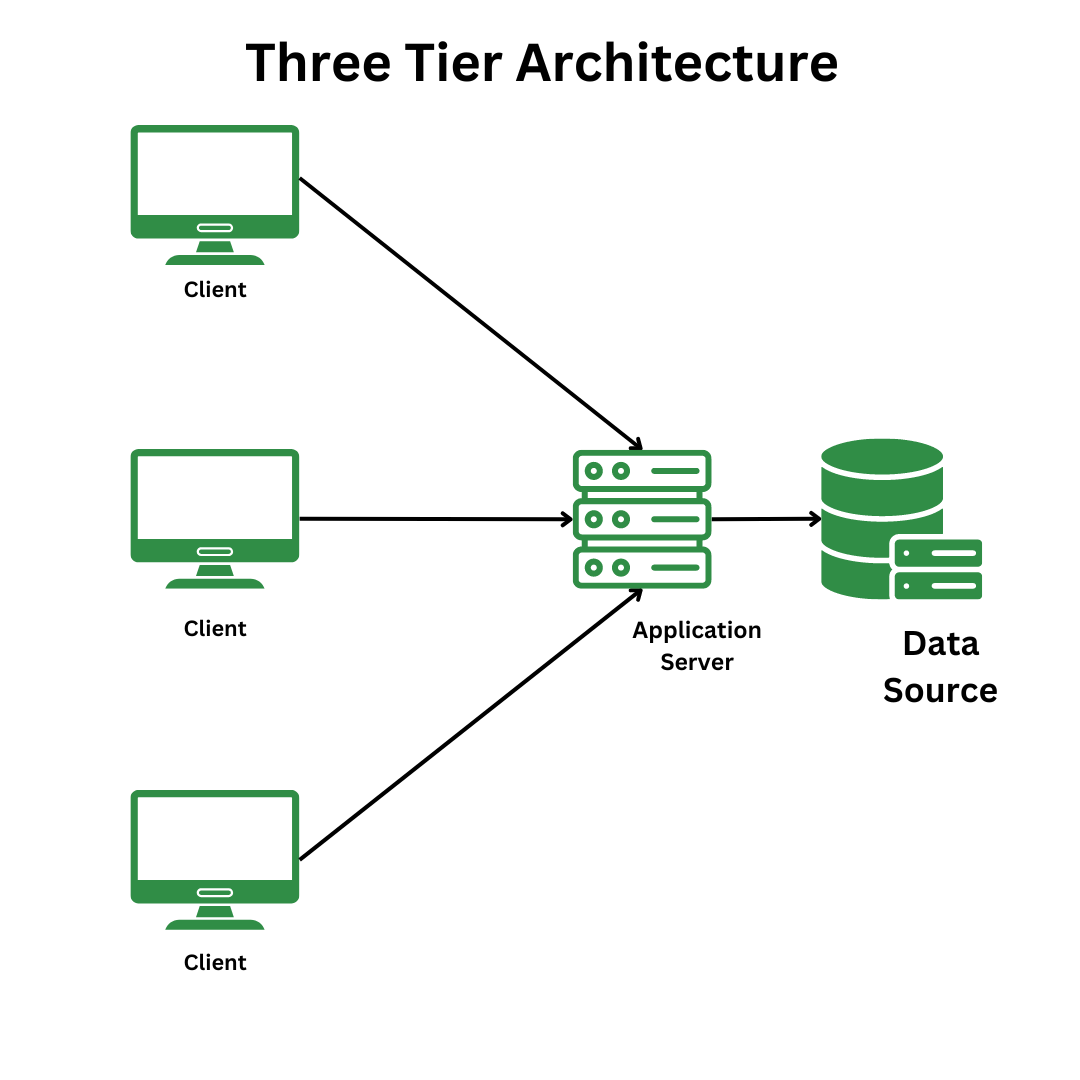
When building a system that uses a database the architecture you choose is key to how everything works together. In a Two-Tier setup, you have the user interface on one side and the database on the other with the two communicating directly. This is great for smaller simpler applications But as things get more complex a Three-Tier architecture is often better. Here there’s an extra layer in the middle like a translator where all the business logic happens making it easier to scale maintain and update the system without disrupting everything. The choice between these two depends on how big and intricate your application needs to be.
In two-tier, the application logic is either buried inside the User Interface on the client or within the database on the server (or both). With two-tier client/server architectures, the user system interface is usually located in the user's desktop environment and the database management services are usually in a server that is a more powerful machine that services many clients.
In the three-tier, the application logic or process lives in the middle tier, it is separated from the data and the user interface. Three-tier systems are more scalable, robust and flexible. In addition, they can integrate data from multiple sources. In the three-tier architecture, a middle tier was added between the user system interface client environment and the database management server environment. There are a variety of ways of implementing this middle tier, such as transaction processing monitors, message servers, or application servers.
| Two-Tier Database Architecture | Three-Tier Database Architecture |
|---|---|
| It is a Client-Server Architecture. | It is a Web-based application. |
| In two-tier, the application logic is either buried inside the user interface on the client or within the database on the server (or both). | In three-tier, the application logic or process resides in the middle-tier, it is separated from the data and the user interface. |
| Two-tier architecture consists of two layers : Client Tier and Database (Data Tier). | Three-tier architecture consists of three layers : Client Layer, Business Layer and Data Layer. |
| It is easy to build and maintain. | It is complex to build and maintain. |
| Two-tier architecture runs slower. | Three-tier architecture runs faster. |
| It is less secured as client can communicate with database directly. | It is secured as client is not allowed to communicate with database directly. |
| It results in performance loss whenever the users increase rapidly. | It results in performance loss whenever the system is run on Internet but gives more performance than two-tier architecture. |
| Example - Contact Management System created using MS-Access or Railway Reservation System, etc. | Example - Designing registration form which contains text box, label, button or a large website on the Internet, etc. |
Two Tier Architecture is straightforward with the client talking directly to the database making it great for smaller and simpler setups. Three Tier Architecture however adds a middle layer the application server which helps manage more complex tasks making the system more scalable and easier to update or secure. The choice between them boils down to the size and needs of your project. For small projects Two Tier works just fine but for larger more intricate systems like Three Tier is usually the better option.