|
VOOZH | about |
|
VOOZH | about |
Smart home systems have revolutionized residential living, offering convenience, energy efficiency, and security through interconnected devices and automation.
Behind the seamless operation of smart home systems lies a well-designed database architecture capable of managing device data, user preferences, automation rules, and security protocols. In this article, we will explore the essential principles of designing databases tailored specifically for smart home systems.
Designing a robust database for a smart home system requires careful consideration of several critical factors, including data structure, scalability, real-time processing, security, and interoperability. A well-structured database ensures efficient storage, retrieval, and management of data to support the functionality and reliability of the smart home system.
Databases for smart home systems offer a range of features designed to support device management, user profiles, automation rules, event logging, and security protocols. These features typically include:
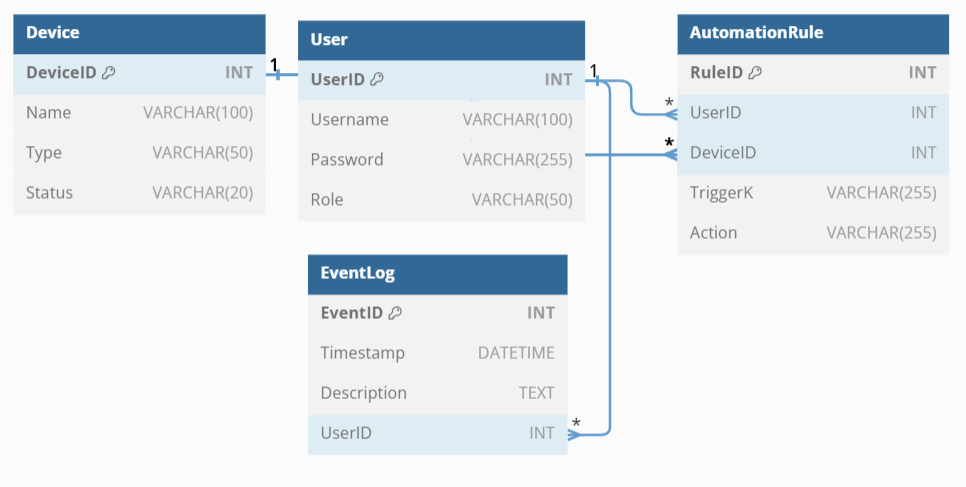
Entities in a smart home system database represent various aspects of the system, such as devices, users, automation rules, events, and security protocols, while attributes describe their characteristics. Common entities and their attributes include:
In smart home system databases, entities are interconnected through relationships that define the flow and associations of system data. Key relationships include:
Here's how the entities mentioned above can be structured in SQL format:
-- Device Table
CREATE TABLE Device (
 DeviceID INT PRIMARY KEY,
 Name VARCHAR(100),
 Type VARCHAR(50),
 Status VARCHAR(20)
 -- Additional attributes as needed
);

-- User Table
CREATE TABLE User (
 UserID INT PRIMARY KEY,
 Username VARCHAR(100) UNIQUE,
 Password VARCHAR(255),
 Role VARCHAR(50)
 -- Additional attributes as needed
);

-- Automation Rule Table
CREATE TABLE AutomationRule (
 RuleID INT PRIMARY KEY,
 UserID INT,
 DeviceID INT, -- Adding DeviceID to establish a relationship with the Device table
 Trigger VARCHAR(255),
 Action VARCHAR(255),
 FOREIGN KEY (UserID) REFERENCES User(UserID),
 FOREIGN KEY (DeviceID) REFERENCES Device(DeviceID) -- Establishing a relationship with the Device table
 -- Additional attributes as needed
);

-- Event Log Table
CREATE TABLE EventLog (
 EventID INT PRIMARY KEY,
 Timestamp DATETIME,
 Description TEXT,
 UserID INT, -- Adding UserID to establish a relationship with the User table
 FOREIGN KEY (UserID) REFERENCES User(UserID)
 -- Additional attributes as needed
);The database model for smart home systems revolves around efficiently managing devices, users, automation rules, event logs, and security protocols to support the functionality and reliability of the system.
Designing a database for a smart home system is essential for delivering a reliable, scalable, and secure user experience. By adhering to best practices and leveraging SQL effectively, developers can create a robust and scalable database schema to support device management, user profiles, automation rules, event logging, and security protocols. A well-designed smart home system database not only enhances the functionality and reliability of the system but also enables users to enjoy the benefits of convenience, energy efficiency, and security offered by smart home technology.