|
VOOZH | about |
|
VOOZH | about |
Relational Online Analytical Processing (ROLAP) is an OLAP approach that performs multidimensional analysis directly on top of relational databases. Instead of storing data in specialized multidimensional cubes, ROLAP uses relational tables-typically organized in star or snowflake schemas-to answer analytical queries.
ROLAP does not pre-compute or store aggregated data in a cube. Instead:
This approach allows real-time queries on fresh data because no cube refresh is required.
Example: Suppose a retail company with billions of daily sales transactions wants:
MOLAP cubes would take too long to rebuild, so ROLAP directly queries the relational warehouse, providing fresh, detailed analytics.
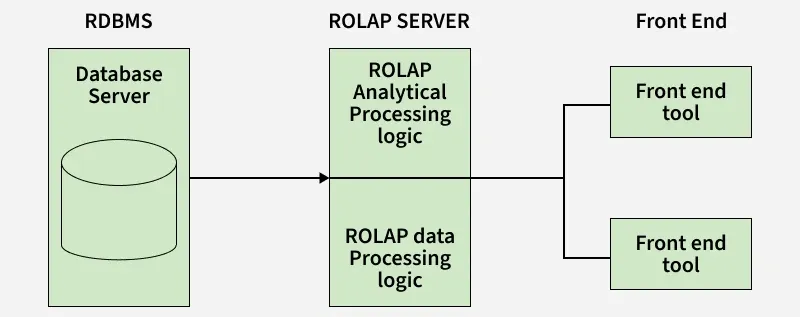
The architecture of ROLAP involves multiple components that work together to enable dynamic data analysis from relational databases. A typical ROLAP system consists of:
1. Relational Data Warehouse (fact & dimension tables)
2. ROLAP Server
3. Presentation Layer / Client Tools: Dashboards, reports, visualization tools
4. DB Optimization Layer
5. Front-End Tools: After the ROLAP server processes the query, the results are sent to the front-end tools to provide an interface for users to interact with the data.
| Advantages | Disadvantages |
|---|---|
| Highly scalable for large fact tables | Slower query response due to on-the-fly computation |
| Uses existing RDBMS infrastructure | Heavy SQL load increases database resource usage |
| No need for pre-computed cubes | High dependence on database indexing and tuning |
| Supports complex queries using SQL | Performance varies with schema design (star/snowflake) |
| Better handling of non-summarizable and detailed data | May require additional optimization techniques like partitioning |
| Easily integrates with ETL and data warehouse systems | Not ideal for real-time OLAP due to query execution overhead |