|
VOOZH | about |
|
VOOZH | about |
A Database Management System (DBMS) is software that allows users to define, store, maintain, and manage data in a structured and efficient manner. It acts as an intermediary between data and users, allowing disparate data from different applications to be managed. A DBMS simplifies the complexity of data processing by providing tools to organize data, ensure its integrity, and prevent unauthorized access or loss of data.
In today's data-driven world, DBMS are essential for applications such as banking systems, e-commerce platforms, education, and medical systems. They not only store and manage large amounts of data, but also provide functionality that provides performance, security, and scalability for multiple users with multiple access levels.
It also allows access to data stored in a database and provides an easy and effective method of:
Data theft means the illicit extraction or manipulation of sensitive information stored in databases, servers, and other storage systems. This is further defined, in DBMS, as improper access to confidential or sensitive data by unauthorized persons.
This may include information such as personal data, financial records, intellectual property, or trade secrets. As digital data storage has grown, so has the threat of data theft; it is now a primary priority concern with serious impacts on organizations worldwide.
Data theft can be carried out by, among others:
Data theft prevention is not only an issue in sensitive information matters but also for building trust between businesses and clients. Controls over access, periodic audits, real-time monitoring of activities done through the database are effective measures one could consider to reduce the risk. Also, following cyber security protocols and periodic inundation of database systems will reduce most of the vulnerabilities.
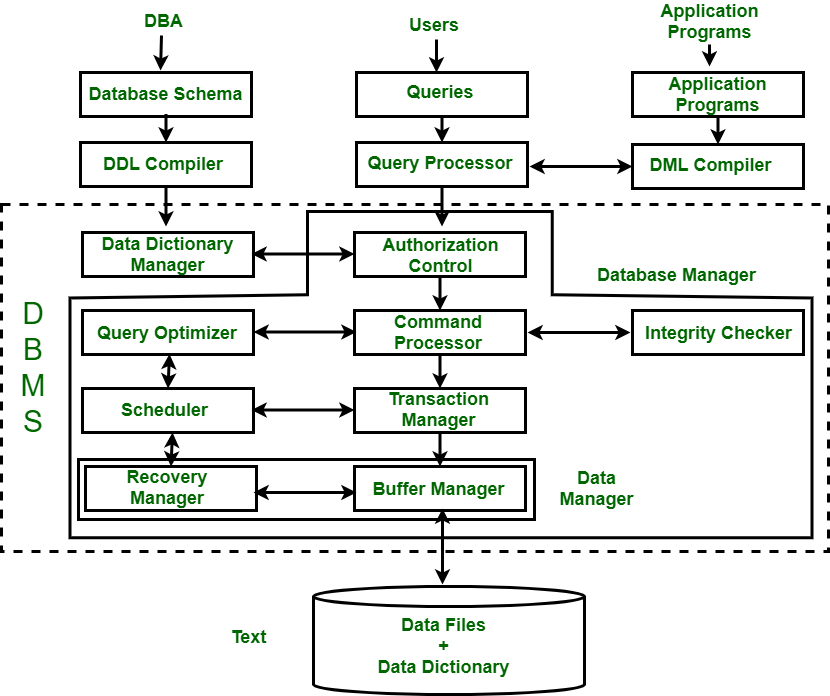
Structure of Database Management System is also referred to as Overall System Structure or Database Architecture but it is different from the Tier architecture of Database.
Query Processor, Storage Manager, and Disk Storage. These are explained as following below.
It interprets the requests (queries) received from end user via an application program into instructions. It also executes the user request which is received from the DML compiler. Query Processor contains the following components -
Storage Manager is an interface between the data stored in the database and the queries received. It is also known as Database Control System. It maintains the consistency and integrity of the database by applying the constraints and executing the DCL statements. It is responsible for updating, storing, deleting, and retrieving data in the database. It contains the following components:
It contains the following essential components:
The structure of a Database Management System (DBMS) can be divided into three main components: the Internal Level, the Conceptual Level, and the External Level.
This level represents the physical storage of data in the database. It is responsible for storing and retrieving data from the storage devices, such as hard drives or solid-state drives. It deals with low-level implementation details such as data compression, indexing, and storage allocation.
This level represents the logical view of the database. It deals with the overall organization of data in the database and the relationships between them. It defines the data schema, which includes tables, attributes, and their relationships. The conceptual level is independent of any specific DBMS and can be implemented using different DBMSs.
This level represents the user's view of the database. It deals with how users access the data in the database. It allows users to view data in a way that makes sense to them, without worrying about the underlying implementation details. The external level provides a set of views or interfaces to the database, which are tailored to meet the needs of specific user groups.
The three levels are connected via schema mapping, ensuring that changes at one level (e.g., the conceptual level) are accurately reflected in the others. This process maintains data independence, allowing changes in physical storage (internal level) without affecting the logical or user views.
In addition to these three levels, a DBMS also includes a Database Administrator (DBA) component, which is responsible for managing the database system. The DBA performs critical tasks such as:
Overall, the structure of a DBMS is designed to provide a high level of abstraction to users, while still allowing low-level implementation details to be managed effectively. By separating the physical storage, logical organization, and user views, DBMSs provide a robust framework for managing complex data while ensuring data integrity, security, and performance. This allows users to focus on the logical organization of data in the database, without worrying about the physical storage or implementation details.