|
VOOZH | about |
|
VOOZH | about |
Docker is an open-source platform for developers and sysadmins to build, ship, and run distributed applications. If we want to define and run more than one container then we should go for docker compose. We have to configure multiple container environments in a single file so that it simplifies the deployment process. In Java applications, Docker Compose sequencing the deployment of Java-based services, databases, and other components, ensuring consistency across various environments.
Table of Content
Docker in java simplifies the deployment of applications by containerizing the Java applications. It facilitates ensuring they run consistently across different environments. It allows the developers to package the application code with all its libraries, runtime, and dependencies into a single container. Through containerizing the application it brings portability, scalability, and efficient resource utilization for the Java applications.
Docker Compose is a docker-supportive native tool that facilitates defining and running multi-container applications in docker. It allows the users to configure the application services in the YAML file and manages them with simple commands. This docker composes support with simplifying the orchestration and scaling of the complex applications.
Docker Compose YAMLml file named 'docker-compose.yml'. This will be created inside the project root directory. In this, file we need to segregate all the services one after another and make dependency if needed. The following are a few terminologies we need to use in the docker-compose.yml file
environment:
 MYSQL_ROOT_PASSWORD: password
 MYSQL_DATABASE: test_db
The following table specifies on the options of docker compose with its functionalities:
| Option/Command | Description |
|---|---|
docker-compose up | It helps to builds, creates, starts, and attaches to containers for a service |
docker-compose down | It helps to stops and removes containers, networks, images, and volumes |
docker-compose build | It helps to builds or rebuilds services |
docker-compose start | It starts the existing containers for a service |
docker-compose stop | It stops the running containers without removing them |
docker-compose restart | It restarts the running containers |
docker-compose ps | It will lists containers |
docker-compose logs | It will displays the log output from services |
docker-compose exec | It executes a command in a running container |
docker-compose config | It validates and views the Compose file |
docker-compose pull | It pulls service images |
docker-compose push | It pushes the service images |
docker-compose scale | It sets the number of containers for a service |
docker-compose rm | It removes stopped service containers |
docker-compose run | It runs a one-time command against a service |
The following are the operations of docker compose:
The docker-compose up command is used to start the services defined in the docker-compose.yml file. It can also be used with the --build option to build images before starting containers.
docker-compose up --buildThe docker-compose down command is used to stop and remove the containers, networks, and volumes defined in the docker-compose.yml file. It also removes any resources created during the docker-compose up process.
docker-compose down -vservices:
app:
image: openjdk:17-jdk-slim
ports:
- 8000:8000
working_dir: /app
volumes:
- ./:/app
environment:
MYSQL_HOST: mysql
MYSQL_USER: root
MYSQL_PASSWORD: password
MYSQL_DB: test_db
mysql:
image: mysql:8.0
volumes:
- gfg-mysql-data:/var/lib/mysql
environment:
MYSQL_ROOT_PASSWORD: password
MYSQL_DATABASE: test_db
volumes:
gfg-mysql-data:
The following command is used to build the docker images specified in the docker compose file. It reads the docker compose file and build the images as per specified in the docker compse file.
docker-compose buildThe following command is used to start the services specified in the docker compose file. It reads the docker compose file and start the containers based on the configurations of the services.
docker-compose runThe following are the some of the main reasons to deploy the java application on the docker compose:
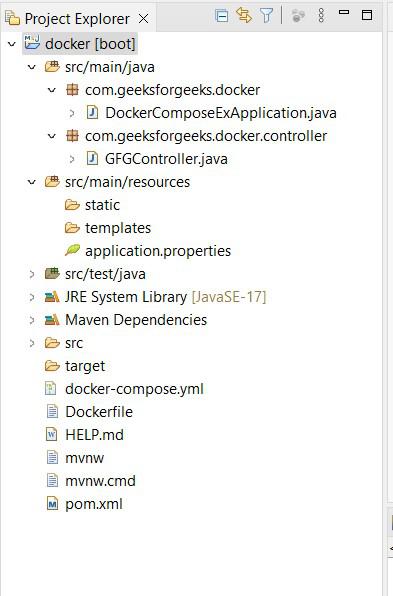
Creating a simple Java application with Docker Compose. In this example, we'll create a simple Spring Boot application. Its having get API, and it provides some sample message like "Geeks For Geeks Docker Compose Example".
Step1: Create a Spring Boot Application
Step2: Create GFGController.java
Step 3: Change Port (Optional)
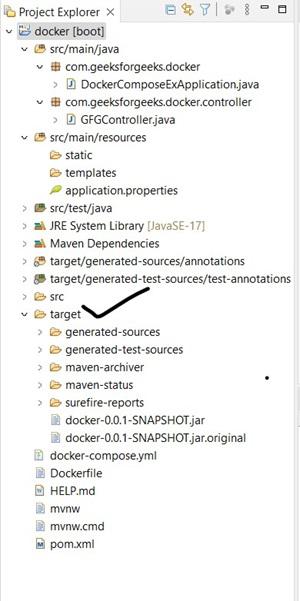
server.port=8081Step 4: Build the Spring Boot Application
Right click on project -> Run as -> maven clean
Right click on project -> Run as -> maven install
Step 5: Create a Dockerfile
FROM openjdk:17-jdk-slim
ARG JAR_FILE=target/*.jar
COPY ${JAR_FILE} app.jar
ENTRYPOINT ["java", "-jar", "/app.jar"]
Step 6: Create Docker Compose File
version: '3'
services:
 myapp:
 build: .
 ports:
 - "8081:8081"
Step 7: Build and Run the Docker Container
# Build the Docker image
docker-compose build
# Run the Docker container
docker-compose up
Note: If you want to build and run your image with single command then use "docker-compose up --build".
👁 docker compose buildStep 8: Access the Application
The docker-compose.yml file easy the process of managing and deploying multiple container applications. Instead of using multiple "docker run" commands with various configurations, we can define everything in a single file. This makes it simplify to share and reproduce application stack across different environments.