|
VOOZH | about |
|
VOOZH | about |
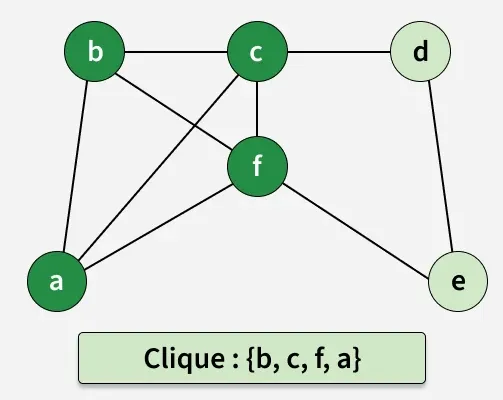
A clique in an undirected graph is a set of vertices where every pair of distinct vertices is connected, forming a complete subgraph.
Cliques are a fundamental concept in graph theory with applications in social networks, bioinformatics, and optimization. The Maximum Clique problem, which aims to find the largest clique in a graph, is NP-complete, making it computationally challenging.
The Max-Clique problem analysis is a non-deterministic algorithm. In this approach, we first try to find a collection of k different vertices, and then we see if these vertices form a complete graph. This issue cannot be solved using a polynomial-time deterministic method. This is an NP-Complete issue.
To discover a maximum clique, one can scan all subsets methodically, but this brute-force search is extremely time-consuming for large graphs.
A maximal clique of a graph G is a clique that cannot be enlarged. The clique number ω(G) is the number of vertices in the graph's greatest clique. A k-clique is a clique of size k, where 0-cliques represent the empty set, 1-cliques represent vertices, 2-cliques represent edges, and 3-cliques represent 3-cycles.
A graph G's clique polynomial is defined as
where is the number of cliques of size k, with equal to the vertex count of G, equal to the edge count of G, etc.
Example 1 (Clique):
All vertices A,B,C,D are directly connected to each other, so the graph forms a complete graph, which is a clique.Example 2 (Not a Clique):
Vertices A,B,C form a clique, but adding D breaks completeness since D is not connected to all others, so the entire graph is not a clique.Example 3 (Graph with Two Cliques):
{A,B,C,D} is one clique and {X,Y,Z} is another clique; they are connected by a single edge but remain separate cliques.
The clique problem involves locating cliques in a graph. Common formulations include:
Most variants are computationally difficult. The decision version is NP-complete, and listing all maximal cliques may take exponential time.
A simple greedy method starts with a vertex and grows the clique by adding vertices that are adjacent to all current clique members. For each vertex v examined by this loop, add v to the clique if it is near to every vertex currently in the clique, else dismiss v. This algorithm is linear in time and finds a maximal clique, not necessarily a maximum clique.
Using a brute force technique, one can test whether a graph G contains a k-vertex clique by examining all subgraphs with k vertices. There are O(nk) such subgraphs, and each requires checking O(k2) edges, resulting in O(nk k2) time complexity. When k is fixed, the problem is solvable in polynomial time. If k varies with the input, the time complexity becomes exponential.
In graph theory, a clique is a subset of vertices where every two vertices are directly connected. Cliques have several important applications:
Social Network Analysis: Cliques help identify close-knit groups in social networks, such as circles of friends or professional connections. They are used for community detection and influence analysis.
Bioinformatics: In protein-protein interaction networks, cliques represent protein complexes. In gene expression networks, they help identify groups of genes that are co-expressed, indicating potential functional relationships.
Computer Vision: Cliques are used in object recognition by analyzing feature-matching graphs. They also assist in image segmentation by grouping similar pixels or regions together.
Data Mining: In market basket analysis, cliques help find sets of items frequently purchased together. They are also used in fraud detection, where tightly connected fraudulent activities can be identified.
Question 1: How does one locate a clique in a graph?
Answer:
To locate a G clique:
Let's say G has n vertices.
Find the minimum feasible degree vertex v in G.
If v has a degree of n 1, stop; G is a clique, and the greatest clique in G has a size of n.
Otherwise, delete v as well as all of its edges from G. In the smaller graph, find the greatest clique.
Question 2: What is the number of cliques in a graph?
Answer:
A full graph is commonly referred to as a clique. The clique number of G is the size of the largest clique that can be formed from G's edges and vertices. The penultimate assertion preceding these definitions may consequently be written as follows: a graph's coloring number is at least its clique number.
Question 3: Is it possible for a graph to have several cliques?
Answer:
If the complement is bipartite, the graph may be partitioned into two sets U and V, with no edge linking vertices from the same set. This indicates that these sets U and V are totally related in the original graph. As a result, the original graph may be partitioned into two Cliques.
Question 4: How many 2-cliques (edges) are there in a graph with edges AB, AC, AD, BC?
Answer:
The graph has 4 edges, which each represent a 2-clique. Thus, there are 4 2-cliques.