|
VOOZH | about |
|
VOOZH | about |
Pareto distribution is a continuous probability distribution named after the Italian economist Vilfredo Pareto, who introduced the concept in 1897 while studying the distribution of wealth.
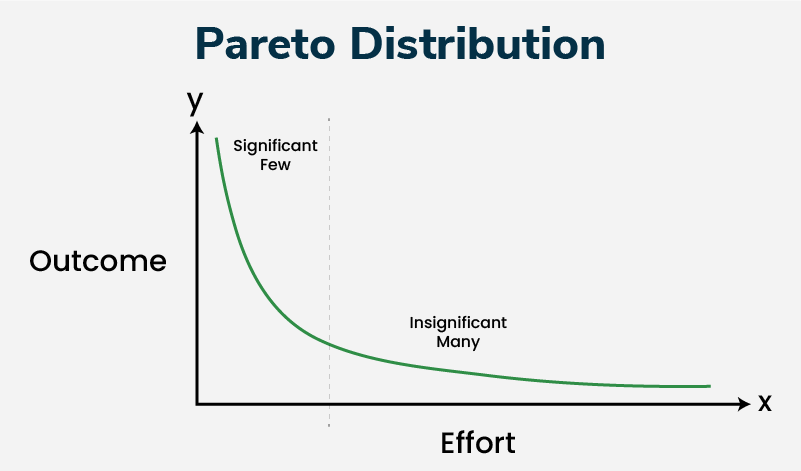
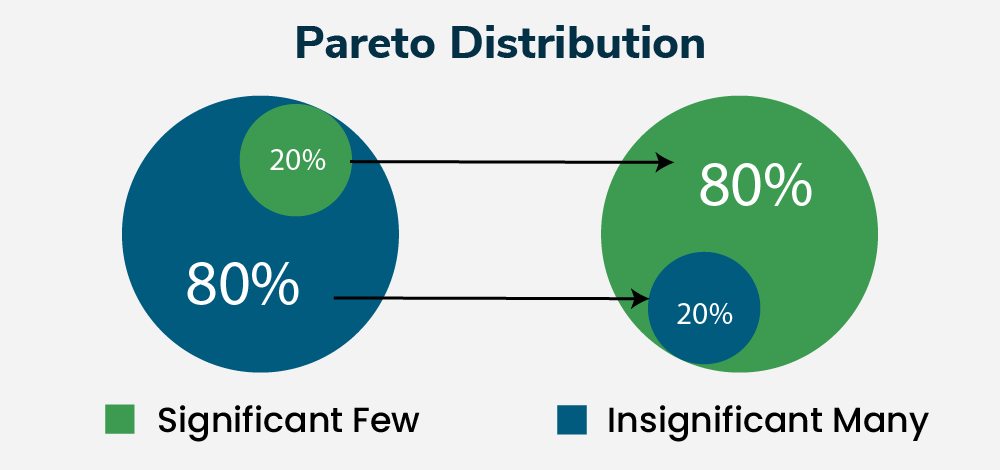
It is widely known for modelling phenomena where a small proportion of occurrences account for the majority of the effect. The distribution is often linked to the Pareto Principle, also called the 80/20 rule, which states that roughly 80% of effects come from 20% of causes.
Some Examples of Pareto Distribution Includes:
- In many economies, the Pareto principle applies to wealth distribution. A small percentage of individuals control a large portion of the total wealth.
- The distribution of internet traffic follows a Pareto distribution. A small number of websites receive a majority of the traffic. For instance, websites like Google, Facebook, and YouTube account for the majority of web traffic, while the majority of smaller websites receive only a fraction of the total.
- The population sizes of cities often exhibit a Pareto distribution. A few large cities (like London, New York, or Tokyo) contain a significant portion of the total population, while most cities are relatively small.
Table of Content
Key Properties of Pareto Distribution are discussed below:
The probability density function of a Pareto distribution is given by:
Where:
The PDF shows that for higher values of α\alphaα, the distribution decays faster, meaning that extreme values are less probable.
The cumulative distribution function is the probability that the variable X is less than or equal to a value xxx. It is expressed as:
This shows the proportion of values less than or equal to x.
A common application of the Pareto distribution is in the Pareto principle, or the 80/20 rule, which states that roughly 80% of effects come from 20% of the causes. This is a consequence of the skewed nature of the Pareto distribution, where a small proportion of occurrences contributes disproportionately to the total outcome.
Que 1. Suppose a random variable X follows a Pareto distribution with shape parameter α = 3α and scale parameter xm = 2. Find the mean of the distribution.
The mean E(X) of a Pareto distribution is given by:
Substitute the given values α = 3 and xm = 2:
Thus, the mean of the distribution is 3.
Que 2. Find the mean of a Pareto distribution with parameters α = 3 and xm = 2.
Solution:
Use the mean formula: Mean
Mean =Thus, Mean = 3
Que 3. Suppose X follows a Pareto distribution with shape parameter α = 2 and scale parameter xm = 1. What is the probability that X ≥ 3?
The cumulative distribution function (CDF) of the Pareto distribution is:
We are looking for P(X ≥ 3). This is given by:
P(X ≥ 3) = 1 − P(X < 3) = 1 − F(3)
F(3) = 1 − (1/3)2 = 1 − 1/9 = 8/9So, P(X ≥ 3) = 1 − 8/9 = 1/9
Thus, the probability that X ≥ 3, or approximately 0.1111.
Q 1. A random variable X follows a Pareto distribution with shape parameter α = 4 and scale parameter xm = 3. Find the mean of the distribution.
Q 2. If X follows a Pareto distribution with shape parameter α = 2.5 and scale parameter xm = 1, what is the probability that X ≥ 5?
Q 3. Let X follow a Pareto distribution with α = 3.5 and xm = 7. Find the variance of the distribution.
Q 4. If X follows a Pareto distribution with shape parameter α = 5 and scale parameter xm = 2, find the probability density function (PDF) of the distribution.
Q 5. Consider a country where the income follows a Pareto distribution with shape parameter α = 1.7 and scale parameter xm = 1200. What proportion of the population holds 90% of the wealth?
Pareto distribution helps explain how in many areas of life, a small number of things have a large impact. Whether it's wealth, internet traffic, or natural disasters, a few big events or individuals often dominate the outcomes.
Read More,