IoT devices are widely used across homes, industries and infrastructure, but weak security design makes them easy targets for attackers. Limited resources and poor maintenance further increase their exposure to cyber threats.
Wide deployment across environments increases exposure to attacks.
Limited processing power restricts strong security implementation.
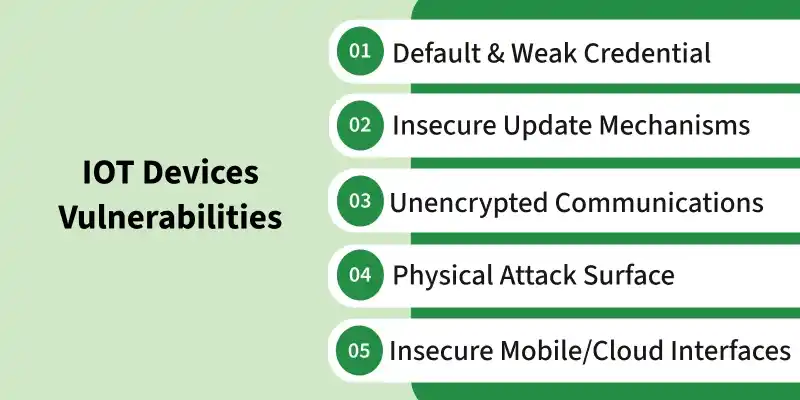
Devices often come pre-configured with factory-default usernames and passwords (e.g., admin/admin), hardcoded credentials embedded in firmware or other easily guessable login details. In many cases, all units of a particular model share the same default credentials.
This represents the most common and straightforward way for attackers to gain unauthorized administrative access. Automated tools and botnets-such as Mirai-routinely scan the internet to exploit devices using these default or weak credentials.
Attackers use automated brute-force and credential-stuffing attacks to guess or try default passwords, allowing them to log into web interfaces, SSH/Telnet services or APIs. Once inside, they can take control of the device, install backdoors, move laterally within networks or steal sensitive data.
2. Insecure update mechanisms
Firmware updates are vulnerable if devices accept them without verifying cryptographic signatures or over unauthenticated channels (e.g., HTTP).
Attackers who can spoof update servers or intercept update traffic can deliver malicious firmware images.
Malicious firmware runs with high privileges, allowing persistent backdoors, altered device behavior, data theft or device bricking.
Common attack methods include man-in-the-middle (MITM) attacks, compromised update servers or placing malicious updates on unsecured repositories.
3. Unencrypted communications
Management, telemetry or API traffic is often sent without encryption or with weak cryptography (e.g., no TLS/DTLS).
Tokens, credentials and sensitive data are transmitted in plaintext and can be intercepted.
Attackers on the same network or anywhere along the data path can eavesdrop on this traffic.
They can steal authentication tokens or credentials to gain unauthorized access.
Attackers may replay intercepted messages or inject malicious commands to hijack device sessions.
4. Physical attack surface
Devices often have exposed debug interfaces (e.g., UART, JTAG) and removable storage.
Physical access allows attackers to connect directly to these interfaces.
Attackers can extract sensitive information such as encryption keys or credentials.
Firmware can be read, dumped or modified to insert backdoors or malware.
Bootloader or system software can be altered to bypass normal security checks.
Physical compromise bypasses network security, making it a critical risk to address.
5. Insecure mobile/cloud interfaces
Mobile apps and cloud backends managing IoT devices may have weak authentication and session handling.
Server-side authorization flaws like IDOR allow attackers to access or control other users’ devices.
Compromising cloud accounts via credential stuffing can grant broad device access.
API traffic interception can be used to replay or manipulate device commands.
Cloud and app vulnerabilities often pose a greater risk than device-level security issues.
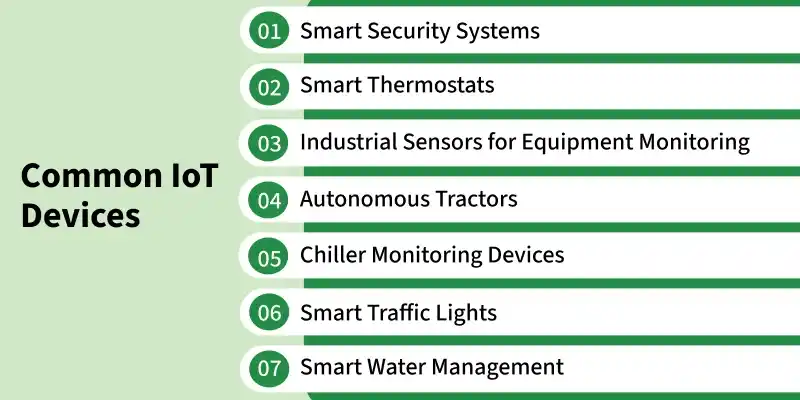
Common IoT Devices
While some connected devices are expected, others may carry hidden vulnerabilities that introduce security and privacy risks. Below are some of the most common IoT devices used across industries today and how they are transforming operations.
IoT-enabled security solutions connect cameras, alarms and sensors into a centralized system. While highly effective for deterring threats, these systems are also prime targets for hackers if devices are left unsecured. Capabilities include:
Real-time alerts when motion or unusual activity is detected
Automated responses such as locking doors or switching on lights
Remote monitoring via mobile apps or dashboards
2. Smart Thermostats
Smart thermostats help organizations manage building temperatures more intelligently. By connecting to the cloud, they:
Enable remote monitoring and control
Allow scheduling of heating/cooling cycles
Reduce energy costs while maintaining comfort
Generate analytics that support long-term sustainability goals
3. Industrial Sensors for Equipment Monitoring
Industrial IoT (IIoT) sensors are critical for monitoring machinery and production environments. These sensors optimize performance, improve safety and extend equipment lifespan. They provide:
Predictive maintenance to reduce breakdowns and downtime
Quality assurance by detecting product defects in real time
Environmental monitoring (temperature, humidity, air quality) for optimal operations
Asset tracking to locate equipment and vehicles across facilities
4. Autonomous Tractors
This automation drives productivity and sustainability but requires strong safeguards against hacking that could disrupt food supply chains. IoT-enabled autonomous tractors are modernizing agriculture by:
Using telematics to detect mechanical issues early
Gathering soil and crop data to improve yields
Reducing labor needs, as one operator can manage multiple machines
5. Chiller Monitoring Devices
Connected chillers help facilities manage HVAC and cooling systems more efficiently. Benefits include:
Continuous performance monitoring
Early detection of refrigerant leaks or mechanical issues
Reduced energy consumption through optimized operation
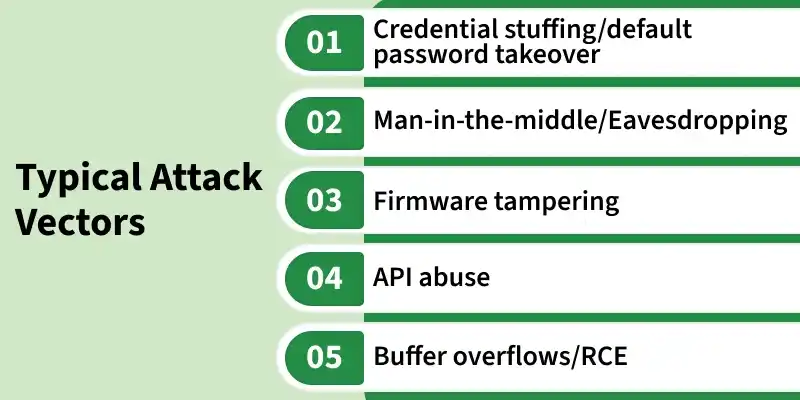
Attackers use leaked or default passwords to gain unauthorized access to IoT device interfaces such as SSH or web dashboards. Once compromised, devices can be remotely controlled, monitored or used in larger cyberattacks.
Enforce strong and unique passwords for all devices.
Enable multi-factor authentication (MFA) for admin access.
Block repeated failed login attempts using security monitoring.
2. Man-in-the-Middle (MITM) / Eavesdropping
Attackers intercept unencrypted network traffic to steal credentials, tokens or sensitive device communications. They may also modify commands in transit to hijack or manipulate connected devices.
Secure communications using TLS/SSL encryption.
Avoid sending sensitive information in plain text.
Regularly update encryption protocols and certificates.
3. Firmware Tampering
Attackers modify firmware files to insert malware, backdoors or hidden malicious functionality into devices. Compromised firmware can provide persistent access and weaken overall device security.
Use digitally signed firmware updates.
Verify firmware integrity before installation.
Allow updates only from trusted sources.
4. API Abuse
Weakly secured APIs can allow attackers to access device data or remotely control connected systems without authorization. Poor authentication and exposed endpoints increase the risk of large-scale device compromise.
Implement strong authentication and authorization controls.
Use secure token management for API sessions.
Apply rate limiting to prevent automated attacks.
5. Buffer Overflows / Remote Code Execution (RCE)
Software vulnerabilities like buffer overflows allow attackers to execute malicious code remotely on IoT devices. Successful exploitation can provide full system access and enable malware deployment.
Validate and sanitize all incoming input data.
Regularly patch software vulnerabilities and bugs.
Implement runtime memory protection mechanisms.
Real World Examples: IoT Devices Vulnerability
Here are five real-world examples of IoT device vulnerabilities that have had significant security implications:
1. Owlet Wi-Fi Baby Heart Monitor (2016)
The Owlet Baby Heart Monitor was found to transmit unencrypted data over WiFi, exposing sensitive information to potential interception. This raised concerns about the security of baby monitors and similar IoT devices.
2. Ring Home Security Cameras (2019)
Hackers gained unauthorized access to Ring's home security cameras, viewing live footage and communicating with residents. This breach was attributed to weak or reused passwords and highlighted the importance of strong authentication measures for IoT devices.
3. Nortek Linear eMerge E3 Access Control System (2019)
Researchers identified multiple vulnerabilities in Nortek's access control system, allowing attackers to hijack credentials, install malware and launch DoS attacks. These flaws underscored the need for secure design and regular updates in IoT-based security systems.
OWASP IoT Resources
Here are some ways you can make good use of OWASP IoT resources:
Security design phase: Use the IoT Top 10 + ISVS as a checklist while designing a new device/product. Ensure default credentials are secure, have a firmware update plan, etc.
Development & Firmware: Use FSTM to test firmware code. Use IoTGoat as a test bed to train teams or try breaking vulnerabilities in a safe environment.
Testing & Audits: Use the ISTG to run penetration tests, the guide includes test cases and methodologies so you don’t miss common weak spots.
Vendor evaluation / procurement: If you procure IoT devices, require compliance / reports based on ISVS or similar standards so you have assurance of the vendor’s security practices.
Operational security: For already deployed devices, use ISTG and Top 10 to audit existing installations (check for weak passwords, firmware versions, etc.), monitor for vulnerabilities and ensure update mechanisms work.
NIST SP 800-213-IoT Device Cybersecurity Guidance
NIST Special Publication 800-213, titled "IoT Device Cybersecurity Guidance for the Federal Government, Establishing IoT Device Cybersecurity Requirements", provides comprehensive guidance for federal agencies to securely integrate Internet of Things (IoT) devices into their information systems.
Secure IoT Integration: Guidance for deploying IoT devices securely within organizational systems.
Device Cybersecurity Requirements: Defines the technical and operational capabilities devices should support.