Capture The Flag competitions are practical cybersecurity challenges designed to help participants develop real-world security skills in a safe and legal environment. Players solve tasks from different security domains and submit flags to earn points. CTFs are widely used for learning, skill development and hands-on practice in cybersecurity.
Encourages critical thinking and problem-solving
Helps improve technical and analytical skills
Suitable for beginners as well as experienced learners
Provides exposure to real-world security scenarios
Common flag format: flag{example_flag_here}
Types of CTF
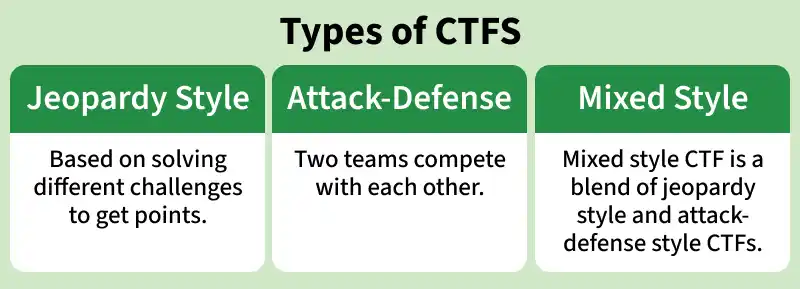
CTF competitions are generally divided into two major formats:
Jeopardy-style CTFs are the most beginner-friendly format. In this type of competition, participants select challenges from different categories and solve them independently to capture flags.Common challenge categories include: Web Exploitation, Cryptography, Reverse Engineering etc.
2. Attack-Defense CTF
In Attack-Defense CTFs, teams are divided into Red Team (Attacks opponents systems) and Blue Team (Defends their own infrastructure). This format simulates real-world cyber warfare and enterprise defense scenarios.Teams perform tasks such as:
Securing their own systems
Identifying and patching vulnerabilities
Launching attacks on opposing teams
Capturing flags from competitors
Skills Required to Start CTFs
Getting started with CTF competitions does not require expert-level hacking skills. As you progress, your skills naturally improve through practice and hands-on challenges.
Here’s a quick glossary of common terms you’ll encounter in CTFs:
Flag: A hidden string proving that a challenge was solved. Example: flag{you_found_me}.
Payload: Code or data sent to a system to trigger a specific action or exploit.
Shell: A command-line interface used to control a system remotely.
Reverse Shell: A shell connection where the target machine connects back to the attacker’s machine.
Buffer Overflow: A vulnerability caused by writing excessive data into memory.
Base64: A text encoding method used to represent binary data in text format.
Brute Force: Trying every possible password or key until one works.
Port Scanning: The process of discovering open ports and services on a machine.
Obfuscation: The technique of making code or data difficult to understand.
Hash: A fixed-length digital fingerprint of data. MD5, SHA-1, SHA-256.
Benefits To Participate in CTFs
Hands-On Learning: You learn by solving real-world security problems instead of only studying theory.
Improves Problem-Solving: CTFs train you to think creatively and analytically under pressure.
Builds Cybersecurity Experience: Many challenges simulate actual vulnerabilities used in real cyberattacks.
Helps Build a Portfolio: Strong CTF performance can improve Resumes, GitHub profiles, Cybersecurity portfolios.
Networking Opportunities: You meet Security researchers, Students, Ethical hackers, Industry professionals.
Career Advantages: CTF experience is valuable for careers in Penetration Testing, Security Research, Malware Analysis, Incident Response, Application Security.