|
VOOZH | about |
|
VOOZH | about |
Cyber threats are evolving rapidly and traditional security tools struggle to keep up. Security Orchestration, Automation, and Response (SOAR) is transforming cybersecurity by automating everyday work by correlating security tools like SIEM, XDR, firewall, and endpoint protection, SOAR also accelerates the incident response. As cyberattacks increased by 300% in the last few years, businesses need a good security solution—this is where SOAR comes into the picture.
By reducing alert fatigue, automating processes, and enhancing threat intelligence, SOAR allows the Security Operations Centers (SOCs) to respond more rapidly and with greater effectiveness. Those organizations implementing SOAR solutions realize 50% faster threat detection and up to 80% improved operational efficiency.
This article will break down the basics of SOAR, how it differs from SIEM and XDR, key benefits, uses, and how to implement it. You are in search of a solution that can enhance your security stance and reduce Mean Time to Detect (MTTD) and Mean Time to Respond (MTTR), and SOAR is that solution.
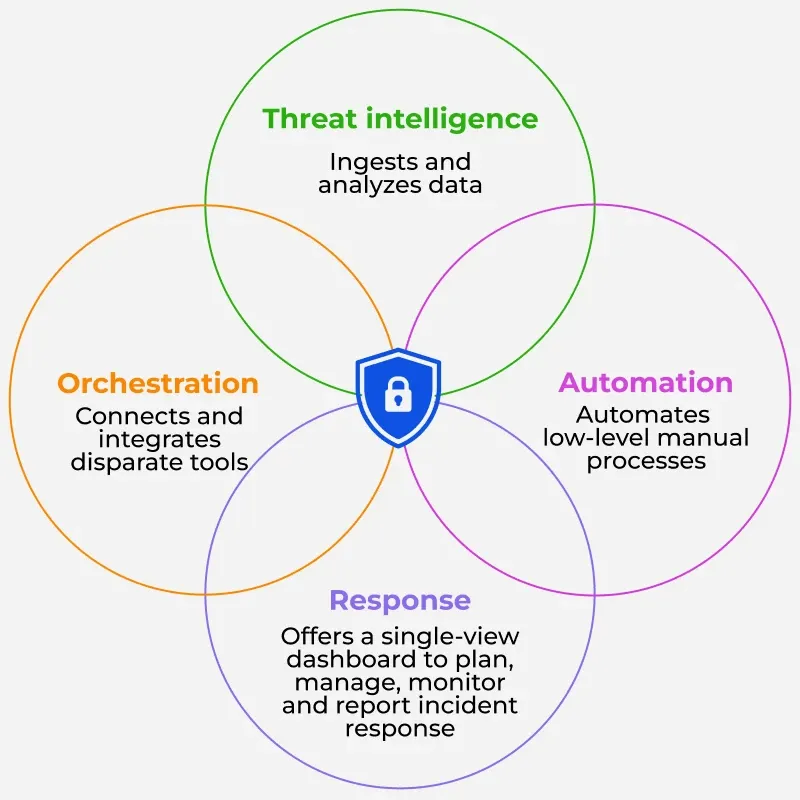
SOAR refers to Security Orchestration, Automation, and Response, and it is a security platform that integrates SIEM (Security Information and Event Management), firewalls, XDR (Extended Detection and Response), endpoint protection, and threat intelligence systems to automate security operations and incident response features and simplify overall security operations. SOAR includes three significant functions:
Automation and Orchestration are two words that are used in cybersecurity scenarios together but with different roles to fulfill in security operations.
Security Automation: This refers to the execution of regular security tasks without any human intervention. It uses scripts, AI-driven workflows, and SOAR playbooks to recognize and respond automatically to threats
Security Orchestration: This refers to the process of bringing together multiple security tools (e.g., SIEM, XDR, firewalls, threat intelligence platforms) to operate in unison. Orchestration helps synchronize automated responses across different layers of security for faster and more effective threat response.
| Feature | Security Automation | Security Orchestration |
|---|---|---|
| Purpose | Automates repetitive security tasks like scanning, blocking, and alerting | Connects and coordinates multiple security tools for a unified response |
| How It Works | Uses scripts, AI-driven workflows, and SOAR playbooks | Integrates SIEM, XDR, firewalls, and threat intelligence platforms |
| Example Use Case | Automatically blocks a phishing email | Combines SIEM logs, firewall data, and threat intelligence to detect and respond to cyber threats |
| Human Involvement | No manual intervention required | Requires initial configuration and monitoring |
| Impact on Incident Response | Reduces MTTD (Mean Time to Detect) | Reduces MTTR (Mean Time to Respond) by streamlining workflows |
| Efficiency Boost | Reduces workload on SOC teams | Enhances coordination between security solutions |
| Best Use Case | Handling routine security tasks (e.g., malware scanning) | Managing complex security workflows involving multiple tools |
For more details refer the article: Automation vs Orchestration
SIEM (Security Information and Event Management) is an information security tool that collects, analyzes, and monitors security events logs throughout an organization's network. It helps detect threats, forensics of security logs, and compliance rule handling.
Note: While SIEM focuses on threat detection, SOAR automates security responses to improve efficiency and reduce mean time to detect (MTTD) and mean time to respond (MTTR).
SIEM (Security Information and Event Management), XDR (Extended Detection and Response), and SOAR (Security Orchestration, Automation, and Response) are applied by all organizations together in order to enhance security operations, incident response, and threat management.
| Feature | SOAR | SIEM (Security Information & Event Management) | XDR (Extended Detection & Response) |
|---|---|---|---|
| Function | Automates security response and incident handling | Gathers, stores, and examines security logs from multiple sourcess | Detects and responds to advanced cyber threats across endpoints, networks, and cloud environments |
| Focus | Threat detection, log correlation, and compliance monitoring | Proactive threat hunting, AI-driven threat detection, and deep visibility | Security automation, orchestration, and response to minimize human burden |
| Data Handling | Integrates multiple security tools and automates security operations | Uses AI, machine learning, and behavioral analytics for real-time attack detection | Saves logs, correlates security data, and generates alerts |
| Use Case | Incident response automation, MTTR reduction (Mean Time to Respond), and security playbooks orchestration | Compliance assurance (ISO 27001, GDPR, HIPAA, NIST), security visibility, and SIEM alert management | Proactive cyber defense, zero-day threat discovery, and attack surface reduction. |
Also Read: Top 10 SIEM Tools in 2025
Implementing a SOAR platform offers significant advantages for security teams, MSSPs (Managed Security Service Providers), and enterprises:
A SOAR platform provides immense benefits to security teams, MSSPs (Managed Security Service Providers), and businesses:
SOAR solutions are used intensively to automate security processes like:
Threat Intelligence Management (TIM) refers the collection, analysis, and use of cyber threat intelligence to improve security defenses. TIM allows organizations to detect, prevent, and respond to cyber threats more effectively.
The selection of a SOAR platform is important for seamless security automation and effective orchestration of your cybersecurity tools.
Deployment of SOAR (Security Orchestration, Automation, and Response) products requires strategic implementation to ensure seamless integration with existing security tools and maximize automation performance
Cyber threats are evolving rapidly, and traditional security operations struggle to keep up with increasing attack volumes. SOAR (Security Orchestration, Automation, and Response) is the ultimate solution for streamlining incident response, threat intelligence management (TIM), and security automation by integrating with SIEM (Security Information and Event Management), XDR (Extended Detection and Response), and SOC (Security Operations Center) workflows.
By streamlining tedious tasks, mitigating alert fatigue, and enhancing mean time to detect (MTTD) and mean time to respond (MTTR), SOAR allows organizations to react to cyber threats quicker and more efficiently. It increases threat hunting, vulnerability management, malware analysis, and phishing response while maintaining ISO 27001, NIST, GDPR, and HIPAA compliance.
Whether you're an enterprise, MSSP, or SOC organization, implementing a SOAR platform such as Cortex XSOAR, Splunk SOAR, IBM Resilient, or FortiSOAR can dramatically enhance security operations. SOAR isn't an evolution—it's imperative for proactive AI-powered cybersecurity defense