|
VOOZH | about |
|
VOOZH | about |
Matrices are the arrangement of numbers or any other mathematical elements in the form of rectangular arrays. Algebra of Matrices denotes the various algebraic operations performed on a matrix.
Algebra of Matrices includes operations such as Addition, Subtraction, Multiplication, transpose, negative, and determinant of the matrix.
In this article, we will learn the various algebraic operations performed on the matrices, and solve some of the examples on the algebra of the matrices.
Table of Content
The various algebraic operation that can be performed on the matrix are collectively referred to as the algebra of the matrices.
The algebraic operations that can be performed on the matrices are namely:
Note: The division of matrices can be represented as the multiplication with the inverse of the matrix.
Learn More: Matrices
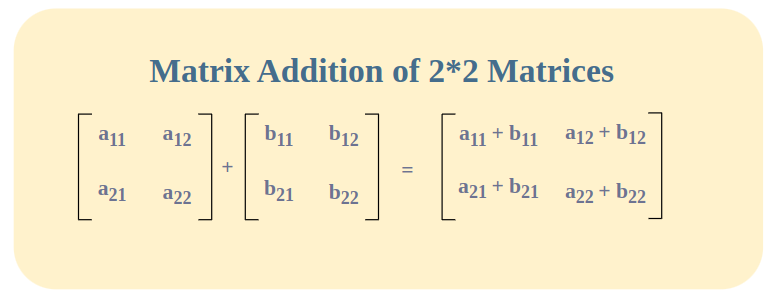
Addition of matrices is the summing of all the given matrices to obtain a single matrix after the operation. The operation is performed on the matrices (plural of matrix), such that element (say aij) in the resultant matrix at some position (say i and j) is equal to the addition operation performed on the elements at same position (i, j) of all the matrix.
Suppose we have n matrices, M1, M2, M3, M4, M5 ..... upto Mn, and addition operation is performed on them and result is stored in R matrix, then for all the elements in R ( Rij , where i is the row number and j is the column number of the element in the matrix R) can be individually represented as,
Rij = M1ij + M2ij + M2ij + ................. Mnij
where,
- Rij is Element in matrix R at ith row and jth column and,
- MkijDenotes the element in Mk matrix at ith row and jth column.
Since every element is result of the operation performed on element at same position in all the matrices, thus the iff (if and only if) condition for addition of matrix is that the number of rows and columns in the all the involved matrices should be same, or in other terms the order of all the matrices should be same. Also the resultant matrix obtained after the operation is of the same order as of the involved matrices.
👁 Addition of MatricesExample: Find the sum of the matrices when the given matrices are, .
Solution:
R = A + B
Consider the A, B and C as there matrices and O is the zero matrix of same dimensions then the following properties hold:
Learn More: Addition of Matrices
Subtraction of matrices is the operation defined on the matrix to obtain a single matrix by subtracting corresponding elements of the two matrices. The two matrices which undergoes subtraction should be of same order and the resultant matrix is also of the same order.
Example: Find the difference between two matrices given as when the given matrices are, A = and
Solution:
R = A - B
R =
Consider the A, B and C as there matrices and O is the zero matrix of same dimensions then the following properties hold:
Matrix multiplication is the operation operation performed on a set of matrices or with a set of matrices and a number to obtain a single matrix of order different from the involved matrices. The matrix multiplication can further have two ways based on whether the multiplication is with another matrix or a number.
When the matrix is multiplied with a scalar quantity it is called scalar multiplication, and the resultant is a singular matrix of same dimension (rows and columns) just all the elements are multiplied with that scalar quantity.
Example: Given k and a matrix A . Find the value of kA.
Solution:
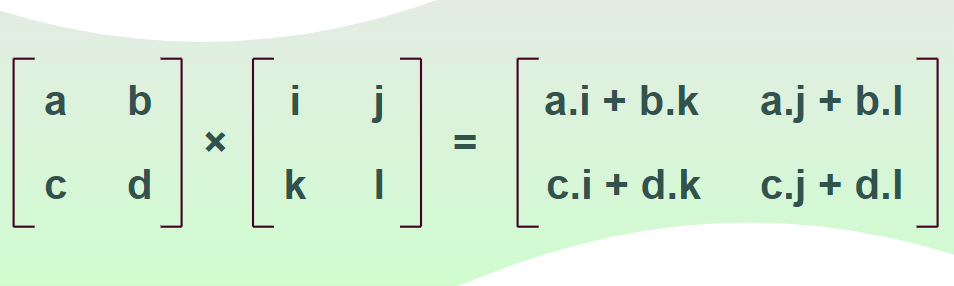
When two matrices are multiplied a resultant matrix with changed dimensions is obtained. In matrix multiplication the two matrices must follow the rule which is, the number of rows in the second matrix should be equal to the number of columns in the first matrix, i.e if we have two matrices A (dimension a1 x b1 ) and B (dimension a2 x b2), then A x B is only possible if and only if b1 = a1 and the resultant matrix will have a dimension of a1 x b2.
👁 Matrix MultiplicationAn element Rij of the resultant matrix is the result of the multiplication and addition operation of the i th row in the first matrix with the j th column in the second i.e Rij = Ai1 × B1j + Ai2 × B2j + .... + Ain × Bnj
Example: Given matrix A = and matrix B = . What will be the result of A × B.
Solution:
R = A × B
R =
R =
Consider the A, B and C as there matrices and O is the zero matrix of same dimensions then the following properties hold:
Learn, Matrix Multiplication
When the rows and columns of matrix are swapped, i.e the row will now become column of the matrix and the column will now become row, the then obtained matrix is called transpose of the original matrix.
It is denoted by AT , where A is the original matrix.
Note: If the order of the original matrix is m x n, then the dimension of the transpose matrix will be n x m.
If we have a matrix , then the transpose matrix AT will be,
Learn, Transpose of Matrix
When each element of the original matrix is replaced by the negative of the element, the then obtained matrix is called negative of the original matrix.
Negative of the matrix is similar to scalar multiplication of the matrix with -1.
The negative of matrix is denoted by -A, where A is the original matrix.
If we have the matrix , then the negative of the matrix will be,
Determinant of Matrix is a scalar value calculated for a given matrix.
It is represented by det(A) or | A |, where A is the original matrix.
Note: The determinant is defined only for the square matrix i.e is the matrix in which the number of rows and columns are equal.
If we have a 2×2 matrix , the
|A| = ac - bd
Read More: Determinant of 2×2 Matrix
If we have a 3×3 matrix , then
| A | = a(ei - fh) - b(di - fg) + c(dh - eg)
Read More: Determinant of 3×3 Matrix
Learn: Determinant of Matrix
Symmetric Matrix are those matrix which has its transpose equal to it.
These matrices are symmetric about the main diagonal of the matrix and are defined for the square matrices only.
For symmetric matrix we can say that,
AT = A
where
- A is the original matrix
- AT denotes the transpose of the original matrix.
Example of symmetric matrix:
A skew symmetric matrix is a special type of square matrix in which transpose of matrix is equal to the negative of the original matrix.
Learn, Symmetric and Skew Symmetric Matrix
For skew-symmetric matrix we can say that:
AT = -A
where,
- A is the original matrix ,
- AT is the transpose of the matrix and,
- -A is the negative of the matrix.
Example of skew-symmetric matrix:
Related Reads
Example 1: Given a matrix A3x3 = and B3x3 = what will be the resultant matrix when addition is performed on these two matrices ?
Solution:
Let the R be the resultant matrix, then
R = A + B
R =
R =
R =
Example 2: Given a matrix A2x2 = and B2x2 = what will be the resultant matrix when addition is performed on these two matrices ?
Solution:
Let the R be the resultant matrix, then
R = A - B
R =
R =
R =
Example 3: Given k = 2 and matrix A = is given below, return the resultant matrix after performing scalar multiplication with k.
Solution:
The scalar multiplication can be given as:
R = kA
R =
R =
Example 4: Given a matrix A2x3 = and B3x2 = what will be the resultant matrix when multiplication is performed on these two matrices ?
Solution:
Let R represents the result of the matrix multiplication, then
R = A × B
R =
R =
R =
Example 5: Calculate the determinant of matrix .
Solution:
|A| = 1 × 4 - 2 × 3 = 4 - 6 = -2
1. Given identity matrix I of dimension 3x3, take any arbitrary matrix A of same dimension and prove that, IA = AI = A.
2. Given zero matrix O of dimension 2x2, take any arbitrary matrix A of same dimension prove that the O + A = A + O = A.
3. Consider the matrix A = and B = prove that matrix addition is commutative.