|
VOOZH | about |
|
VOOZH | about |
A 3 × 3 matrix is a square matrix with three rows and three columns, often used to organize numbers in math and related fields. It plays a key role in linear algebra, mainly when calculating the determinant—a single value that provides essential information about the matrix. This article will explain what a 3 × 3 matrix is, how to find its determinant step by step and explore its practical applications. Whether you're a student or just curious about matrix operations, understanding the determinant is a valuable skill.
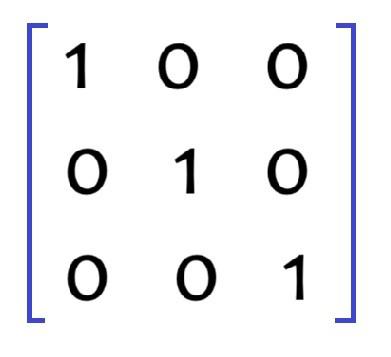
An example of a 3 × 3 matrix is shown below:
Table of Content
The determinant of a Matrix is a single number calculated from a square matrix. In linear algebra, determinants are found by using the values within the square matrix. This number acts like a scaling factor, influencing how the matrix transforms. Determinants are valuable for solving systems of linear equations, finding the inverse of a matrix, and various calculus operations.
Like other matrices, 3 × 3 matrices also have some essential properties.
There are various methods that exist for calculating a matrix's determinant. The most common approach is by breaking a given 3 × 3 matrix into smaller 2 × 2 determinants. This simplifies the process of finding the determinant and is widely used in linear algebra.
Let's take a 3 × 3 square matrix, which is written as
👁 Determinant of 3x3 Matrix Formula - 1To calculate the determinant of matrix A, i.e., |A|.
👁 aaaExpand the Matrix along the elements of the first row.
👁 Determinant of 3x3 Matrix Formula - 2Therefore,
👁 Determinant of 3x3 Matrix Formula - 3Let us understand the calculation of a 3 × 3 matrix with an example. For the given 3 × 3 matrix below.
Select a row and column to start, suppose in this example we take the first element (2) as the reference to calculate the determinant of 3 × 3 matrix.
So, expanding along row R1
Remove the chosen row and column to simplify it in a 2 × 2 matrix.
Find the determinant of the 2 × 2 matrix using the formula
Determinant = (a × d) - (b × c)
Here, a = 0, b = 1, c = -1, d = 2
Putting these values in the above formula of determinant, we get
Determinant = (0 × 2) - (1 × -1)
Determinant = 0- (-1)
Determinant = 0+1
∴ Determinant of the 2 × 2 matrix = 1
Multiply the determinant of the 2 × 2 matrix by the chosen element from the reference row (which is 2, 1, and 3 in this case):
First element = 2 × 1 = 2
Find the Determinant for the second element 1 by putting the values of the 2x2 matrix in the formula.
Determinant = (a × d) - (b × c)
Here, a = 4, b= 1, c= 2, d= 2
Determinant = (4 × 2) - (1 × 2)
Determinant = 8 - 2
Determinant = 6
Now, multiply the determinant of the 2 × 2 matrix by the chosen element from the reference row (which is 1 in this case):
Second element = 1 × 6 = 6
Find the Determinant for the third element 3 by putting the values of the 2x2 matrix in the formula.
Determinant = (a × d) - (b × c)
Here, a = 4, b = 0, c = 2, d = -1
Determinant = (4 × -1) - (0 × 2)
Determinant = -4 - 0
Determinant = -4
Now, multiply the determinant of the 2x2 matrix by the chosen element from the reference row (which is 3 in this case):
Second element = 3 × (-4) = -12
Add up all the results from steps 4, 5, and 6
2 - 6 + (-12) = (-16)
∴ -16 is the determinant of the 3 × 3 matrix.
Also Check:
Determinants of a Matrix can be used to find the inverse and solve the system of linear equations. Hence, we learn to find the inverse of a 3 × 3 Matrix and also solve a system of linear equations using Cramer's Rule, which involves the use of the determinant of a 3 × 3 Matrix.
The formula to find the inverse of a square matrix A is:
Where,
- A-1 is the inverse of matrix A.
- Det(A) represents the determinant of matrix A.
- adj(A) stands for the adjugate of matrix A
In simple terms, you can follow these steps to find the inverse of a matrix:
Step 1. Calculate the determinant of matrix A.
Step 2. Find the adjugate of matrix A.
Step 3. Multiply each element in the adjugate by 1/det(A).
This formula is used for square matrices (matrices with the same number of rows and columns) and assumes that the determinant is non-zero, which is a necessary condition for a matrix to have an inverse.
Cramer's Rule provides a formula to solve a system of linear equations using determinants. For a system of linear equations with n variables are given in the form of
AX = B
Where,
- A = Coefficient of the square matrix
- X = Column matrix having variables
- B = Column matrix having constants
Consider the following system of linear equation
a1x + b1y + c1z + . . . = d1
a2x + b2y + c2z + . . . = d2
...
anx + bny + cnz + . . . = dn
The variables x, y, z, ..., are determined using the following formulas:
Where:
Cramer's Rule is applicable when the determinant of the coefficient matrix D is non-zero. If D = 0, the rule cannot be applied, which indicates either no solution or infinitely many solutions depending on the specific case.
Also, Check
Example 1: Find the determinant of matrix A
Determinant of A = 2 (4×2 - 5×6) - 3(0×2 - 5×1) + 1(0×6 - 4×1)
⇒ Determinant of A = 2(8-30) - 3(0-5) +1(0-4)
⇒ Determinant of A =2(-22) - 3(-5) +1(-4)
⇒ Determinant of A = (-44) +15 - 4
⇒ Determinant of A =-44+11∴ Determinant of A i.e., |A| = (-33)
Example 2: Findthe determinant of matrix B =
Detrminant of B = 1(3×2 - 0×1) - 2(0×2 - 0×4) + 1(0×1 - 3×4)
⇒ Determinant of B = 1(6-0) - 2(0) + 1(-12)
⇒ Determinant of B = 1(6) - 0 - 12
⇒ Determinant of B =6-12
⇒ Determinant of B = (-6)∴ Determinant of B i.e., |B| = 6
Example 3: Find the Determinant of matrix C
Determiinant of matrix C = 3(2×4 - 5×0) - 1(0×4 - 5×2) + 2(0×0 - 2×2)
⇒ Determinant of C = 3(8-0) - 1(0-10) + 2(0-4)
⇒ Determinant of C =3(8) - 1(-10) + 2(-4)
⇒ Determinant of C = 24 + 10 -8
⇒ Determinant of C = 26∴ Determinant of C i.e., |C| = 26
Example 4: Solve the given system of Equations using Cramer's Rule.
2x + 3y - z = 7
4x - 2y + 3z = 8
x + y + 2z = 10
Solution:
Step1: First, find the Determinant D of coefficient matrix.
On Solving this determinant D
D= 2(-2×2-3×1) - 3(4×2-1×3) - (-1)(4×1-(-2)×1)
⇒ D= 2(-4-3) - 3(8-3) - 1(4+2)
⇒ D= 2(-7) - 3(5) - 1(6)
⇒ D= -14 - 15 - 6
⇒ D= -35Step2: Now, find the determinants of Dx,Dy and Dz
For Dx, we replace the coefficients of x with the constants on the right-hand side:
For Dy, we replace the coefficients of y with the constants:
For Dz, we replace the coefficients of z with the constants:
On Solving the determinant Dx
Dx = 7(-2×2 - 3×1) - 3(8×2 - 3×10) - (-1)(8×1 - (-2×10)
⇒ Dx = 7(-4 - 3) - 3(16 - 30) - -1(8 + 20)
⇒ Dx = 7(-7) - 3(-14) - 28
⇒ Dx = -49 + 42 - 28Thus, Dx = - 35
On Solving the determinant Dy
Dy = 2(8 × 2 - 3×10) - 7(4×2 - 3×1) - (-1)(4×10 - 8×1)
⇒ Dy = 2(16 - 30) - 7(8 - 3) - 1(40 - 8)
⇒ Dy = 2(-14) - 7(8 - 3) + 1(32)
⇒ Dy = -28 - 35 -32
⇒ Dy = - 95On Solving the determinant Dz
Dz = 2(-2×(10) - 8×(1)) - 3(4×(10) - 8×(1)) - 7(4×1 - (-2×1)
⇒ Dz = 2(-20 - 8) - 3(40 - 8) - 7(4 + 2)
⇒ Dz = 2(-28) - 3(32) - 7(6)
⇒ Dz = -56- 96 + 42
⇒ Dz = - 110Step 3: Now putting the values of D, Dx, Dy and Dz in the Carmer's Rule Formula to find the values of x,y and z.
x = Dx/D = (-35)/(-35 )= 1
y = Dy/D = (-95)/(-35) = 19 /7
z = Dz/D = (-110)/(-35) = 22/7
Question 1: Calculate the determinant of the identity matrix:
Question 2: Find the determinant of the matrix:
Question 3: Determine the determinant of the matrix:
Question 4: Calculate the determinant of the matrix:
Question 5: Find the determinant of the matrix:
Question 6: Determine the determinant of the matrix:
Answer key:
- 1
- 59
- 4
- 6
- -8
- 9