|
VOOZH | about |
|
VOOZH | about |
The determinant of a matrix is a single numerical value that can be calculated from a square matrix (a matrix with the same number of rows and columns).
Here are some properties of a 4×4 matrix:
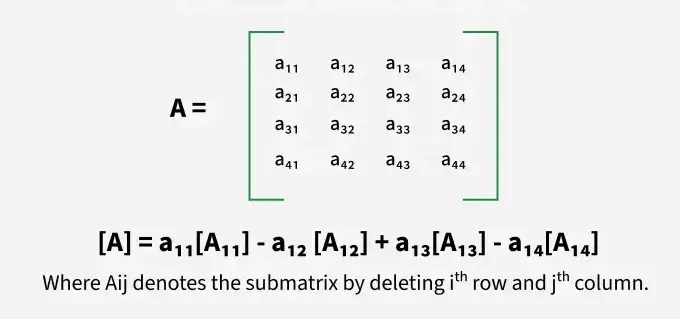
Determinant of any 4 × 4 Matrix, i.e., , can be calculated using the following formula:
det(A) = a11 · det(A11) - a12 · det(A12) + a13 · det(A13) - a14 · det(A14)
To find the determinant of a 4x4 matrix, you can use various methods such as expansion by minors, row reduction, or applying specific properties.
One common method is to use expansion by minors, where you expand along a row or column by multiplying each element by its cofactor and summing the results. This process continues recursively until you reach a 2x2 submatrix, for which you can directly compute the determinant. To understand how to find the determinant of a 4×4 matrix, consider an example.
Step 1: Expand along the first row:
det(A) = 2 · det(A11) - 1 · det(A12) + 3 · det(A13) - 4 · det(A14)
Where Aij denotes the submatrix obtained by deleting the i-th row and j-th column.
Step 2: Compute the determinant of each 3x3 submatrix.
For A11
⇒ |A11| = (-1)[(0)(1)-(5)(2)] - 2[(2)(1)-(5)(3)] + 1[(2)(2)-(0)(3)]
⇒ |A11| = (-1)[(-10)] - 2[(2)-(15)] + 1[(4)-(0)]
⇒ |A11| = 10 - 2(-13) + 4
⇒ |A11| = 10 + 26 + 4= 40
For A12
⇒ |A12| = (0)[(0)(1)-(5)(2)] - 2[(3)(1)-(5)(-1)] + 1[(3)(2)-(0)(-1)]
⇒ |A12| = (0)[(-10)] - 2[(3)+(5)] + 1[(6)-(0)]
⇒ |A12| = 0 - 2(8) + 6
⇒ |A12| = 0 - 16+ 6= - 10
For A13
⇒ |A13| = (0)[(2)(1)-(3)(5)] - (-1)[(3)(1)-(5)(-1)] + 1[(3)(3)-(2)(-1)]
⇒ |A13| = (0)[(2)-(15)] - (-1)[(3)+(5)] + 1[(9)-(-2)]
⇒ |A13| = 0 - (-1)(8) + 1(11)
⇒ |A13| = 8 + 11 = 19
For A14
⇒ |A14| = (0)[(2)(2)-(3)(0)] - (-1)[(3)(2)-(0)(-1)] + 2[(3)(3)-(2)(-1)]
⇒ |A14| = (0)[(4)-(0)] - (-1)[(6)-(0)] + 2[(9)-(-2)]
⇒ |A14| = 0 - (-1)(6) + 2(11)
⇒ |A14| = 6 + 22 = 28
Step 3: Substitute the determinants of the 3x3 submatrices into the expansion formula:
(A) = 2 · 40 + 1 · 10 + 3 · 19 - 4 · 28
Step 4: Compute the final determinant:
det(A) = 80 + 10 + 57 - 112
det(A) = 35
So, the determinant of the given 4x4 matrix is 35.
Here are the special cases (or situations) where the determinant of a matrix becomes zero (0):
Example:
Here, the second row consist entirely of zeros.
When the row( or column ) in determinant is made of all zeros,the value of the determinant is always zero.
|A| = 0
Example :
Notice that Column 1 and Column 3 are exactly the same.
If any two columns ( or rows) of determinants are identical , its determinants is zero.
|B| = 0
Example:
Here, the second row is excatly twice the first row.
That means the two rows are proportional, and whenever any two rows( or column) are proportional, the determinants is zero.
Example 1: Calculate the determinant of the matrix A =
Solution:
First Expand along the first row:
Now, compute the determinant of each 3x3 submatrix.
For (A11):
= (-1)((1)(3)-(5)(-2)) - 2((2)(3)-(5)(0)) + 0((2)(-2)-(1)(0))
= (-1)((3)+(10)) - 2((6)-(0)) + 0((-4)-(0))
= (-1)(13) - 2(6) + 0(-4)
= -13 - 12
= -25
For (A12):
= (4)((1)(3)-(5)(2)) - (2)((-3)(3)-(5)(1)) + (0)((-3)(2)-(1)(1))
= (4)((3)-(10)) - (2)((-9)-(5)) + 0
= 4 (-7) - 2(- 14 )
= =28 + 28 = 0
For (A13):
Since a13 = 0, the contribution of C13 will be zero. (Computation unnecessary.)
For (A14):
=4[(2)(−2)−(1)(0)]−(−1)[(−3)(−2)−(1)(1)]+2[(−3)(0)−(2)(1)]
=4 [− 4 − 0] + 1[6 − 1] + 2[0 − 2]
= 4(-4) + 5 + (- 4)
=− 16 + 5 − 4
= - 15
Now, substitute the determinants of the 3x3 submatrices into the expansion formula:
det(A) = 2 ( - 25 ) - 1( 80 ) - 3 ( - 15)
= -50 - 80 + 45 + 0
= - 130 + 45
= - 85
So, the determinant of matrix (A) is - 85 .
Example 2: Calculate the determinant of the matrix
Solution:
To find the determinant of the matrix ( A ), we'll use the expansion by minors method along the first row:
Now, let's compute the determinants of the 3x3 submatrices:
= 0 - 2 ( 2 - 0) + 5 ( 6 + 2)
= -4 + 5(8) = - 4 + 40 = 36
= -1 · ( 1 - 0) - 2 ( 3- 0) + 5(9 - 4)
= - 1 - 6 + 5(5)
= - 7 + 25 = 18
= -1( 2- 0) - 0 + 5 (-6 - 8 )
= - 72
= -1 · (6 + 2) - 0 + 2( - 6 - 8)
= (- 1)(8) + 2 (-14) = -8 - 28 = - 36
Now, substitute these determinants back into the expansion formula:
det(A) = 72 - 18 + 216 + 144 = 54 + 360 = 414
So, the determinant of matrix ( A ) is det(A) = 414.
Example 3: Let C = find its determinants using the cofactor expansion method.
Solution:
Expand along the first row [3, 0, 2, 1]. The expansion is
det(C) = 3 C11 + 0 C12 + 2 C13 + 1C14
where C1j = (−1)1+j det(M1j) (cofactor).
=4(15) - 1(-5) - 3(-6)
= 60 + 5 + 18
= 83.
= 0 - 4(10) - 3(5)
= -40 - 15
= -55=0 - 4(-3) + 1(5)
=12 + 5
= 17.Now substitute:
|C| = 3(83) - 2(-55) + (-17)
|C| = 249 + 110 - 17
|C| = 342
Question 1: Calculate the determinant of the following 4×4 matrix:
Question 2: Find the determinant of the matrix:
Question 3: Calculate the determinant of the following 4×4 matrix:
Question 4: Determine the determinant of the matrix:
Question 5: Find the determinant of the matrix:
Question 6: Find the determinant of the following lower triangular matrix: