|
VOOZH | about |
|
VOOZH | about |
In statistical hypothesis testing, the alternative hypothesis is an important proposition in the hypothesis test. The goal of the hypothesis test is to demonstrate that in the given condition, there is sufficient evidence supporting the credibility of the alternative hypothesis instead of the default assumption made by the null hypothesis.
👁 409843018Both hypotheses include statements with the same purpose of providing the researcher with a basic guideline. The researcher uses the statement from each hypothesis to guide their research. In statistics, alternative hypothesis is often denoted as Ha or H1.
Table of Content
"A hypothesis is a statement of a relationship between two or more variables." It is a working statement or theory that is based on insufficient evidence.
While experimenting, researchers often make a claim, that they can test. These claims are often based on the relationship between two or more variables. "What causes what?" and "Up to what extent?" are a few of the questions that a hypothesis focuses on answering. The hypothesis can be true or false, based on complete evidence.
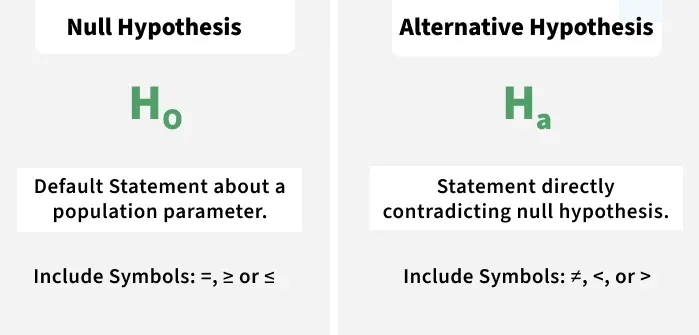
While there are different hypotheses, we discuss only null and alternate hypotheses. The null hypothesis, denoted Ho, is the default position where variables do not have a relation with each other. That means the null hypothesis is assumed true until evidence indicates otherwise. The alternative hypothesis, denoted H1, on the other hand, opposes the null hypothesis. It assumes a relation between the variables and serves as evidence to reject the null hypothesis.
Example of Hypothesis:
Mean age of all college students is 20.4 years. (simple hypothesis).
An Alternative Hypothesis is a claim or a complement to the null hypothesis. If the null hypothesis predicts a statement to be true, the Alternative Hypothesis predicts it to be false. Let's say the null hypothesis states there is no difference between height and shoe size then the alternative hypothesis will oppose the claim by stating that there is a relation.
We see that the null hypothesis assumes no relationship between the variables whereas an alternative hypothesis proposes a significant relation between variables. An alternative theory is the one tested by the researcher and if the researcher gathers enough data to support it, then the alternative hypothesis replaces the null hypothesis.
Null and alternative hypotheses are exhaustive, meaning that together they cover every possible outcome. They are also mutually exclusive, meaning that only one can be true at a time.
There are a few types of alternative hypothesis that we will see:
1. One-tailed test H1: A one-tailed alternative hypothesis focuses on only one region of rejection of the sampling distribution. The region of rejection can be upper or lower.
2. Two-tailed test H1: A two-tailed alternative hypothesis is concerned with both regions of rejection of the sampling distribution.
3. Non-directional test H1: A non-directional alternative hypothesis is not concerned with either region of rejection; rather, it is only concerned that null hypothesis is not true.
4. Point test H1: Point alternative hypotheses occur when the hypothesis test is framed so that the population distribution under the alternative hypothesis is a fully defined distribution, with no unknown parameters; such hypotheses are usually of no practical interest but are fundamental to theoretical considerations of statistical inference and are the basis of the Neyman–Pearson lemma.
the differences between Null Hypothesis and Alternative Hypothesis is explained in the table below:
Null Hypothesis(Ho) | Alternative Hypothesis(Ha) | |
|---|---|---|
Definition | A default statement that states no relationship between variables. | A claim that assumes a relationship between variables. |
Denoted by | Ho | Ha or H1 |
In Research | States a presumption made before-hand | States the potential outcome a researcher may expect |
Symbols Used | Equality Symbol (=, ≥, or ≤) | Inequality Symbol (≠, <, or >) |
Example | Experience matters in a tech-job | Experience does not matter in a tech-job |
Formulating an alternative hypothesis means identifying the relationships, effects or condition being studied. Based on the data we conclude that there is a different inference from the null-hypothesis being considered.
Alternative hypothesis must be true when the null hypothesis is false. When trying to identify the information need for alternate hypothesis statement, look for the following phrases:
When alternative hypotheses in mathematical terms, they always include an inequality (usually ≠, but sometimes < or >). When writing the alternate hypothesis, make sure it never includes an "=" symbol.
To help you write your hypotheses, you can use the template sentences below.
Does independent variable affect dependent variable?
Various examples of Alternative Hypothesis includes:
Two-Tailed Example
Example 1:
Example 2:
One-Tailed Example
Example 1:
Example 2:
Some applications of Alternative Hypothesis includes:
We defined the relationship that exist between null-hypothesis and alternative hypothesis. While the null hypothesis is always a default assumption about our test data, the alternative hypothesis puts in all the effort to make sure the null hypothesis is disproved.
Null-hypothesis always explores new relationships between the independent variables to find potential outcomes from our test data. We should note that for every null hypothesis, one or more alternate hypotheses can be developed.
Also Check: