|
VOOZH | about |
|
VOOZH | about |
In trigonometric graphs, amplitude and periodicity are two important properties that describe the shape and behavior of the function.
For y = 2sin(x), the amplitude is ∣2∣ = 2, and period is 2π. In this article, Amplitude and Periodicity in Trigonometric Graphs is discussed in detail.
Table of Content
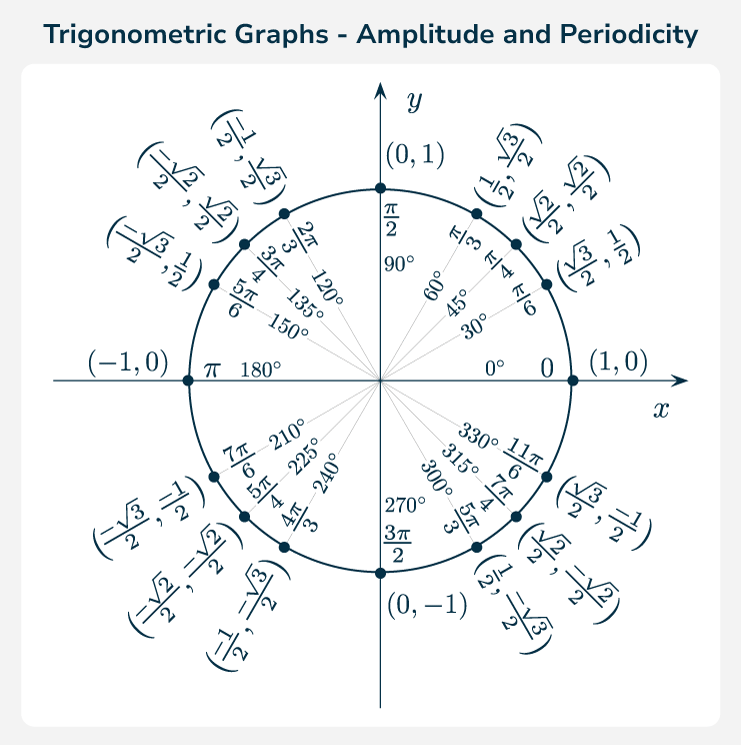
Trigonometric functions are defined based on the x- and y-coordinates of points on a unit circle. When we move around the circle one full time (an angle of 2π), we end up at the same point with the same x- and y-coordinates. This idea works for going around the circle any number of times, as long as the angle is a multiple of 2π.
Trigonometric function | Expression | Periodicity |
|---|---|---|
Sine(sin) | sin(θ) = sin(θ + 2π) | 2π |
Cosine (cos) | cos(θ) = cos(θ + 2π) | 2π |
Tangent (tan) | tan(θ) = tan(θ + π) | π |
Cosecant (cosec) | cosec(θ) = cosec(θ + 2π) | 2π |
Secant (sec) | sec(θ) = sec(θ + 2π) | 2π |
Cotangent (cot) | cot(θ) = cot(θ + π) | π |
For example:
This works for any whole number k.
This shows that trigonometric functions repeat. These functions are called periodic, and the period is the smallest interval that repeats the entire function.
The periods of basic trigonometric functions are:
- sin(θ), cos(θ): 2π
- cosec (θ), sec(θ): 2π
- tan(θ), cot(θ): π
Trigonometric functions, like sine and cosine, follow a pattern of rising and falling, like hills and valleys. The amplitude of a trigonometric function is half the distance between the highest and lowest points on the curve.
The formula for amplitude is:
Amplitude = (Maximum - Minimum) / 2.
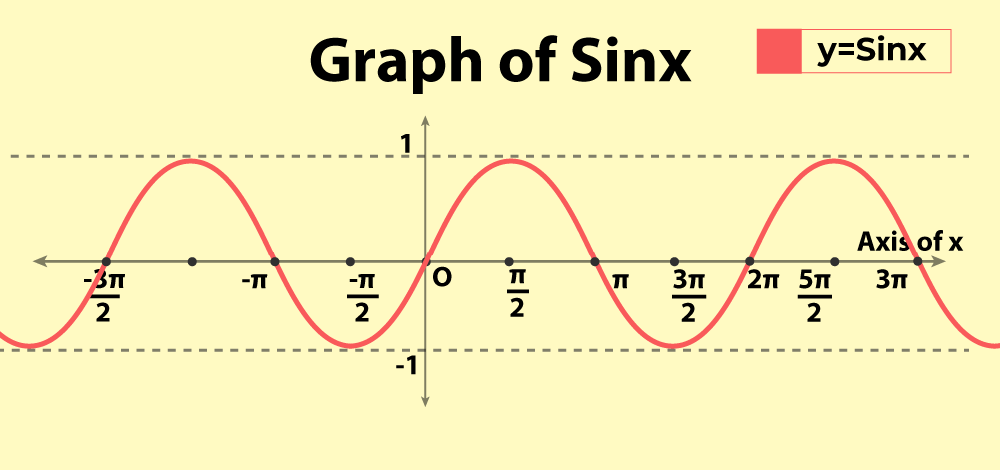
The sine function oscillates between -1 and 1 with a period of 2π. This means it repeats every 2π units along the x-axis. The highest point (peak) is 1, and the lowest point (trough) is -1. The amplitude is the vertical distance from the middle of the wave (0) to a peak or trough, which is 1.
👁 Sine-Function-1Like the sine function, the cosine function also oscillates between -1 and 1, repeating every 2π. The main difference is that the cosine function starts at a peak (1) when x = 0, whereas the sine function starts at 0.
👁 Cosine-FunctionExample 1: What are the amplitude and period of the graph ?
Solution:
For the graph :
- The amplitude is 5 because the sine function is multiplied by 5, which stretches the graph vertically by a factor of 5.
- The graph is shifted down by 2 in the y-direction.
- Since there is no horizontal stretching, the period remains the same as the sine function, which is 2π.
So, the amplitude is 5, and the period is 2π.
Example 2: What are the amplitude and period of the graph ?
Solution:
For the graph :
- The amplitude is 100 because the graph stretches vertically by a factor of 100 (whether it's + 100 or -100 doesn’t matter).
- The period is calculated as .
So, the amplitude is 100, and the period is .
Example 3: The fundamental period of a sine function f that passes through the origin is given to be 3π and its amplitude is 5. Construct f(x).
Solution:
Since the function passes through the origin, it must be of the form f, because f(0) = 0. Given that the amplitude is 5, we have .
The fundamental period is 3π, so:
Thus, the function is
Example 4: What are the fundamental period and amplitude of the function f(x) = 40sin(2x) + 9cos(2x)?
Solution:
Using the R method, we have:
where α is a constant that doesn’t depend on x. Therefore, the amplitude is 41.
The fundamental period is calculated as:
So, the amplitude is 41, and the period is \pi.
Example 5: What is the period of the function h(x) = sin(∣123x∣)?
Solution:
A simple sketch of the graph around x = 0 for shows that it is not periodic. The function does not return to its original value after a certain interval, indicating that it doesn't repeat itself periodically.
To clarify further, while itself is periodic, if you are looking at a specific transformation or combination that includes , this expression simplifies to , which is a constant function and thus not periodic.
Question 1: What are the amplitude and period of the graph ?
Question 2: What are the amplitude and period of the graph ?
Question 3: The amplitude of a cosine function g is 2, and its period is 6π. Construct g(x).
Question 4: What are the amplitude and period of the function ?
Question 5: What is the amplitude and period of the function ?
Question 6: The fundamental period of a sine function f is given to be 4π and its amplitude is 3. Construct f(x).
Question 7: What are the amplitude and period of the graph ?
Question 8: What are the amplitude and period of the function?
Question 9: What is the amplitude and period of the function ?
Question 10: The fundamental period of a cosine function h is 5π and its amplitude is 4. Construct h(x).
Amplitude and Periodicity are really important concepts of trigonometric graphs. Solving math problems with the use of the concepts learned above will enhance your understanding and help you solve real life problems in engineering, physics, computer science and many others.