|
VOOZH | about |
|
VOOZH | about |
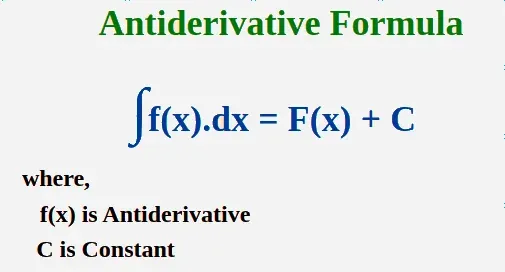
An antiderivative is a function that reverses the process of differentiation. It is also known as the indefinite integral. If F(x) is the antiderivative of f(x), it means that:
d/dx[F(x)] = f(x)
In other words, F(x) is a function whose derivative is f(x).
Antiderivatives include a family of functions that differ by a constant C, because the derivative of a constant is zero. Thus, the general form of the antiderivative is: F(x) = ∫f(x) dx = F(x) + C, where C is the constant of integration.
This can be explained by the example, let's take a function f(x) = x2, on differentiating this function, the output is another function g(x) = 2x.
Example: Suppose you're given the function g(x) = 2x. What function has a derivative of 2x?
Solution:
f(x) = x2
d/dx[f(x)] = f'(x) = g(x)Thus, g(x) = 2x
Now the antiderivative of 2x is,
∫g(x).dx
= ∫(2x).dx
= 2(x2)/2 + C
= x2 + C
Here, the symbol ∫ denotes the anti-derivative operator, which is called the indefinite integral. Also, C is the integration constant or Antiderivative constant.
There are certain important rules that need to be followed while integrating a function to obtain its antiderivatives. These rules are listed as follows:
Constant Rule
∫kf(x)dx = k ∫ f(x)dx, here "k" is any constant.
Sum Rule
This rule states that the integral of the sum of two functions is equal to the sum of integrals of those two functions.
∫(f(x) + g(x))dx = ∫ f(x)dx + ∫g(x)dx
Difference Rule
This rule states that the integral of difference of two functions is equal to difference of integrals of those two functions.
∫(f(x) - g(x))dx = ∫ f(x)dx - ∫g(x)dx
Power Rule
The power rule underlies the Taylor series as it relates a power series to a function's derivatives.
It is not always possible to just guess the integral of any function by thinking of the reverse differentiation process. A formal approach or a formula is necessary for calculating the Antiderivatives.
To calculate the antiderivative of any function, follow the steps added below,
Check the given integral and try to guess the derivative of the function whose antiderivative is to be calculated.
Example: Find the antiderivative of xn.
Solution:
Antiderivative of xn = ∫ xn dx
Using Integration Formulas
= x(n+1)/(n+1) {except when n = -1}
The table below represents some standard functions and their integrals.
| Function | Integral |
|---|---|
| sin(x) | -cos(x) + C |
| cos(x) | sin(x) + C |
| sec2(x) | tan(x) + C |
| ex | ex + C |
| 1/x | ln(x) + C |
Antiderivative of the trigonometric functions is easily found, which helps us to solve various problems of integration. Antiderivatives of the Trigonometric Functions are,
- ∫ sin x dx = -cos x + C
- ∫ cos x dx = sin x + C
- ∫ tan x dx = -ln |cos x| + C = ln |sec x| + C
- ∫ cot x dx = ln |sin x| + C = -ln |cosec x| + C
- ∫ sec x dx = ln |sec x + tan x| + C
- ∫ cosec x dx = - ln |cosec x + cot x| + C
- ∫ cos (ax + b)x dx = (1/a) sin (ax + b) + C
- ∫ sin (ax + b)x dx = -(1/a) cos (ax + b) + C
There are some functions whose antiderivative gives Inverse Trigonometric Functions that are,
- ∫ 1/√(1 - x2).dx = sin-1x + C
- ∫ 1/(1 - x2).dx = -cos-1x + C
- ∫ 1/(1 + x2).dx = tan-1x + C
- ∫ 1/(1 + x2).dx = -cot-1x + C
- ∫ 1/x√(x2 - 1).dx = sec-1x + C
- ∫ 1/x√(x2 - 1).dx = -cosec-1x + C
For functions of the form sin(ax+b)sin(ax+b) or cos(ax+b)cos(ax+b), the antiderivatives are:
- ∫sin(ax + b) dx = −1acos(ax + b) + C∫sin(ax + b)dx = −a1cos(ax + b) + C
- ∫cos(ax + b) dx = 1asin(ax + b) + C∫cos(ax + b)dx = a1sin(ax + b) + C
Question 1: Find the integral for the given function; f(x) = 2x + 3.
Solution:
Using Integral Formula,
Given,
f(x) = 2x + 3
Splitting the function
⇒
⇒
⇒
⇒ x2 + 3x + C
Question 2: Find the integral for the given function; f(x) = x2 - 3x.
Solution:
Using Integral Formula,
Given,
f(x) = x2 - 3x
Splitting the function
⇒
⇒
Question 3: Find the integral for the given function; f(x) = x3 + 5x2 + 6x + 1.
Solution:
Using Integral Formula,
Given,
f(x) = x3 + 5x2 + 6x + 1
Splitting the function
⇒
⇒
Question 4: Find the integral for the given function; f(x) = sin(x) - cos(x).
Solution:
Using Integral Formula,
Given,
f(x) = sin(x) - cos(x)
Splitting the function
⇒
⇒
Question 5: Find the integral for the given function; f(x) = 2sin(x) + sec2(x) + 7ex.
Solution:
Given, f(x) = 2sin(x) + sec2(x) + 7ex
Splitting the function
⇒
⇒
⇒
Question 6: Find the integral for the given function; f(x) = .
Solution:
Using Integral Formula,
Given,
f(x) =
Splitting the function
⇒
⇒ x - 3ln(x) + C
Question 7: Find the integral for the given function; f(x) = x2 - 4x + 4.
Solution:
Using Integral Formula,
Given, f(x) = x2 - 4x + 4
Splitting the function
⇒
Question 1: ∫1/√x dx
Question 2: ∫a2logax dx
Question 3: ∫2/(1 + cos 2x)dx
Question 4: ∫3x+3dx
Question 5: ∫1/2tan x dx