|
VOOZH | about |
|
VOOZH | about |
Integration by Partial Fractions is one of the methods of integration, which is used to find the integral of rational functions. In Partial Fraction decomposition, an improper-looking rational function is decomposed into the sum of various proper rational functions.
If f(x) and g(x) are polynomials such that g(x) ≠ 0, then f(x)/g(x) is called a Rational function.
For example, rational function 1/(x2-4) can be rewritten as 1/4(x-2) -1/4(x+2) and rational function 3x/(x2+x-2) can be rewritten as 1/(x-1) + 2/(x+2).
Partial fraction decomposition is applicable when integrating a rational function P(x)/Q(x), where:
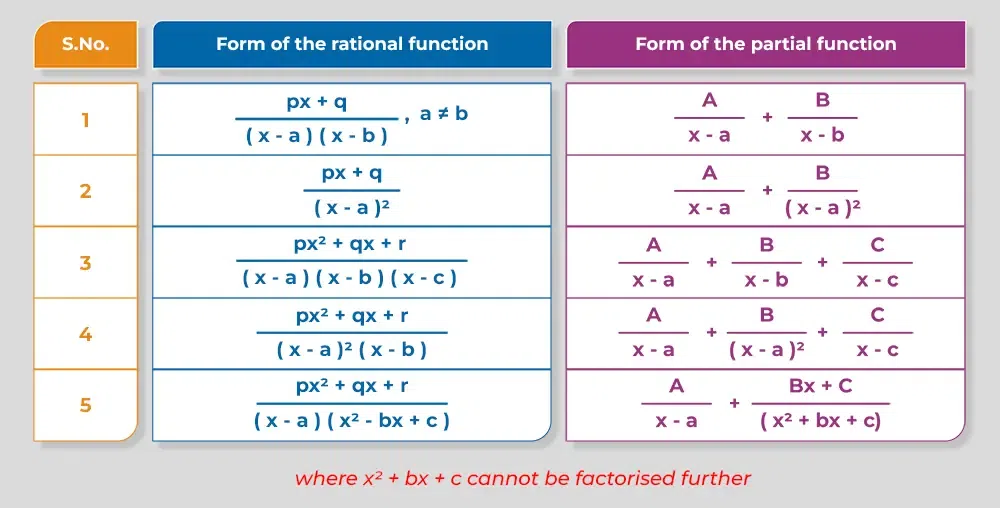
To evaluate the integral ∫[p(x)/q(x)] dx where p(x)/q(x) is in a proper rational fraction, we can factorize the denominator i.e., q(x) then using the following rational fraction cases we can write the integrand in a form of the sum of simpler rational functions including constant A, B, C, etc. Then values of A, B, C, etc. can be obtained using various methods of algebra.
👁 Various Forms Used in Integration by Partial FractionsTo integrate any rational function using Partial Fractions, we need to follow the following steps:
- Step 1: Factor the denominator given rational function into linear and quadratic factors.
- Step 2: Use the Partial Fraction formula to write the rational function as a sum of simpler fractions.
- Step 3: Determine the constants A, B, and C.
- Step 4: Integrate each partial fraction separately with appropriate methods to get the final integral.
Example: Integrate the following function using partial fractions: f(x) = (3x2 + 2x + 1)/(x3 + x2)
Solution:
Step 1: Factor the denominator into linear and quadratic factors: x3 + x2 = x2(x + 1)
Step 2: Write the rational function as a sum of simpler fractions.
f(x) = (3x2 + 2x + 1)/[x2(x + 1)] = A/x + B/(x2) + C/(x+1)
Step 3: Determine the constants A, B, and C.
Multiplying both sides by the common denominator (x2(x + 1)), we get:
3x2 + 2x + 1 = Ax(x+1) + B(x+1) + C(x2)
Substituting x = 0, x = -1, and x = infinity into the above equation, we get:
When x = 0, B = 1
When x = -1, C = 2
When x = 1, A = 1Solving the above equations simultaneously, we get:
A = 1, B = 1, C = 2Step 4: Integrate each partial fraction using substitution.
Integrating A/x = 1/x, we get ln|x|
Integrating B/(x2) = 1/x2, we get: -1/x
Integrating C/(x+1) = 2/(x+1), we get: @ ln|x+1|Therefore, the final answer is:
∫f(x)dx = ln|x| - 1/x + 2 ln|x+1| + C, where C is the constant of integration.
Example 1: Evaluate ∫(x - 1)/(x + 1)(x - 2) dx?
Solution:
Let (x - 1)/(x + 1)(x - 2) = A/(x + 1) + B/(x - 2)
Then, (x - 1) = A(x - 2) + B(x + 1) . . .(i)
Putting x = -1 in (i), we get A = 2/3
Putting x = 2 in (i), we get B = 1/3
Therefore,
(x - 1)/(x + 1)(x - 2) = 2/3(x + 1) + 1/3(x - 2)
⇒ I = ∫(x - 1)/(x + 1)(x - 2) = 2/3∫dx/(x + 1) + 1/3∫dx/(x - 2)
⇒ I = 2/3log | x + 1 | + 1/3 log | x - 2 | + C
Example 2: Evaluate ∫dx/(x3 + x2 + x + 1)?
Solution:
Let I = ∫dx/(x3 + x2 + x + 1)
Now, 1/(x3 + x2 + x + 1) = 1/[x2(x + 1) + (x + 1)] = 1/(x + 1)(x2 + 1)
Let 1/(x + 1)(x2 + 1) = A/(x + 1) + Bx + C/(x2 + 1) . . . (i)
⇒ 1 = A(x2 + 1) + (Bx + C) (x + 1)Putting x = -1 on both sides of (i), we get A = 1/2.
Comparing coefficients of x2 on the both sides of (i), we get
A + B = 0 ⇒ B = -A = -1/2
Comparing coefficients of x on the both sides of (i), we get
B + C = 0 ⇒ C = -B = 1/2
Therefore, 1/(x + 1) (x2 + 1) = 1/2(x + 1) + (-1/2x + 1/2)/(x2 + 1)
Therefore, I = ∫dx/(x + 1) (x2 + 1)
⇒ I = 1/2∫dx/(x + 1) - 1/2∫x/(x2 + 1)dx + 1/2∫dx/(x2 + 1)
⇒ I = 1/2∫dx/(x + 1) - 1/4∫2x/(x2 + 1)dx + 1/2∫dx/(x2 + 1)
⇒ I = 1/2 log | x + 1 | - 1/4 log | x2 + 1 | + 1/2 tan-1x + C
Example 3: Evaluate ∫dx/x{6(log x)2 + 7log x + 2}?
Solution:
Putting log x = t and 1/x dx = dt, we get
I = ∫dx/x{6(log x)2 + 7log x + 2} = ∫dt/(6t2 + 7t + 2) = ∫dt/(2t + 1)(3t + 2)
Let 1/(2t + 1)(3t + 2) = A/(2t + 1) + B/(3t + 2)
Then, 1 ≡ A(3t + 2) + B(2t + 1) . . . (i)
Putting t = -1/2 in (i), we get A = 2
Putting t = -2/3 in (i), we get B = -3
Therefore, 1/(2t + 1)(3t + 2) = 2/(2t + 1) + (-3)/(3t + 2)
⇒ I = ∫dt/(2t + 1)(3t + 2)
⇒ I = ∫2dt/(2t + 1) - ∫3dt/(3t - 2)
⇒ I = log | 2t + 1 | - log | 3t + 2 |
⇒ I = log | 2t + 1 |/log | 3t + 2 | + C
⇒ I = log | 2 log x + 1 | / log | 3 log x + 2 | + C
Example 4: Evaluate ∫dx/x(x4 + 1).
Solution:
We have
I = ∫dx/x(x4 + 1) = ∫x3/x4 (x4 + 1) dx [multiplying numerator and denominator by x3].
Putting x4 = t and 4x3dx = dt, we get
⇒ I = 1/4∫dt/t(t + 1)
⇒ I = 1/4∫{1/t - 1/(t + 1)}dt [by partial fraction]
⇒ I = 1/4∫1/t dt - 1/4∫1/(t + 1)dt
⇒ I = 1/4 log | t | - 1/4 log | t + 1 | + C
⇒ I = 1/4 log | x4 | - 1/4 log | x4 + 1 | + C
⇒ I = (1/4 * 4) log | x | - 1/4 log | x4 + 1 | + C
⇒ I = log | x | - 1/4 log | x4 + 1 | + C
Example 5: Evaluate ∫x2/(x2 + 2)(x2 + 3)dx?
Solution:
Let x2/(x2 + 2) (x2 + 3) = y/(y + 2)(y + 3) where x2 = y.
Let y/(y + 2) (y + 3) = A/(y + 2) + B/(y + 3)
⇒ y ≡ A(y + 3) + B/(y + 2) . . . (i)
Putting y = -2 on the both sides of (i), we get A = -2.
Putting y = -3 on the both sides of (i), we get B = 3.
Therefore, y/(y + 2) (y + 3) = -2/(y + 2) + 3/(y + 3)
⇒ x2/(x2 + 2) (x2 + 3) = -2/(x2 + 2) + 3/(x2 + 3)
⇒ ∫x2/(x2 + 2) (x2 + 3) = -2∫dx/(x2 + 2) + 3∫dx/(x2 + 3)
⇒ ∫x2/(x2 + 2) (x2 + 3) = -2/√2tan-1(x/√2) + 3/√3tan-1(x/√3) + C
⇒ ∫x2/(x2 + 2) (x2 + 3) = -√2tan-1(x/√2) + √3tan-1(x/√3) + C
Solve these Integrals using integration by Partial Fractions:
1.
2.
3.
4.
5.