|
VOOZH | about |
|
VOOZH | about |
Area of Triangle when measures of its three sides are given is found using Heron's formula. The area of any two-dimensional shape is the measure of a region’s size on a surface. A triangle is a closed polygon having three sides and three vertices. Area of a triangle can be found using different methods. One of them includes determining the area using measures of the length of each side of the triangle.
In this article, we will discuss that method, the formula, and some solved examples based on the calculation of the area of a triangle with three sides.
Area of Triangle with 3 sides is calculated using Heron's Formula. The formula was given by a Greek Mathematician named Heron. The formula can be further extended to calculate area of quadrilaterals. Heron's Formula for Area of Triangle with 3 sides is given as follows:
A = √{s(s-a)(s-b)(s-c)}
Where,
Semi-perimeter of the triangle (s) is calculated as follows:
s = (a+b+c)/2
Formula for Area of Triangle with 3 Sides can be derived two ways
Let's discuss these methods in detail as follows:
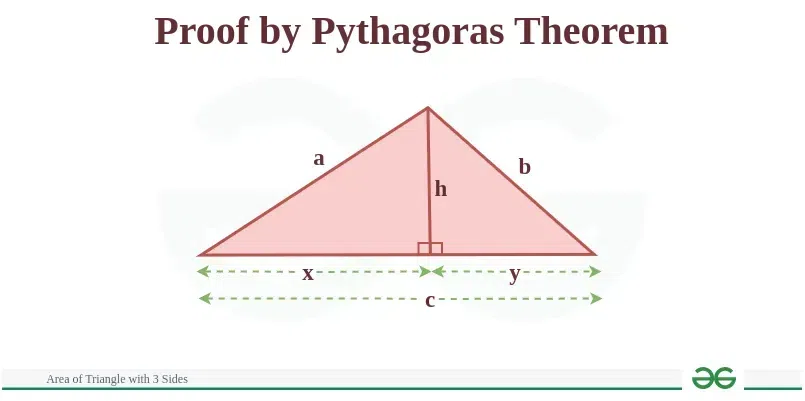
To prove Heron's formula using the Pythagorean theorem, let's consider a triangle with side lengths a, b, and c where c is the longest side. We'll divide this triangle into two right triangles using an altitude from the vertex opposite the hypotenuse. Let's denote the altitude as h and the two segments of the hypotenuse as x and y as the following diagram:
👁 Proof-of-Formula-for-Area-of-Triangle-with-3-Sides-by-Pythagoras-Theorem
For the first right triangle, using pythagoras theorem
x2 + h2 = a2
⇒ h2 = a2 - x2 . . .(i)
For the second right triangle, using pythagoras theorem
y2 + h2 = b2
⇒ h2 = b2 - y2 . . .(ii)
From equation (i) and (ii), we get
a2 - x2 = b2 - y2
⇒ a2 - b2 = x2 - y2 . . .(iii)
Now, let's consider the segments of the hypotenuse:
c = x + y
⇒ c2 = (x + y)2
⇒ c2 = x2 + y2 + 2xy
From equation (iii),
c2 = a2 - b2 + 2xy
⇒ 2xy = c2 - a2 + b2
Now, let's find the area A of the triangle using the formula for the area of a triangle with base c and height h:
A = 1/2 × ch
. . .(iv)
As we know, s = (a + b + c)/2
⇒ c = 2s - a - b
Putting c = 2s - a - b in equation (iv)
Therefore, we have proven Heron's formula using the Pythagorean theorem.
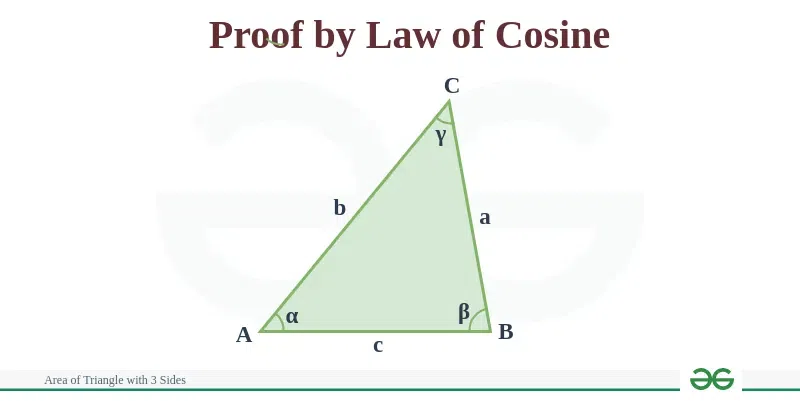
Heron's Formula can be proved using the trigonometric law of cosines. For a ΔABC, let a, b, and c be the sides of the triangle and α, β, and γ be the angles opposite to the respective sides.
👁 Proof-of-Formula-for-Area-of-Triangle-with-3-Sides-by-Law-of-Cosine
Then, using law of cosines, we get,
cos γ = (a2+b2-c2)/2ab
Using sinγ = √(1 - cos2γ), we get
sin γ = √{4a2b2 - (a2 + b2 - c2)2}/2ab
We have,
We know that Area of triangle, A = 1/2 × Base × Height,
A = 1/2 × (ab sin γ)
⇒ A = 1/4 × √{4a2b2 - (a2 + b2 - c2)2}
⇒ A = 1/4 × √{(2ab - (a2 + b2 - c2))*(2ab + (a2 +b2 -c2))}
⇒ A = 1/4 × √{(c2 - (a-b)2)*((a+b)2 - c2)}
⇒ A = 1/4 × √{(c-a+b)(c+a-b)(a+b+c)(a+b-c)}
Putting s = (a+b+c)/2, we get,
A = √{s(s-a)(s-b)(s-c)}
Thus, we have derived the formula for area of triangle with 3 sides using the trigonometric cosine rule and some basic mathematical identities.
Steps to calculate area of triangle with 3 sides are discussed as follows:
Step 1: Calculate perimeter of triangle as P = a+b+c
Step 2: Calculate semi-perimeter as s = P/2
Step 3: Using Heron's formula, find the area as A = √{s(s-a)(s-b)(s-c)}
Step 4: Use appropriate units as mm2, cm2, etc.
For an equilateral triangle, all three sides are equal. Let's denote the length of each side as a.
The semiperimeter s of the equilateral triangle is:
s = (a + a + a)/2 = 3a/2
So, using Heron's formula:
So, the area A of an equilateral triangle with side length a is given by the formula:
Following is a table discussing other formulas to find area of different triangles:
Dimesions known | Equilateral | Isosceles | Scalene |
|---|---|---|---|
Three sides | √{s(s-a)3} | (s–a)√{s(s–b)} | √{s(s-a)(s-b)(s-c)} |
Base and Height | 1/2 × Base × Height | 1/2 × Base × Height | 1/2 × Base × Height |
Other | √3/4 × (side)2 | 1/2 × ab sin γ | 1/2 × bc sin α |
Where,
Read More,
Example 1: Find the area of a triangle with measure of three sides as 3 cm, 4 cm and 5 cm respectively.
Solution:
We know that,
Area of triangle, A = √{s(s-a)(s-b)(s-c)} , and
Semi-Perimeter, s = (a+b+c)/2
⇒ s = (3+4+5)/2 = 6 cm
Now Area of triangle, A = √{6(6-3)(6-4)(6-5)} = √(6x3x2x1) = 6 cm2
Thus, area of triangle with three sides as 3 cm, 4 cm and 5 cm respectively is found to be 6 cm2 using Heron's Formula.
Example 2: A triangle has its three sides as 6 cm, 8 cm and 10 cm, Find its area.
Solution:
Here, a = 6 cm, b = 8 cm, and c = 10 cm
We know that,
Area of triangle, A = √{s(s-a)(s-b)(s-c)}
where, s = (a+b+c)/2 = (6+8+10)/2 = 12
⇒ A = √{12x(12-6)x(12-8)x(12-10)}
⇒ A = √(12x6x4x2) = 24 cm2
⇒ A = 24 cm2
Example 3: Derive an expression for area of an equilateral triangle with each having side length = a.
Solution:
According to Heron's formula, we have, A = √{s(s-a)(s-b)(s-c)}
For equilateral triangle, a = b = c
⇒ A = √{s(s-a)(s-a)(s-a)} = √{s(s-a)3}
Putting, s = (a+a+a)/2 = 3a/2, we get,
⇒ A = √{3a/2(3a/2-a)3}
⇒ A = √3a2/4
P1: Find the area of a triangle having sides as 4 cm, 6 cm and 12 cm.
P2: Perimeter of a triangle is 54 cm. If two of its sides measure 12 cm and 20 cm, find its area.
P3: Find the area of an equilateral triangle having each side measuring 5 cm.
P4: The semi perimeter of a triangle is 20cm. Two of its sides measure 8 cm and 12 cm, find its area.
P5: An isosceles triangle has its sides as 4 cm, 4 cm and 6 cm. Find its area.