|
VOOZH | about |
|
VOOZH | about |
Understanding the surface areas and volumes of geometric shapes is fundamental in mathematics, particularly in Class 10. Chapter 13 of the NCERT textbook deals with these concepts extensively. Exercise 13.5 specifically focuses on applying these concepts to solve practical problems involving different geometric figures. This article provides a detailed solution to the Exercise 13.5 helping the students grasp the concepts and improve their problem-solving skills.
The Surface areas and volumes are crucial topics in the geometry and mathematics. They help us determine the space and surface characteristics of the various 3D shapes such as cubes, cylinders, and spheres. In this chapter, students learn to:
Solution:
Given,
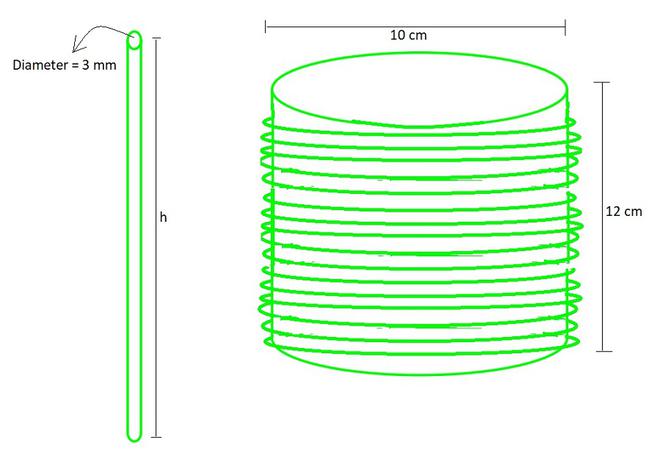
Radius of copper wire (r) = mm = cm
Height of cylinder (H) = 12 cm
Radius of Cylinder (R) = = 5 cm
👁 ImageLength of copper wire needed for one round will be circumference of cylindrical circle end = 2πR
=2π(5)
length of each round = 10π cm
Now, to completely cover the cylinder with wire no of rounds (n) of copper wire should be:
n = height of cylinder / diameter of copper wire
n =
no. of rounds = 40
Now, Total length of copper wire will be:
h = no. of rounds × length of each round
h = 40×10π
h = 400×3.14 (taking π = 3.14)
h = 1256 cm
Volume of copper wire = πr2h
=π×()2×1256
=π××1256
= 88.82 cm3 (taking π = )
Now, as it is given that,
For 1cm3 = 8.88 g of wire
so, for 88.82 cm3 = 8.88×88.82 g
Mass of copper wire = 788.7216 g
Hence, the length and mass of the wire are and respectively.
Solution:
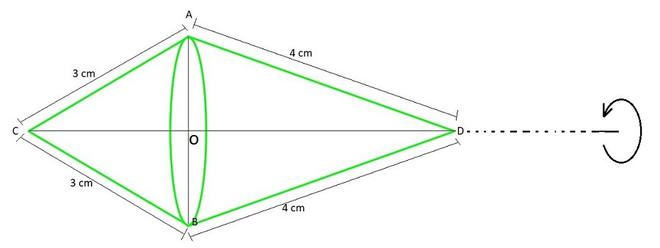
After revolving the triangle about its hypotenuse, we get two cones having slant height as 3 cm and 4 cm each.
Hypotenuse of triangle (CD) = √(32 + 42) = 5 cm
l1 = 3 cm
l2 = 4 cm
👁 Imagear(△ACD) = ×AC×AD = ½×AO×CD (as AC⊥AD and AO⊥CD)
⇒ AC×AD = AO×CD
⇒ 4×3 = AO×5
AO = cm
Hence, radius of cone base is cm
Now, Volume of double cone = Volume of cone 1 + Volume of cone 2
= ()πr2×OD + ()πr2×OC
= ()πr2×(OD+OC)
= πr2×CD
=
= 30.17 cm3
Now, Curve Surface area of double cone = CSA of cone 1 + CSA of cone 2
= πrl1 + πrl2
= πr(l1+l2)
= ×(3+4)
= 30.17 cm2
Hence, the volume and surface area of the double cone so formed is 3 and 2 .
Solution:
Given,
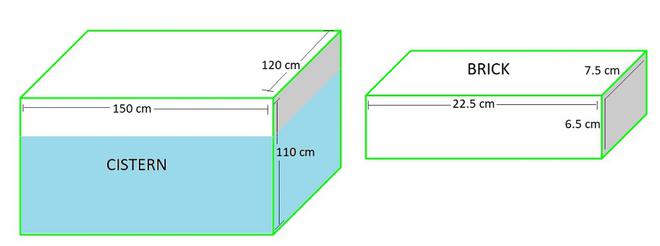
Length of Cistern (L) = 150 cm
Breadth of Cistern (W) = 120 cm
Height of Cistern (H) = 110 cm
Length of Brick (l) = 22.5 cm
Breadth of Brick (w) = 7.5 cm
Height of Brick (h) = 6.5 cm
👁 ImageVolume of Cistern = L×B×H
= 150×120×110
= 1980000 cm3
Volume of Water = 129600 cm3
Empty space left in Cistern = 1980000-129600
= 1850400 cm3
Volume of Brick = l×b×h
= 22.5×7.5×6.5
= 1096.88 cm3
Volume of n Bricks = 1096.88×n cm3
Volume absorbed by each brick = ()th (volume of brick)
= ×1096.88 cm3
= 64.522 cm3
Then, Volume absorbed by n bricks = 64.522×n
Volume of brick = Empty space left in Cistern + volume absorbed by bricks
1096.88×n = 1850400 + 64.522×n
n×(1096.88-64.522) = 1850400
n =
n = 1792.40
n ≈ 1792
Hence, 1792 bricks can be put in without overflowing the water.
Solution:
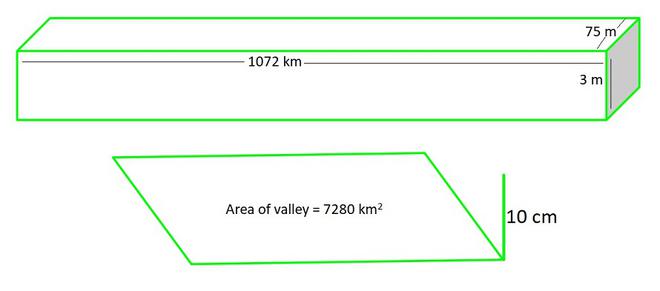
Length of river (l) = 1072 km
Width of river (w) = km = 0.075 km
Depth of river (h) = = 0.003 km
Depth of rainfall = km
👁 ImageThe total rainfall was approximately equivalent to the addition to the normal water of three rivers each
Which means,
has to be equal.
Let's check, for each case,
so,
Volume of three rivers = 3×(l×b×h)
= 3×(1072×0.075×0.003) km3
= 0.7236 km3 .............................(1)
Volume of rainfall in valley = Area of valley×depth of rainfall
= 7280×
= 0.728 km3.....................................(2)
From (1) and (2) we can see that,
Hence, proved, Total rainfall was approximately equivalent to the addition to the normal water of three rivers each.
Solution:
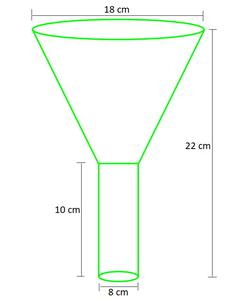
Oil funnel contains two shapes = frustum + Cylinder
Given values,
Larger radius of frustum (R) = = 9 cm
Smaller radius of frustum (r) = = 4 cm
Height of frustum (H) = 22-10 = 12 cm
Radius of cylinder (r) = = 4 cm
Height of cylinder (h) = 10 cm
👁 ImageArea of the tin sheet required = CSA of frustum + CSA of cylinder
CSA of frustum = π(r+R)l
= π×(9+4)×√(122 + (9-4)2) (l =√(H2 + (R-r)2))
= π×13×13
= 169π cm2
CSA of cylinder = 2πrh
= 2×π×4×10
= 80π cm2
Area of the tin sheet required = 169π + 80π
= 249π
= 782.571 cm2 (Taking π=)
Hence, the area of the tin sheet required to make the funnel is
Solution:
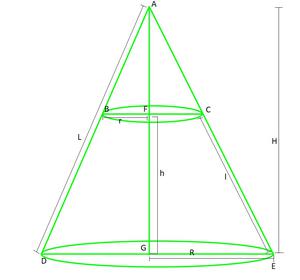
Let ADE be a cone. From the cone the frustum BCDE is cut by a plane parallel to its base. Here, r and R are the radii of the frustum ends of the cone and h be the frustum height.
Here, as BC||DE
👁 ImageIn △ADG and △ABF
So, ΔADG ∼ ΔABF (as BC||DE)
..............(1)
from (1), we get
1-() =
= 1 -
=
L(R-r) = Rl...........................(2) (By rearranging)
Total surface area of frustum = CSA of frustum + Area of upper circular end + Area of the lower circular end
- CSA of frustum = CSA of cone ADE - CSA of cone ABC
= πRL - πr(L-l)
= πL(R-r)+πrl
= πRl+πrl (from (2) replacing L(R-r) = Rl )
= π(R+r)l
- Area of upper circular end = πR2
- Area of the lower circular end = πr2
Total surface area of frustum = π(R+r)l + πR2 + πr2
Solution:
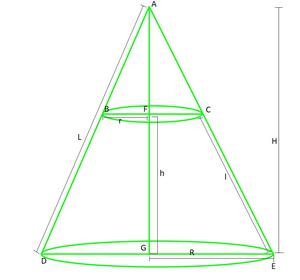
Let ADE be a cone. From the cone the frustum BCDE is cut by a plane parallel to its base. Here, r and R are the radii of the frustum ends of the cone and h be the frustum height.
Here, as BC||DE
👁 ImageIn △ADG and △ABF
So, ΔADG ∼ ΔABF (as BC||DE)
.....................(1)
from (1), we get
1-() =
= 1 -
=
H(R-r) = Rh...........................(2) (By rearranging)
Total volume of frustum of the cone will be = Volume of cone ADE – Volume of cone ABC
= πR2H - πr2(H-h)
= πR2H - πr2H + πr2h
= π(H(R2-r2)+r2h)
= π(H(R-r)(R+r)+r2h) (Replacing (R2-r2) = (R-r)(R+r))
= π(Rh(R+r)+r2h) (from (2) replacing H(R-r) = Rh )
= π(R2h+Rrh+r2h)
= πh(R2+Rr+r2) (Taking h common)
Hence, Total volume of frustum of the cone will be = πh(R2+Rr+r2)