|
VOOZH | about |
|
VOOZH | about |
In this section, we delve into Chapter 14 of the Class 10 RD Sharma textbook, which focuses on Coordinate Geometry. Exercise 14.2, Set 3, is designed to help students apply the principles of coordinate geometry to solve various problems involving points, lines, and distances in the Cartesian plane.
This section provides detailed solutions for Exercise 14.2, Set 3, from Chapter 14 of the Class 10 RD Sharma textbook. These solutions are aimed at helping students develop a solid understanding of coordinate geometry, ensuring they can confidently solve problems related to points and lines on the Cartesian plane.
Solution:
Let us considered the given points are A(3, 0), B(4, 5), C(-1, 4) and D(-2, -1)
Now we find the length of the sides and diagonals,
By using distance formula
So, AB =
AB2 = (4 + 3)2 + (5 - 0)2
= (1)2 + (5)2
= 1 + 25 = 26
Similarly, BC2 = (-1 - 4)2 + (4 - 5)2
= (-5)2 + (-1)2 = 25 + 1 = 26
CD2 = (-2 + 1)2 + (-1 - 4)2
= (-1)2 + (-5)2 = 1 + 25 = 26
and DA2 = (3 + 2)2 + (0 + 1)2
= (5)2 + (1)2 = 25 + 1 = 26
Diagonal AC2 = (-1 - 3)2 + (4 - 0)2
= (-4)2 + (4)2 = 16 + 16 = 32
and BD2 = (-2 - 4)2 + (-1 - 5)2
= (-6)2 + (-6)2 = 36 + 36 = 72
So, we conclude that the sides AB = BC = CD = DA and diagonal AC is not equal to BD
Hence, ABCD is a rhombus
Now we find the area of rhombus ABCD = Product of diagonals/2
= (√32 × √72)/2
= (√16 × 2 × 2 × 36)/2
= 4 × 2 × 6/2
= 24 sq. units
Solution:
Given that A (3, 1), B (6, 4) and C (8, 6)
Now we find the length of the sides and diagonals,
By using distance formula
AB =
AB2 = (6 - 3)2 + (4 - 1)2
= (3)2 + (3)2 = 9 + 9 = 18
Similarly, BC2 = (8 - 6)2 + (6 - 4)2
= (2)2 + (2)2 = 4 + 4 = 8
and BC2 = (8 - 6)2 + (6 - 4)2
= (2)2 + (2)2 = 4 + 4 = 8
and CA2 = (3 - 8)2 + (1 - 6)2
= (-5)2 + (-5)2 = 25 + 25 = 50
AB = √18 = √9 * 2 = 3√2
BC = √8 = √4 * 2 = 2√2
and CA = √50 = √25 * 2 = 5√2
AB + BC = 3√2 + 2√2 = 5√2 = CA
Hence, A, B and C are collinear points. Hence, they are seated in a line.
Solution:
Let us assume P be the point lies on y-axis. So, its x = 0, so the coordinates of P is (0, y)
It is given that the point P (0, y) is equidistant from the points A(5, -2) and B(-3, 2).
So, PA = PB
Also, PA2 = PB2
Now by using distance formula, we get
(5 - 0)2 + (-2 - y)2 = (-3 - 0)2 + (2 - y)2
25 + 4 + y2 + 4y = 9 + 4 - 4y + y2
y2 + 4y + 4y - y2 = 13 - 29
8y = -16
y = -16/8 = 2
Hence, the required point P is (0,-2)
Solution:
Let us considered P (x, y) is equidistant from A(3, 6) and B(-3, 4)
So, PA = PB
Also, PA2 = PB2
Now by using distance formula, we get
On squaring both sides, we get
(x - 3)2 + (y - 6)2 = (x + 3)2 + (y - 4)2
x2 - 6x + 9 + y2 - 12y + 36 = x2 + 6x + 9 = y2 - 8y + 16
-6x - 12y + 45 = 6x - 8y + 25
-6x - 6x - 12y + 8y + 45 - 25 = 0
-12 - 4y + 20 = 0
3x + y - 5 = 0
3x + y = 5
Solution:
Given that the point A (0, 2) is equidistant from the points B (3, p) and C (p, 5)
Now by using distance formula, we get
It is given that AB = AC
√p2 - 4p + 13 = √p2 + 9
So, on squaring both side, we get
= p2 - 4p + 13 = p2 + 9
p2 - 4p - p2 = 9 - 13
-4p = -4
p = 1
Hence, the value of p is 1
Solution:
Let us considered the points are A (7, 10), B (-2, 5) and C (3, -4)
Now we find the length of the sides
By using distance formula
Now AB =
Similarly, BC =
and AC =
So, we conclude that AB = BC = √106 and AB2 + BC2 = AC2
Hence, ABC is an isosceles right triangle
Solution:
It is given that Point P (x, 3) is equidistant from the points A (7, -1) and B (6, 8)
So, PA = PB
On squaring both sides, we get
(x - 7)2 + (4)2 = (x - 6)2 + (-5)2
x2 - 14x + 49 + 16 = x2 - 12x + 36 + 25
x2 - 14x + 65 = x2 - 12x + 61
x2 - 14x + 12x - x2 = 61 - 65
-2x = -4
x = -4/-2 = 2
x = 2
Now we find the distance
Solution:
It is given that point A (3, y) is equidistant from P (8, -3) and Q (7, 6)
So, AP = AQ
On squaring both sides, we get
(3 - 8)2 + (y + 3)2 = (-4)2 + (y - 6)2
(-5)2 + y2 + 6y + 9 = 16 + y2 - 12y + 36
25 + y2 + 6y + 9 = 16 + y2 - 12y + 36
y2 + 6y - y2 + 12y = 36 - 9 - 25 + 16
18y = 18
y = 18/18 = 1
y = 1
Now we find the distance
Solution:
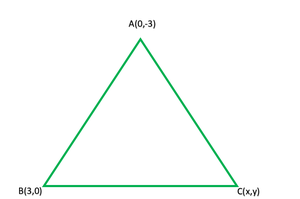
Given that the A (0, -3) and B (0, 3) are the two vertices of an equilateral triangle ABC
Let us assume that the coordinates of the third vertex be C (x, y)
In equilateral triangle, AC = AB
So,
(x - 0)2 + (y + 3)2 = (0 - 0)2 + (3 + 3)2
x2 + (y + 3)2 = 0 + (6)2 = 36
x2 + y2 + 6y + 9 = 36
x2 + y2 + 6y = 36 - 9 = 27 .......(i)
Also, BC = AB
(x - 0)2 + (y - 3)2 = 36
x2 + y2 + 9 - 6y = 36
x2 + y2 - 6y = 36 - 9 = 27 ........(ii)
So, from eq (i) and (ii), we get
x2 + y2 + 6y = x2 + y2 - 6y
x2 + y2 + 6y - x2 - y2 + 6y = 0
12y = 0
y = 0
Now put the value of y in eq(i)
x2 + y2 + 6y = 27
x2 + 0 + 0 = 27
x = ±√27 = ±3√3
So, the coordinates of third point is(3√3, 0) or (-3√3, 0)
Solution:
Given that the point P (2, 2) is equidistant from the points A (-2, k) and B (-2k, -3)
So, AP = BP
(2 + 2)2 + (2 - k)2 = (2 + 2k)2 + (2 + 3)2
(4)2 + (2 - k)2 = (2 + 2k)2 + (5)2
16 + 4 + k2 - 4k = 4 + 4k2 + 8k + 25
4k2 + 8k + 29 - 16 - 4 - k2 + 4k = 0
3k2 + 12k + 9 = 0
k2 + 4k + 3 = 0
k2 + k + 3k + 3 = 0
k(k + 1) + 3(k + 1) = 0
(k + 1)(k + 3) = 0
So, the value of k either k + 1 = 0, then k = -1
or k + 3 = 0, then k = -3
Therefore, k = -1, -3
Now we find the distance
Solution:
Given that In ∆ABC, the vertices are A (-2, 0), B (2, 0), C (0, 2)
In ∆PQR, the vertices are P (-4, 0), Q (4, 0), R (0, 4)
Show that ∆ABC ~ ∆PQR
So,
Now,
So, AB/PQ = 4/8 = 1/2
BC/QR = 2√2/4√2 = 1/2
CA/PQ = 2√2/4√2 = 1/2
So, AB/PQ = BC/QR = CA/RP
By using SSS
∆ABC ~ ∆PQR
Solution:
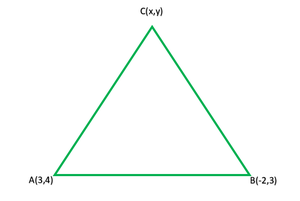
Given that the A (3, 4) and B (-2, 3) are the two vertices of an equilateral triangle ABC
Let us assume that the coordinates of the third vertex be C (x, y)
Now
As we know that in equilateral triangle, AB = BC = CA
So, BC = AB
On squaring both side we get
(x + 2)2 + (y - 3)2 = 26
x2 + 4x + 4 + y2 - 6y + 9 = 26
x2 + y2 + 4x - 6y + 13 = 26
x2 + y2 + 4x - 6y = 26 - 13 = 12 ...........(i)
Similarly, CA = AB
On squaring both side we get
(3 - x)2 + (4 - y)2 = 26
9 + x2 - 6x + 16 + y2 - 8y = 26
x2 + y2 - 6x - 8y + 25 = 26
x2 + y2 - 6x - 8y = 26 - 25 = 1 .......(ii)
Now on subtracting eq(ii) from (i), we get
10x + 2y = 12
5x + y = 6 ........(iii)
y = 6 - 5x
Now substituting the value of y in eq(i), we get
x2 + (6 - 5x)2 + 4x - 6(6 - 5x) = 13
x2 + 36 + 25x2 - 60x + 4x - 36 + 30x - 13 = 0
26x2 - 26x - 13 = 0
2x2 - 2x - 1 = 0
Here, a = 2, b = -2, c = -1
When x = (1 + √3)/2, then y = 6 - 5x = 6 - 5((1 + √3)/2) = (7 - 5√3)/2
Or when x = (1 - √3)/2, then y = 6 - 5x = 6 - 5((1 - √3)/2) = (7 + 5√3)/2
Hence, the co-ordinates of the point C is ((1 + √3)/2, (7 - 5√3)/2) or ((1 - √3)/2, (7 + 5√3)/2)
Solution:
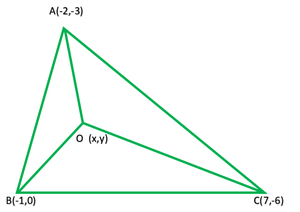
Given that the vertices of ∆ABC are A(-2, -3), B(-1, 0), and C(7, -6), and
let us assume that O is the circumcenter ∆ABC. So, the coordinates of O will be (x, y)
So, OA = OB = OC
Or OA2 = OB2 = OC2
Now
OA2 = (x + 2)2 + (y + 3)2
= x2 + 4x + 4 + y2 + 6y + 9
= x2 + y2 + 4x + 6y + 13
OB2 = (x + 1)2 + (y + 0)2
= x2 + 2x + 1 + y2
= x2 + y2 + 2x + 1
OC2 = (x - 7)2 + (y + 6)2
= x2 - 14x + 49 + y2 + 12y + 36
= x2 + y2 - 14x + 12y + 85
OA2 = OB2
x2 + y2 + 4x + 6y + 13 = x2 + y2 + 2x + 1
4x + 6y -2y = 1 - 13
2x + 6y = -12
x + 3y = -6 .........(i)
OB2 = OC2
x2 + y2 + 2x + 1 = x2 + y2 - 14x + 12y + 85
2x + 14x - 2y = 85 - 1
16x - 12y = 84
4x - 3y = 21 .........(ii)
From eq (i), we get
x = -3y - 6
On substituting the value of x in eq (ii)
4(-3y - 6) - 3y = 21
-12 - 24 - 3y = 21
-15y = 21 + 24
-15y = 45
y = -45/15 = -3
x = -3y - 6 = -3 × (-3) - 6
= + 9 - 6 = 3
Hence, the co-ordinates of O are (3,-3)
Solution:
Let us considered the co-ordinates of the end points of a line segment are
A (0, 100), B (10, 0) and origin is O (0, 0)
So, the angle subtended by the line PQ at the origin is 90° or π/2
Solution:
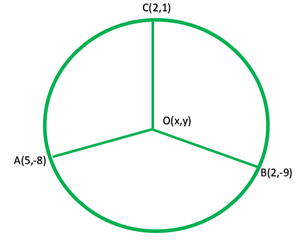
Given that O is the centre of the circle and A(5, -8), B(2, -9), and C (2, 1) are the points on the circle.
So, let us considered the co-ordinates of O be (x, y)
Therefore, OA = OB = OC
OA2 = OB2 = OC2
Now
OA2 = (x - 5)2 + (y + 8)2
= x2 - 10x + 25 + y2 + 16y + 64
= x2 + y2 - 10x + 16y + 89
Similarly, OB2 = (x - 5)2 + (y + 9)2
= x2 + 4 - 4x + y2 + 81 + 18y
= x2 + y2 - 4x + 18y + 85
and OC2 = x2 - 4x + 4 + y2 - 2y + 1
= x2 + y2 - 4x - 2y + 5
OA2 = OB2
x2 + y2 - 10x + 16y + 89 = x2 + y2 - 4x + 18y + 85
-10x + 4x + 16y - 18y = 85 - 89
-6x - 2y = -4
3x + y = 2 .......(i)
OB2 = OC2
x2 + y2 - 4x + 18y + 85 = x2 + y2 - 4x - 2y + 5
18y + 2y = 5 - 85
20y = -80
y = -80/10 = -4
Now substitute the value of y in eq(i), we get
3x + y = 2
3x - 4 = 2
3x = 2 + 4 = 6
x = 6/3 = 2
Hence, the co-ordinates of O are(2,-4)
Solution:
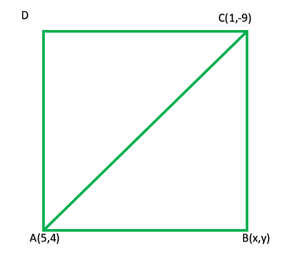
Given that the two opposite points of a ABCD square are A(5, 4) and C(1, -6)
Let us considered that the co-ordinates of B be (x, y).
So, join AC
As we know that the sides of a square are equal, so,
AB = BC
AB2 = BC2
(x - 5)2 + (y - 4)2 = (x - 1)2 + (y + 6)2
x2 - 10x + 25 + y2 - 8y + 16 = x2 - 2x + 1 +y2 + 12y + 36
-10x + 2x - 8y - 12y = 37 - 41
-8x - 20y = -4
2x + 5y = 1
2x = 1 - 5y
x = (1 - 5y)/2
So, ABC is a right-angled triangle
Now by using Pythagoras theorem, we get
AC2 = AB2 + BC2
(5 - 1)2 + (4 + 6)2 = x2 - 10x + 25 + y2 - 8y + 16 + x2 - 2x + 1 + y2 + 12y + 36
(4)2 + (10)2 = 2x2 + 2y2 - 12x + 4y + 78
16 + 100 = 2x2 + 2y2 - 12x + 4y + 78
2x2 + 2y2 - 12x + 4y + 78 - 16 - 100 = 0
2x2 + 2y2 - 12x + 4y - 38 = 0
x2 + y2 - 6x + 2y - 19 = 0 .....(i)
Now substituting x = (1 - 5y)/2 in eq(i), we get
1 + 25y2 - 10y + 4y2 - 12 + 60y + 8y - 76 = 0
29y2 + 58y - 87 = 0
y2 + 2y - 3 = 0
y2 + 3y - y - 3 = 0
y(y + 3) - 1(y + 3) = 0
(y + 3)(y - 1) = 0
The value of y can be either y + 3 = 0, then y = -3
or y - 1 = 0, then y = 1
When y = 1, then
x = (1 - 5y)/2
= (1 - 5(1))/2
= -2
When y = -3, then
x = (1 - 5(-3))/2
= 8
So, the other points of ABCD square are(-2,1) and (8,-3)
Solution:
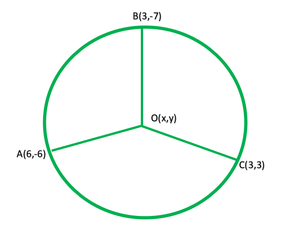
Let us considered O be the centre of the circle is (x, y)
It is given that centre of the circle passing through (6, -6), (3, -7), and (3, 3)
Join OA, OB and OC
So, OA = OB = OC
OA2 = (x -6 )2 + (y + 6)2
OB2 = (x - 3)2 + (y + 7)2
and OC2 = (x - 3)2 + (y-3)2
As we know that OA2 = OB2
So, (x - 6)2 + (y + 6)2 = (x - 3)2 + (y + 7)2
x2 - 12x + 36 + y2+12y + 36 = x2 - 6x + 9 + y2 + 14y + 49
x2 - 12x + 36 + y2+12y + 36 - x2 + 6x - 9 - y2 - 14y - 49 = 0
-12x + 12y + 72 + 6x - 14y - 58 = 0
-6x - 2y + 14 = 0
-6x - 2y = -14
3x + y = 7 .....(i)
Also, OB2 = OC2
(x - 3)2 + (y + 7)2 = (x - 3)2 + (y - 3)2
x2 - 6x + 9 + y2+ 14y + 49 = x2 - 6x + 9 + y2 - 6y + 9
x2 + y2 - 6x + 58 + 14y - x2 - y2 + 6x + 6y - 18 = 0
20y + 40 = 0
20y = -40
y = -40/20 = -2
3x + (-2) = 7
3x = 7 + 2 = 9
x = 9/3 = 3
Hence, the co-ordinates of the centre are(3,-2)
Solution:
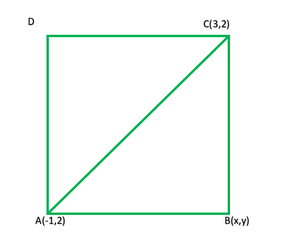
Let us considered ABCD is square, in which the co-ordinates are A (-1, 2) and C (3, 2).
Let us assume the coordinates of B are (x, y)
Now, join AC
As we know that the sides of a square are equal, so,
AB = BC
AB2 = BC2
Now
AB2 = (x + 1)2 + (y - 2)2
Similarly, BC2 = (x - 3)2 + (y - 2)2
As we know that AB = BC
So,
(x + 1)2 + (y - 2)2 = (x - 3)2 + (y - 2)2
(x + 1)2 = (x - 3)2
x2 + 2x + 1 = x2 - 6x + 9
x2 + 2x + 6x - x2 = 9 - 1 = 8
8x = 8
x = 8/8 = 1
Now in right triangle ABC
AC2 = AB2 + BC2
(3 + 1)2 + (2 - 2)2 = (x + 1)2 + (y - 2)2 + (x - 3)2 + (y - 2)2
(4)2 + (0)2 = x2 + 2x + 1 + y2 - 4y + 4 + x2 - 6x + 9 + y2 - 4y + 4
16 = 2x2 + 2y2 - 4x - 8y + 18
2x2 + 2y2 - 4x - 8y = 16 - 18
2x2 + 2y2 - 4x - 8y = -2
x2 + y2 - 2x - 4y = -1 .......(i)
Now substitute the value of x, in eq(i), we get
(1)2 + y2 - 2 × 1 - 4y = -1
1 + y2 - 2 - 4y = -1
y2 - 4y = -1 - 1 + 2 = 0
y(y - 4) = 0
So the value of the y can be either y = 0
or y - 4 = 0, then y = 4
Hence, the coordinates of other points will be (1, 0) and (1, 4)