|
VOOZH | about |
|
VOOZH | about |
Chapter 10 of the Class 8 NCERT Mathematics textbook, titled "Visualising Solid Shapes," introduces students to the concept of three-dimensional geometry. This chapter helps students visualize and understand the properties of various solid shapes, such as cubes, cuboids, cylinders, cones, spheres, and more. Exercise 10.3 focuses on the concept of visualizing different views of solid shapes, such as front, side, and top views, which are essential for understanding the spatial structure of these shapes.
This section provides detailed solutions for Exercise 10.3 from Chapter 10 of the Class 8 NCERT Mathematics textbook. The exercise involves problems that require students to identify and draw different views (top, front, and side) of various solid shapes. The solutions are designed to help students develop their spatial reasoning and ability to visualize solid shapes from different perspectives.
In this chapter, students learn to visualize and interpret solid shapes in three dimensions. Exercise 10.3 involves problems that test students' ability to identify and work with the different views of solid shapes including top, front, and side views. This exercise is crucial for understanding how to project 3D objects onto 2D planes which is a fundamental skill in geometry and essential for solving more complex mathematical problems. Mastery of these concepts is not only important for the exams but also for real-life applications in fields such as engineering and design.
Solution:
(i) 3 triangles: No, because polyhedron must have minimum 4 faces i.e all edges should meet at vertices.
(ii) 4 triangles: Yes, as all the edges are meeting at the vertices and has four triangular faces.
(iii) a square and four triangles: Yes, because all the eight edges meet at the vertices having a square face and four triangular faces.
Solution:
Yes, It is possible to have a polyhedron with any given faces only if the number of faces are greater than or equal to four.
Solution:
Prisms among the given images are
(ii) Unsharpened pencil
(iv) A box.
Solution:
(i) If the number of sides in a prism are increased to certain extent, then the prism will take the shape of cylinder i.e. a prism with a circular base.
(ii) If the number of sides of the pyramid is increased to same extent, then the pyramid becomes a cone i.e. a pyramid with a circular base.
Solution:
Yes, a square prism can be same as a cube, but if the height of the prism is greater than It may be cuboid.
(i)
👁 Image(ii)
👁 ImageSolution:
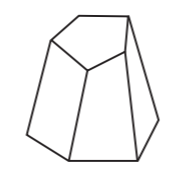
(i) No. of Faces (F) = 7
No. of Vertices (V) = 10
No. of Edges (E) = 15
By Using Euler’s formula: F + V – E = 2 and Substituting the values, we get
⇒ 7 + 10 – 15 = 2
⇒ 2 = 2
Therefore, Euler’s formula is verified.
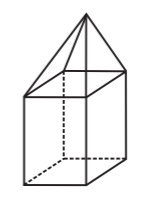
(ii) No. of Faces (F) = 9
No. of Vertices (V) = 9
No. of Edges (E) = 16
By Using Euler’s formula: F + V - E = 2 and Substituting the values, we get
⇒ 9 + 9 - 16 = 2
⇒ 2 = 2
Therefore, Euler’s formula is verified.
| Faces | ? | 5 | 20 |
| Vertices | 6 | ? | 12 |
| Edges | 12 | 9 | ? |
Solution:
(i)
No. of Faces (F) = F
No. of Vertices (V) = 6
No. of Edges (E) = 12
By Using Euler’s formula: F + V – E = 2 and Substituting the values, we get
⇒ F + 6 – 12 = 2
⇒ F = 2 + 6
⇒ F = 8
Therefore, No. of Faces (F) = 8
(ii)
No. of Faces (F) = 5
No. of Vertices (V) = V
No. of Edges (E) = 9
By Using Euler’s formula: F + V – E = 2 and Substituting the values, we get
⇒ 5 + V – 9 = 2
⇒ E = 2 + 4
⇒ E = 6
Therefore, No. of Vertices (V) = 6
(iii)
No. of Faces (F) = 20
No. of Vertices (V) = 12
No. of Edges (E) = E
By Using Euler’s formula: F + V – E = 2 and Substituting the values, we get
⇒ 20 + 12 – E = 2
⇒ E = 32 - 2
⇒ E = 30
Therefore, No. of Edges (E) = 30
Solution:
Since every polyhedron satisfies Euler’s formula, therefore checking if polyhedron can have 10 faces, 20 edges and 15 vertices.
No. of Faces (F) = 10
No. of Vertices (V) = 15
No. of Edges (E) = 20
By Using Euler’s formula: F + V – E = 2 and Substituting the values, we get
⇒ 10 + 15 – 20 = 2
⇒ -5 = 2
As Euler’s formula is not satisfied, therefore polyhedron cannot have 10 faces, 20 edges and 15 vertices.
Read More: