|
VOOZH | about |
|
VOOZH | about |
In this section, we explore Chapter 20 of the Class 8 RD Sharma textbook, which focuses on the Area of Trapezium and Polygon. Exercise 20.3 is designed to help students understand the methods for calculating the area of trapeziums and various polygons, reinforcing their understanding of geometric properties and formulas.
Exercise 20.3 of Chapter 20 in RD Sharma Solutions for Class 8 focuses on advanced applications and problem-solving techniques related to the area of trapeziums and polygons. This exercise set likely combines concepts from previous sections and introduces more complex scenarios.
This exercise set explores intricate applications of area calculations for trapeziums and polygons. It may include problems involving composite shapes, transformations, optimizations, and real-world scenarios that require a deep understanding of geometric principles and creative problem-solving approaches.
This section provides comprehensive solutions for Exercise 20.3 from Chapter 20 of the Class 8 RD Sharma textbook. These solutions are crafted to assist students in mastering the concepts related to the area of trapeziums and polygons, ensuring a solid foundation in geometry.
Solution:
Given:
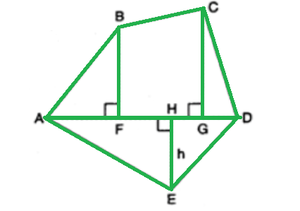
AD = 10 cm, AG = 8 cm, AH = 6 cm, AF = 5 cm BF = 5 cm, CG = 7 cm, EH = 3 cm
From given data,
FG = AG – AF = 8 – 5 = 3 cm
And,
GD = AD – AG = 10 – 8 = 2 cm
From given figure:
Area of Pentagon = (Area of triangle AFB) + (Area of trapezium FBCG) +
(Area of triangle CGD) + (Area of triangle ADE)
= (0.5 x AF x BF) + [0.5 x (BF + CG) x (FG)] + (0.5 x GD x CG) + (1/2 x AD x EH).
= (0.5 x 5 x 5) + [0.5 x (5 + 7)x (3) + (0.5 x 2 x 7) + (0.5 x 10 x 3)
= 12.5 + 18 + 7 + 15 = 52.5 cm2
Solution:
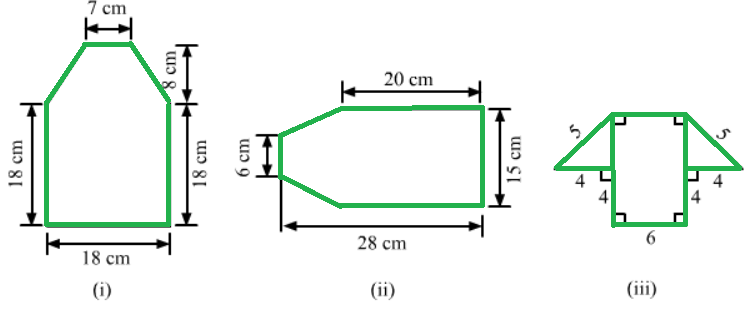
(i) Figure can be divided into 2 parts a square and a trapezium as shown:
Area = (Area of square) + (Area of trapezium)
= (side)2 + (0.5 x (sum of parallel sides) x height
= (18 x 18) + 0.5 x (18 + 7) × (8)
= 324+100
= 424 cm2
(ii) Figure can be divided into 2 parts a rectangle and a trapezium as shown:
From the figure:
Height of trapezium = 28 - 20 = 8 cm
Area = (Area of rectangle) + (Area of trapezium)
= (length x breadth) + (0.5 x (sum of parallel sides) x height)
= (20 x 15) + [0.5 x (15 + 6) × (8)]
= 300 + 84
= 384 cm2
(iii) Figure can be divided into 2 parts one trapezium and one rectangle:
Pythagoras theorem in one of the right angle triangle:
52 = 42 + (base)2
base2 = 25 - 16
base = √9 = 3 cm
Therefore,
The height of trapezium = 3 cm
One side of trapezium = 6 + 4 + 6 = 14 cm
Area = (Area of rectangle) + (Area of trapezium)
= (length x breadth) + (0.5 x (sum of parallel sides) x height)
= (6 x 4) + (0.5 x (14 + 6) x (3))
= 24 + 30
= 54 cm2
Solution:
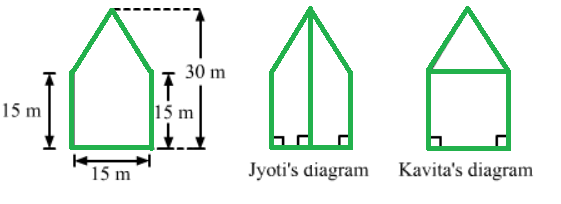
Jyoti and Kavita divided the park in two different ways.
(i) Jyoti divided the park into two equal trapeziums:
From the figure the park divided into equal trapezium having height 7.5 m and sides 30 m and 15 m
Area of the park = 2 x (Area of a trapezium)
= 2 x (0.5 x (sum of parallel sides) x height)
= 2 x (0.5 x (30 + 15) x (7.5))
= 337.5 m2
(ii) Kavita divided the park into a rectangle and a triangle:
From diagram,
The height of the triangle = 30 - 15 = 15 m
Area of the park = (Area of square) + (Area of triangle)
= (15 x 15) + (0.5 x 15 x 15)
= 225 + 112.5
= 337.5 m2
Solution:
Given:
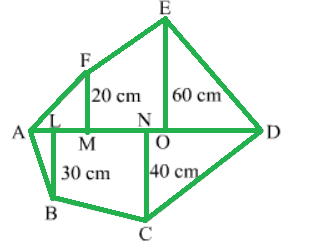
AL = 10 cm, AM = 20 cm, AN = 50 cm
AO = 60 cm, AD = 90 cm
From given data,
MO = AO – AM = 60 – 20 = 40 cm
OD = AD – A0 = 90 – 60 = 30 cm
ND = AD – AN = 90 – 50 = 40 cm
LN = AN – AL = 50 – 10 = 40 cm
Area of Polygon = (Area of triangle AMF) + (Area of trapezium MOEF) +
(Area of triangle DNC) + (Area of trapezium NLBC) +
(Area of triangle ALB)
= (0.5 x AM x MF) + [0.5 x (MF + OE) x OM] + (0.5 x OD x OE) +
(0.5 x DN x NC) + [0.5 x (LB + NC) x NL] + (0.5 x AL x LB)
= (0.5 x 20 x 20) + [0.5 x (20 + 60) x (40)] +(0.5 x 30 x 60) +
(0.5 x 40 x 40) +[0.5 x (30 + 40) x (40)] + (0.5 x 10 x 30)
= 200 + 1600 + 900 + 800 + 1400 +150 = 5050 cm2
Solution:
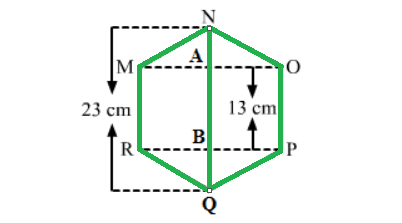
As it is a regular Hexagon so all sides are 13 cm and AN = BQ
From the figure,
As the diagonal QN is 23 cm,
QB + BA + AN = QN
AN + 13 + AN = 23
2AN = 23 – 13 = 10
AN = 5 cm
Hence, AN = BQ = 5 cm
Applying Pythagoras theorem in triangle MAN:
MN2 = AN2 + AM2
169 = 25 + AM2
AM² = 169 - 25
AM = √144
AM = 12cm
From figure,
OM = RP = 2 × AM = 2 x 12 = 24 cm
This Hexagon can be divided into 3 parts 2 triangles and one rectangle therefore,
Area of the regular hexagon = (area of triangle MON) + (area of rectangle MOPR) +
(area of triangle RPQ)
= (0.5 x OM x AN) + (RP X PO) + (0.5 x RP x BQ)
= (0.5 x 24 x 5) + (24 x 13) + (0.5 x 24 x 5)
= 60 + 312 + 60
= 432 cm2
Exercise 20.3 of Chapter 20 in RD Sharma Solutions for Class 8 presents advanced problems on areas of trapeziums and polygons. It incorporates complex geometric scenarios, real-world applications, and multi-step problems. This set challenges students to apply their knowledge creatively, enhancing their problem-solving skills and deepening their understanding of advanced geometric concepts and their practical applications.