|
VOOZH | about |
|
VOOZH | about |
Chapter 3 of the Class 9 NCERT Mathematics textbook, "Coordinate Geometry," introduces the basic concepts of coordinate geometry, focusing on the Cartesian plane and the distance formula. Exercise 3.2 deals with problems related to finding distances between points and understanding geometric properties using coordinate geometry.
This section provides detailed solutions for Exercise 3.2 from Chapter 3 of the Class 9 NCERT Mathematics textbook. The exercise involves calculating distances between points on the Cartesian plane using the distance formula, as well as applying coordinate geometry principles to solve geometric problems. Solutions are provided step-by-step to help students grasp the concepts effectively.
Coordinate Geometry chapter deals with the concept of locating a point in a plane with the help of a coordinates system, also called a cartesian system as it was developed by a French Mathematician, Rene Descartes.
This exercise deals with the concept of cartesian coordinates system. In this system, a cartesian plane is drawn in such a way that the x-axis and y-axis intersect at a point called an origin. Each point in this plane is located by its coordinates written as (x,y) where x is the distance of the point from the y-axis (i.e. abscissa) and y is the distance of a point from the x-axis (i.e. ordinate). This concept helps to find the distance between two points and calculate the area of shapes in the cartesian plane in higher classes.
Question 1: Write the answer to each of the following questions:
(i) What is the name of the horizontal and the vertical lines drawn to determine the position of any point in the Cartesian plane?
(ii) What is the name of each part of the plane formed by these two lines?
(iii) Write the name of the point where these two lines intersect.
Solution:
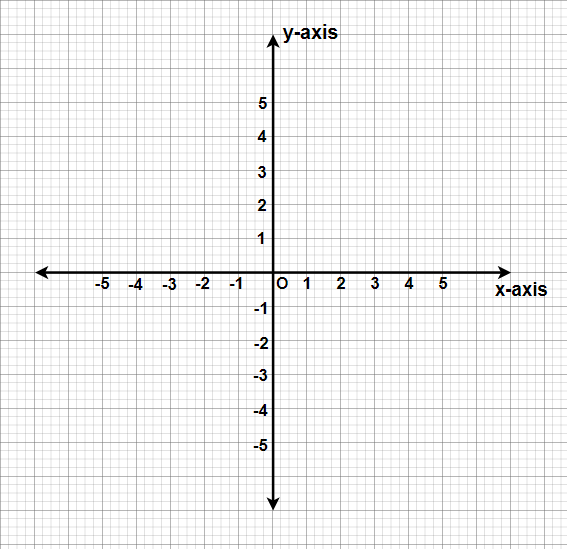
👁 Image(i) Name of the horizontal and vertical lines are:
- The horizontal line drawn on the Cartesian plane is known as x-axis.
- The vertical line drawn on the Cartesian plane is known as y-axis.
(ii) The name of each part of the plane formed by the two lines x-axis and y-axis is called as a quadrant (1/4 part).
(iii) Name of the point where there two lines intersect is called the origin(O).
Solution:
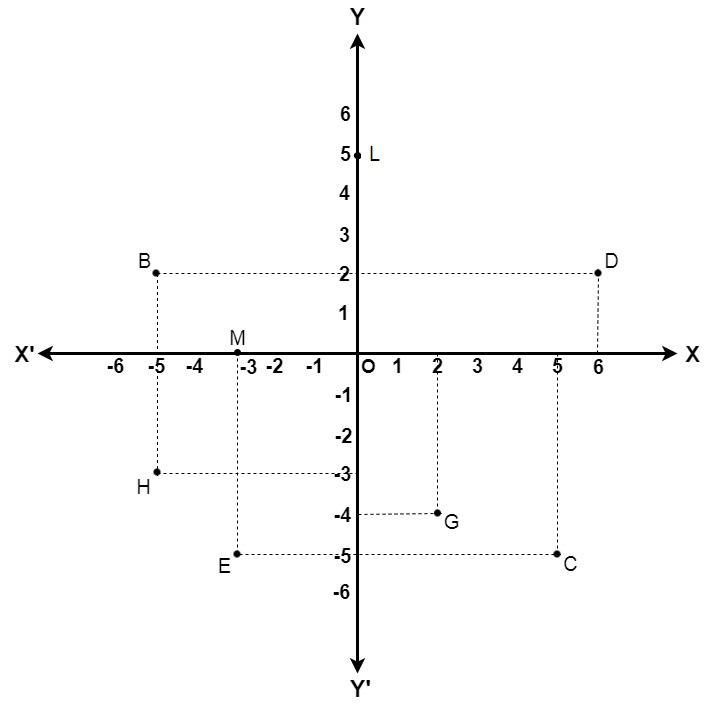
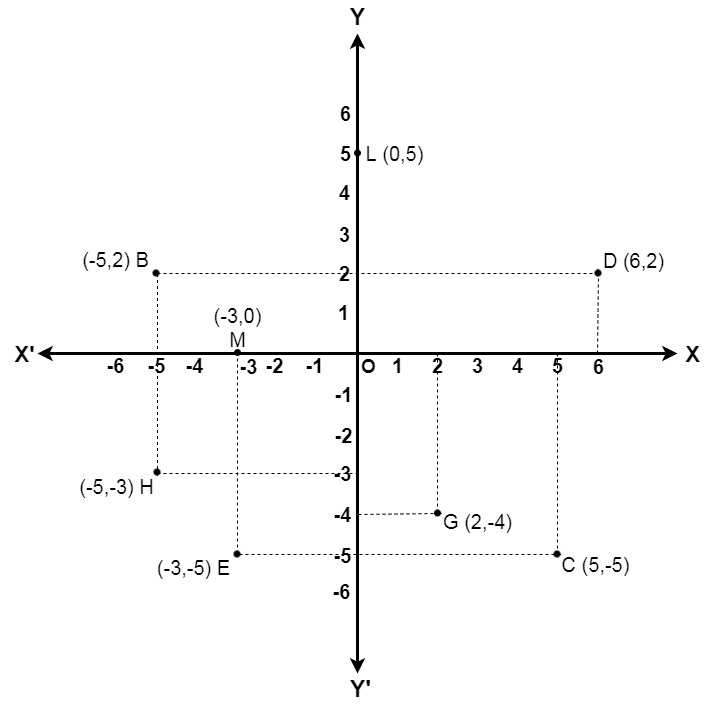
👁 Image(i) The coordinates of point B is the distance of point B from x-axis and y-axis that is −5 and 2 respectively.
Therefore, the coordinates of point B are (−5, 2).(ii) The coordinates of point C is the distance of point C from x-axis and y-axis that is 5 and −5 respectively.
Therefore, the coordinates of point C are (5, −5).(iii) The point whose x-coordinate and y-coordinate are −3 and −5 respectively is point E.
(iv) The point whose x-coordinate and y-coordinate are 2 and −4 respectively is point G.
(v) The x-coordinate of point D is 6. Therefore, the abscissa of point D is 6.
(vi) The y-coordinate of point H is −3. Therefore, the ordinate of point H is −3.
(vii) The coordinates of point L is the distance of point L from x-axis and y-axis that is 0 and 5 respectively.
Therefore, the coordinates of point L are (0, 5).(viii) The coordinates of point M is the distance of point M from x-axis and y-axis that is −3 and 0 respectively. Therefore, the coordinates of point M is (−3, 0).
Exercise 3.2 focuses on applying the distance formula to calculate the distance between two points on the Cartesian plane. Key concepts include:
The exercise helps students practice and reinforce their understanding of coordinate geometry concepts by solving practical problems related to distances on the Cartesian plane.