|
VOOZH | about |
|
VOOZH | about |
The Conjugate of a Complex Number is a number having the same real part as the original complex number, and the imaginary part has the same magnitude but the opposite sign.
Example: (5 + 3i) and (5 - 3i) are complex conjugates to each other.
Conjugate z is represented by while together are known as a complex-conjugate pair because and are conjugates to each other.
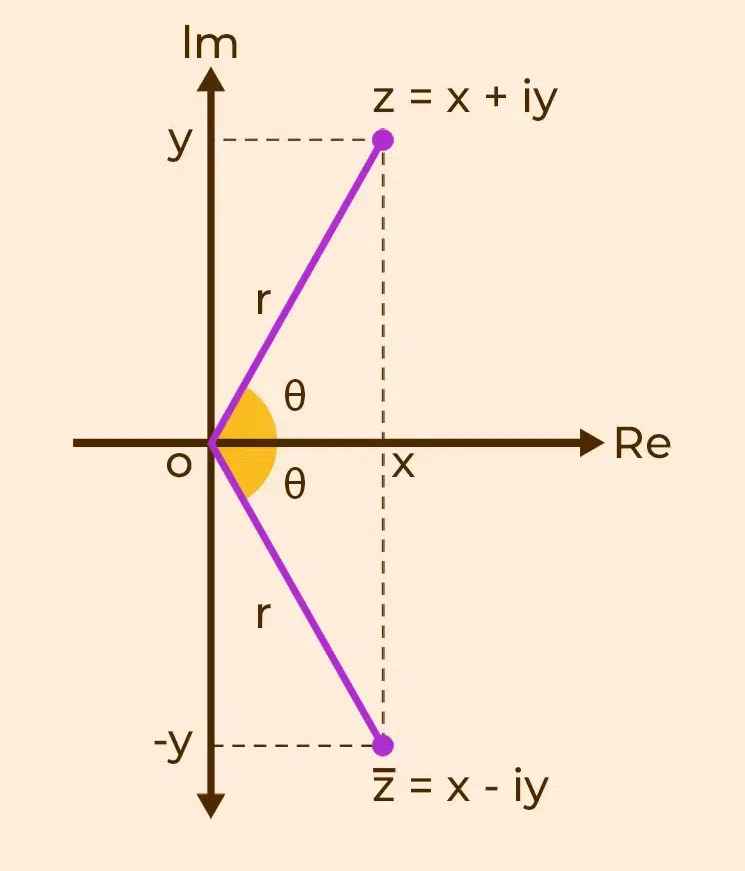
If z = x + iy is a complex number, then the conjugate of z is defined as
The geometrical meaning of the conjugate of a complex number is the reflection or mirror image of the complex number z about the real axis (x-axis) in the complex plane or argand plane, which is shown in the following figure:
If we multiply a complex number with its conjugate, the result will always be a non-negative real number.
The product of the complex conjugate pair is given as (a + ib)(a - ib) = a2 - i2b2 = a2 + b2
Example:
For z = 3 + 4i, the conjugate is 3 − 4i.
The product is:(3 + 4i)(3 − 4i) = 32 + 42 = 9 + 16 = 25
So, the result is a real number: 25.
If z, z1, and z2 are complex numbers, then below will be the conjugate properties.
Note: To find out the conjugate of a complex number that complex number must be in its standard form which is Z = (x + i y). If the complex number is not in its standard form then it has to be converted into its standard form before finding its complex conjugate.
According to the Complex Conjugate Root Theorem, if p(x) is a polynomial in which coefficients are real numbers and its root is a + ib, then the conjugate of the root, a - ib, will also be the root of the polynomial.
Read More
Example 1: If z = (5 + 7 i) is a complex number, then its conjugate is given by.
Solution:
The conjugate of the complex number is obtained by changing the sign of the imaginary part.
Thus, = (5 - 7 i).
Example 2: Find the conjugate of the complex number 3 + 4i.
Solution:
The conjugate of the complex number 3 + 4i is the complex number obtained by changing the sign of the imaginary part, i.e., (3 - 4i).
Therefore, the conjugate of 3 + 4i is 3 - 4i.
Example 3: If z = 1 / (4 + 3 i) is a complex number, then its conjugate is given by
Solution:
First z has to be converted into its standard form by multiplying the numerator and
denominator with the conjugate of (4 + 3 i)
z = (1 / (4 + 3 i)) × ((4 - 3 i) / (4 - 3 i))
z = (4 - 3 i) / (16 + 9)
z = (4 / 25) - (3 / 25) i
The conjugate of z is = (4 / 25) + (3 / 25) i
Example 4: If (a + ib) is a complex number that is the complex conjugate of (8 - 3i), then find the values of a and b.
Solution:
Let z = a + i b
= (8 + 3 i)
z =
z = (8 + 3 i)
Two complex numbers are equal only when their corresponding real & imaginary parts are equal
Equating the real and imaginary parts of z & (8 + 3 i)
Re(z) = a = 8
Im(z) = b = 3
Hence 8 & 3 are the respective values of a and b.
Example 5: Find the product of the complex numbers (2 - 3i) and its conjugate.
Solution:
The conjugate of the complex number (2 - 3i) is (2 + 3i).
Required number is (2 - 3i)(2 + 3i) = 4 -6i + 6i -9i2 = 4 + 9 = 13
Therefore, the product of the complex numbers (2 - 3i) and their conjugate is 13.