|
VOOZH | about |
|
VOOZH | about |
Concavity and points of inflection help us understand the shape and behavior of curves.
Concavity shows whether a graph bends upward or downward, while a point of inflection is where the curve changes its direction of bending. These concepts are useful for graph sketching, optimization, and the analysis of functions.
Concavity describes the direction in which a curve bends. A function is said to be concave upward if its graph bends upward like a cup and concave downward if its graph bends downward like an upside-down cup. Concavity helps us understand the shape and behavior of a function and is determined using the second derivative.
There are basically two types of concavity in mathematics:
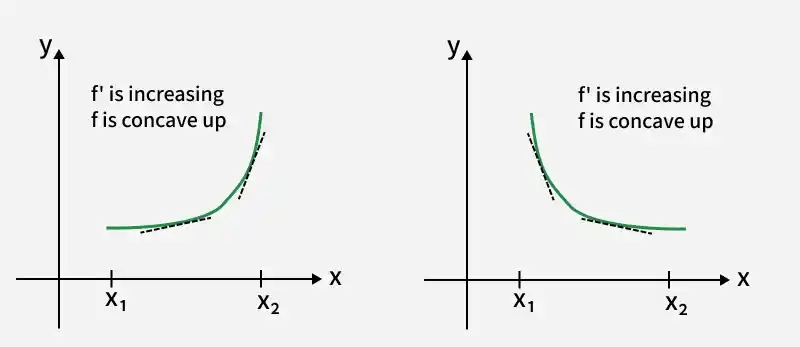
A function is said to be concave upward if its graph bends upward like a cup (∪).
The above graphs explain concave upward curves. As x increases from x₁ to x₂, the slope of the tangent increases in both graphs, indicating that the functions are concave upward.
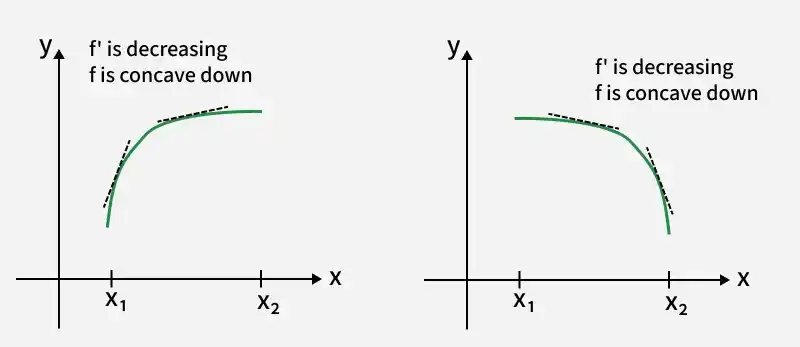
A function is said to be concave downward if its graph bends downward like an upside-down cup (∩).
The above graphs explain concave downward curves. As x increases from x₁ to x₂, the slope of the tangent decreases in both graphs, indicating that the functions are concave downward.
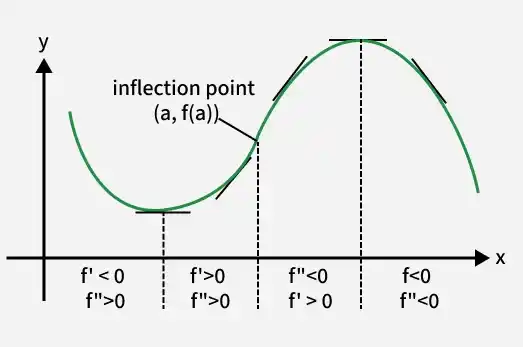
The concavity of a function can be identified by observing the slopes of its tangent lines. In a concave upward curve, the slopes of the tangent lines increase as x increases, whereaswhileoncave downward curve, the slopes decrease as x increases. Thus, the behavior of tangent slopes helps determine the concavity of a function.
The above graphs illustrate the relationship between concavity and the slope of tangent lines. Increasing slopes indicate concave upward behavior, while decreasing slopes indicate concave downward behavior.
The test for concavity helps determine whether a function is concave upward or concave downward without drawing its graph.
Step 1: Find the first derivative, f'(x).
Step 2: Find the second derivative, f''(x).
Step 3: Analyze the sign of the second derivative.
- If f''(x) > 0, the function is concave upward.
- If f''(x) < 0, the function is concave downward.
Therefore:
- f''(x) > 0 ⟹ Concave Upward
- f''(x) < 0 ⟹ Concave Downward
This method is known as the Second Derivative Test for Concavity.
A point of inflection is a point on the graph where the concavity of the function changes. It occurs when the graph changes from concave upward to concave downward or from concave downward to concave upward.
Conditions for a Point of Inflection
Points of inflection are the points where the concavity of the functions changes , where as, Extrema are points on a function where it reaches a maximum (local or global) or minimum (local or global) value.
Here is a differentiation between point of inflection and extrema:
FEATURE | POINTS OF INFLECTION | EXTREMA (MINIMA/MAXIMA) |
|---|---|---|
Definition | Where the curve changes its concavity | Where the function reaches a peak (max) or a low point (min) |
Curvature | The direction of the curve's bend changes | The curve is at its highest or lowest point locally |
Graphical Representation | Point where the curve shifts from curving up to curving down, or vice versa | Point where the curve has a peak (highest) or valley (lowest) |
Derivation Condition | Second derivative ?(x) changes sign | First derivative ?′(x)=0 and second derivative test tells if it's a max or min |
Extreme Relation | Not necessarily a maximum or minimum | Definitely a maximum or minimum |
Significance | Shows where the behavior of the curve changes | Shows optimal points and critical values of the function |
Example 1: Determine the intervals where the function f(x) = x3−6x2+9x+15 is concave up and concave down.
First Derivative: f'(x) = 3x2 -12x + 9
Second Derivative: f"(x) = 6x-12
Find Critical Points for Concavity:
Set the second derivative equal to zero to find potential points of inflection:
6x-12 = 0
x = 12/6 = 2
Test the Intervals Around the Critical Point:
for x<2 (eg. x = 1):
f"(1) = 6(1)-12 = -6 (negative, concave down)
for x>2(eg. x = 3):
f"(3) = 6(3)-12 = 6 (positive, concave up)
Conclusion:
- The function is concave down on the interval (−∞, 2).
- The function is concave up on the interval (2, ∞).
Example 2: Determine the intervals where the function g(x) = 2x³-4x²-24x+48x is concave up and concave down.
First Derivative: g'(x) = 8x3-12x2-48x+48
Second Derivative: g"(x) = 24x2-24x-48
Find Critical Points for Concavity:
Set the second derivative equal to zero to find potential points of inflection:
24x2-24x-48 = 0
x2-x-2 = 0
(x-2)(x-1) = 0
x = 2, 1
Test the Intervals Around the Critical Points:
For x<-1(eg. x = -2):
g"(2) = 24(-2)2-24(-2)-48 = 96+48-48=96 (positive, concave up)
For -1<x<2 (eg. x = 0):
g"(0) = 24(0)2-24(0)-48 = -48 (negative, concave down)
For x>2 (eg., x = 3):
g"(3) = 24(3)2-24(3)-48 = 216-72-48 = 96 (positive, concave up)
Conclusion:
The function is concave up on the intervals (−∞,−1) and (2,∞).
The function is concave down on the interval (−1,2).
Example 3: Determine whether the function f(x) = x³ has a point of inflection.
Solution:
First derivative: f'(x) = 3x2
Second derivative: f"(X) = 6x
Find Potential Points of Inflection:
Set the second derivative equal to zero:
6x = 0
x = 0
Test for Sign Change:
for x<0 (e.g., x = -1):
f"(-1) = 6(-1) = -6 (negative, concave down)
for x>0 (e.g., x = 1)
f"(1) = 6(1) = 6 (positive , concave up)
Conclusion:
There is a point of inflection at x=0 because the concavity changes from down to up.
Example 4: Determine whether the function g(x) = x⁴ − 4x³ + 6x² has a point of inflection.
Solution:
First derivative: g'(x) = 4x3-12x2+12x
Second derivative: g"(x) = 12x2-24x+12
Find Potential Points of Inflection:
Set the second derivative equal to zero:
12x2-24x+12 = 0
x2-2x+1 = 0
(x-1)2 = 0
x = 1
Test for Sign Change:
for x<1 (e.g. , x = 0)
g"(0) = 12(0)2-24(0)+12 = 12 (positive, concave up)
for x>1 (e.g., x = 2)
g"(2) = 12(2)2-24(2)+12 = 12 (positive, concave up)
Conclusion:
There is no point of inflection at x = 1 because the concavity does not change.
Question 1: Determine the intervals where the function h(x) = x⁴-4x³+6x²-4x+1 is concave up and concave down.
Question 2: Find the intervals of concavity for the function p(x) = 1/3 x - 2x + 3x + 5.
Question 3: Analyze the concavity of the function q(x) = sin(x) - x on the interval [0, 2π].
Question 4: Determine whether the function h(x) = x³ − 3x² + 3x − 1 has a point of inflection.
Question 5: Determine the points of inflection of the function k(x) = sin(x) on the interval [0, 2π].